Philip Polkinghorne trial: Defence suggests robe stains bolster Pauline Hanna suicide evidence
WARNING: DISTRESSING CONTENT
A disturbing, previously unseen piece of evidence briefly became an intense focus of attention today as the defence revealed a new theory in the ongoing murder trial of Auckland eye surgeon Philip Polkinghorne.
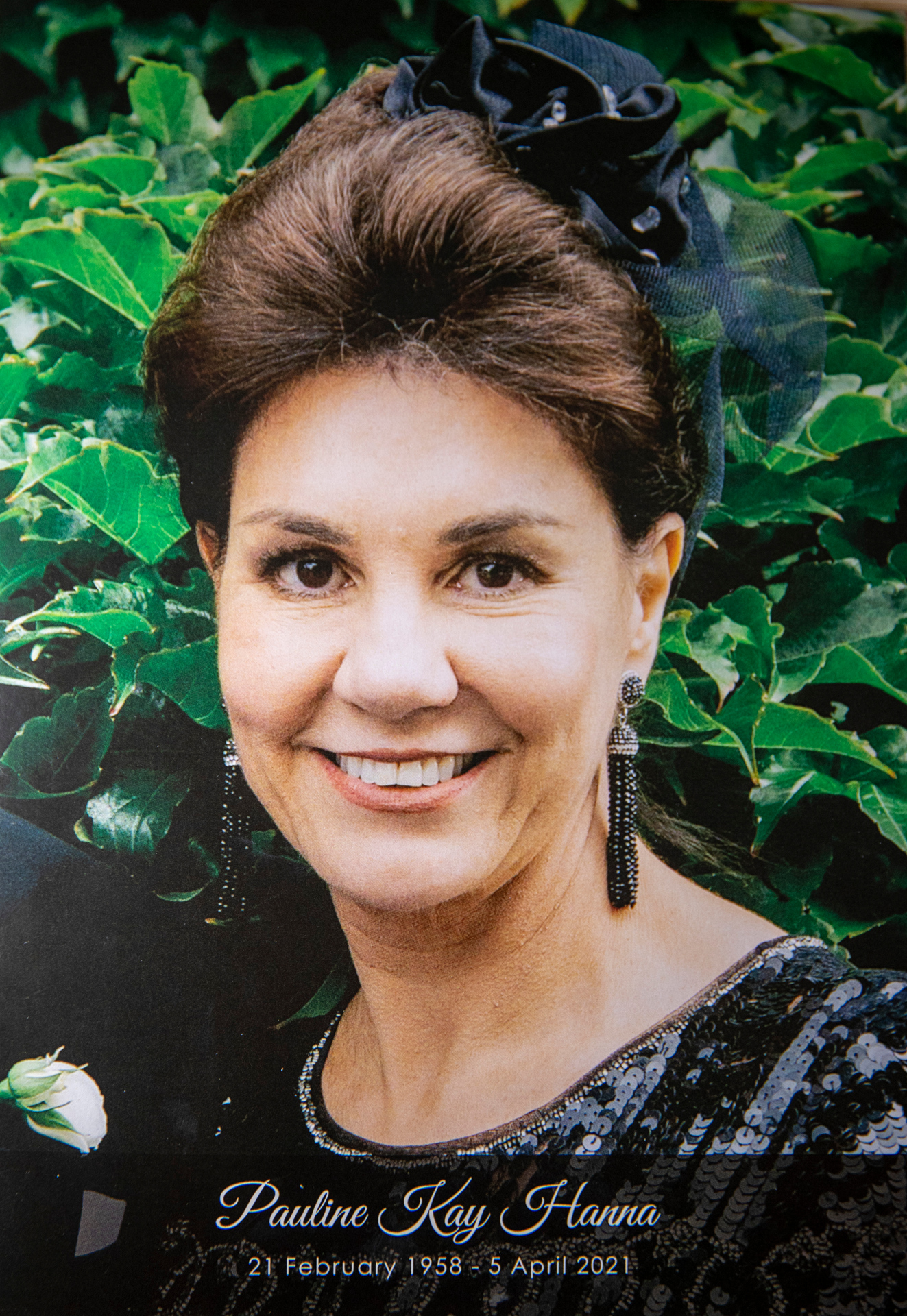
Jurors, now in the second week of hearing evidence in the High Court at Auckland, were shown photos of the seemingly urine-soaked robe that Polkinghorne’s 63-year-old wife, Pauline Hanna, was found dead in at their Remuera home on the morning of April 5, 2021.
Polkinghorne, now 71, told authorities he found his wife dead and seated on a chair in the entryway of their home. She had hanged herself by leaning forward in the chair into a belt tied to an orange rope, the defence has contended throughout the trial – referring to the death repeatedly as a “partial suspension” or “incomplete” hanging.
The urine stain patterns on the robe support that assertion, defence lawyer Ron Mansfield, KC, suggested today as he wrapped up the lengthy cross-examination of forensic scientist Fiona Matheson.
But Matheson, as well as the Crown, were not so certain.
Prosecutors allege Polkinghorne strangled his wife – perhaps while high on methamphetamine and during an argument over his spending on prostitutes – then staged the scene to look like a suicide by hanging. His behaviour has been described as strange, having told police their marriage was “quite good” or “perfect” even though it would later be revealed he was living a “double life” in Australia with a sex worker, the Crown said at the outset of the trial. Prosecutor Alysha McClintock also told jurors that witnesses will testify later in the trial that Hanna revealed a violent strangling attempt by her husband about a year before her death.
But the defence has said the death was simply the result of a suicide by a person who had a history of depression.
Referring to the robe today, Mansfield pointed out that people often soil themselves at the time of death or soon after as their muscles relax. He noted the yellow staining was mostly below the belt of Hanna’s terry-cloth robe but, for the most part, not present in the buttocks area of the robe.
The defence lawyer theorised that the yellow staining must have been urine, although it was not tested for that. The lesser staining in the buttocks area suggests Hanna was in a seated position when she died, with the pressure between her backside and the seat stopping the spread of the urine in that area, Mansfield put to the forensic scientist.
Matheson agreed it “appeared” to be urine and that it was on the robe but said that because she didn’t know for sure she felt uncomfortable entertaining such a scenario. Even if it was urine, the scientist said, “there are a number of variables that I’d want to consider” before making an assumption about Hanna’s position at the time of death based on the patterns.
She later expanded on her reasons for reluctance when the Crown was given another opportunity to question her later in the afternoon. Variables that could affect the yellow pattern could be the amount of urine that was released and the orientation of the robe on the deceased person, she said.
Mansfield also noted during his cross-examination of Matheson that no testing was done on the white vinyl kitchen chair his client said he found his wife in that morning to see if there were traces of urine on it. Had urine been found on the seat, that would be another piece of evidence supporting Polkinghorne’s claim.
But Matheson said there is no test in New Zealand for detecting urine. There are some international tests on the market, but they are not used in New Zealand because they have been found to create false positives, she explained.
She noted that no liquid was noticed on the seat of the chair or on the ground underneath where Polkinghorne said the chair was found. But she also acknowledged that there’s no way to know if something had been there but dried before her arrival or if it would have been visible to the naked eye.
“There’s nothing immediately obvious that suggests stains,” she said.
Matheson’s testimony, which spanned two days, was followed late in the afternoon by that of fellow forensic scientist Nicholas Curnow, who specialises in DNA analysis.
He tested probable blood samples from Hanna’s index and middle fingers on her left hand, along with samples from either side of her neck. The sample from the left of her neck was found to feature DNA from her and from Polkinghorne, plus a much smaller amount that “could have” originated from a third person. But there was no indication that there was any more than one male’s DNA present, Curnow said.
On the other side of Hanna’s neck was a mix of DNA from her and Polkinghorne, the expert said.
Blood stains from her fingernail clippings were low level and partial and could have originated from Hanna, he added.
Curnow was also asked about DNA testing of two items that have been repeatedly referred to through the first week of evidence: the orange rope found next to Hanna’s body and the belt Polkinghorne told police his wife had hung herself with. The belt was later found rolled up in the couple’s kitchen, with Polkinghorne explaining that he removed it after discovering his wife.
“Were there any results that were able to be linked to anyone?” McClintock asked about the seven samples taken from the rope.
”In short, no,” Curnow replied.
STORY CONTINUES AFTER LIVE BLOG
What we learnt from the Crown's DNA expert
Vera Alves
What did we learn from ESR forensic scientist Nicholas Curnow, the Crown's DNA expert?
- Pauline Hanna's neck had DNA from both herself, Polkinghorne, and a much smaller amount, possibly from a third person.
- DNA testing is extremely sensitive and DNA can be transferred indirectly, via intermediary objects.
- There were no conclusive results from the analysis of seven samples from the two orange ropes found at the scene.
The trial will resume at 10am tomorrow. The jury was not told who the Crown will call as its first witness tomorrow.
Trial resumes at 10am tomorrow
Vera Alves
Justice Lang has concluded proceedings for today.
The trial will resume at 10am tomorrow. The jury was not told who the Crown will call next, when proceedings resume on Tuesday.
Defence begins cross-examination of forensic scientist
Vera Alves
Mansfield is asking why the protocols changed. ESR forensic scientist Nicholas Curnow said it was found other substances could cause false positives, so they made their guidelines more conservative.
DNA testing is very sensitive, Curnow said. But they had shown through experience and validation that the male specific test is slightly more sensitive, the scientist said.
That meant they could get results from smaller amounts compared to the standard tests.
"Is it fair to say that the male specific DNA analysis is extremely sensitive?" defence lawyer Ron Mansfield asked.
"Yes, it's very sensitive."
"If we touch a surface or we touch another person, we might leave behind our DNA?" asked Mansfield.
"That's correct." Curnow said.
Curnow confirmed they were unable to age the DNA.
"It could have been there for minutes, hours or days, or even much longer than that?"
"That's correct."
"You can't tell us how the DNA"s go there either?"
"No, that's one of the limitations," Curnow said.
"Is there potential for DNA for one individual to get on another object or a person without there being a formal touch?"
"Yes, what you're referring to their is indirect transfer."
Curnow is using a cup to illustrate his point. He could touch a cup, hand it to Mansfield, and transfer his DNA to Mansfield.
That ends Curnow's cross-examination, there's nothing further from the Crown Solicitor, and that ends his evidence.
Vera Alves
Now, finally, Crown prosecutor Alysha McClintock is on to the frequently mentioned brown stain on the fitted sheet on Hanna's mattress, which tested positive for probable blood.
"A low-level and partial DNA profile was obtained which corresponded to Mr Polkinghorne’s reference DNA profile," ESR forensic scientist Nicholas Curnow said.
McClintock has finished her questioning of Curnow so we move on to Mansfield's cross-examination.
[from earlier in the blog: Each of those samples from her neck did give a weak positive result from a chemical test for blood. That was then reported as possibly a blood stain. ESR has since updated reporting guidelines, meaning Curnow would now report the samples as "inconclusive" for blood as a result of its new protocols.]
DNA testing of contentious orange ropes inconclusive, but Polkinghorne's DNA on wife's neck – scientist
Vera Alves
Samples from Pauline Hanna's neck were tested with both standard DNA analysis and the male-specific Y STR analysis.
The sample from the left of her neck had results from three people. They were Hanna herself, and Polkinghorne, plus a much smaller amount that could have originated from a third person.
The Y STR analysis showed the DNA could have come from Polkinghorne, ESR forensic scientist Nicholas Curnow said.
There was no indication that there was any more than one male's DNA present, Curnow said.
Turning to the sample on the left-hand side of the neck, low-level DNA from at least two people was found, explained by a mixing of DNA from Hanna and Polkinghorne.
The right neck sample's Y STR analysis showed the male DNA could have come from Polkinghorne.
Blood stains from fingernail clippings were low-level and partial and could have originated from Hanna.
Now the focus moves on to the DNA testing of the ropes, and an answer to the question raised in Matheson's cross-examination.
Curnow said there were seven samples taken from the two sections of orange rope.
"Were there any results that were able to be linked to anyone?" asked Crown solicitor Alysha McClintock.
"In short, no," Curnow replied.
Both types of DNA testing were conducted. Standard analysis returned no profiling results.
Male-specific DNA testing showed either no results or results that weren’t suitable for comparison purposes, Curnow said.
There were indications in some DNA results that there could have been more than one male present, but they were ultimately inconclusive and not suitable for comparison purposes, Curnow said.
Hanna had blood on her fingers
Vera Alves
ESR forensic scientist Nicholas Curnow used two types of DNA testing.
They were the standard profiling DNA analysis used in most cases, and Y STR DNA profiling, used to analyse DNA from the Y chromosome found only in males, Curnow said.
The second type of testing for just male DNA is useful if you only want to look at the male DNA sample in a sample rich in female DNA, Curnow said.
He was asked to test samples from the left, index and middle fingers, along with samples from either side of her neck.
Each of those samples from her neck did give a weak positive result from a chemical test for blood. That was then reported as possibly a blood stain. ESR has since updated reporting guidelines, meaning Curnow would now report the samples as "inconclusive" for blood, as a result of its new protocols.
Samples from Hanna's left index and middle fingers did have the visual appearance of blood and gave a positive result for blood.
New witness takes the stand
Vera Alves
The Crown has now called ESR forensic scientist Nicholas Curnow.
He is the forensic scientist who ESR forensic scientist Fiona Matheson earlier said would be better placed to answer questions relating to DNA.
Auckland Crown solicitor Alysha McClintock is leading the evidence-in-chief of Curnow, who joined ESR in 2009, and specialises in DNA analysis.
He is one of two forensic scientists who have analysed DNA samples taken by Matheson.
Vera Alves
Philip Polkinghorne told detectives he found his wife on a chair in the entranceway, having hanged herself leaning forward while sitting in the chair with her neck tied in a belt, itself tied to an orange rope.
That means the hanging would amount to a partial suspension, like a prison hanging, rather than a full suspension hanging as used in executions.
Defence lawyer Ron Mansfield repeatedly suggested in cross-examination that the urine stains on the dressing gown, focused around the lower back of the gown, support the scenario of her dying in the chair as she hanged herself.
ESR forensic scientist Fiona Matheson said the Polkinghorne home was one of the largest scenes she had ever examined in terms of a residential home.
It is not possible to age when blood staining is deposited, Matheson said.
There were no further questions for Matheson, who has been discharged after nearly two days in the witness box across Friday and Monday.
Questions raised over staining on Hanna's bathrobe
Vera Alves
Questions are now coming from Auckland Crown solicitor Alysha McClintock about the urine staining on the dressing gown that has become the key piece of evidence to emerge this afternoon.
"The scenario is that Ms Hanna was lying down. What, if anything, are you able to say about the urine staining – if indeed that's what it is?" McClintock asked.
"I'm very reluctant to form a comment about that, primarily because I'm not confident the staining is urine," Matheson said.
There were also a number of variables that led to more uncertainty about the path of the urine.
Defence brings up analysis not yet mentioned in trial evidence
Vera Alves
Now a bit of a curveball.
Defence lawyer Ron Mansfield has referenced an analysis, not yet mentioned at the trial in evidence, conducted in 2023 of a red mark on another set of stairs that ESR forensic scientist Fiona Matheson had tested and found not to contain blood. He said the analysis showed the red mark did contain blood – Polkinghorne's.
"Have you got any comment that you’d like to make on that?" Mansfield asked.
"I carried out an examination of the area described. I found no blood," Matheson said.
It is clear there is more discussion to come on this piece of evidence.
Mansfield has now finished his cross-examination.
Auckland Crown solicitor Alysha McClintock now has some questions in reply, relating to luminol testing.
The stain detected on the floor under Hanna's head was probably blood, detected with luminol, Matheson said.
Now there are questions from the Crown on urine or faeces testing from upstairs, and signs of blood downstairs.
There were no signs of bloodstaining aside from that under her head, Matheson said. There were no signs of urine or faeces staining upstairs either, the scientist said.
One question remains unanswered
Vera Alves
As defence lawyer Ron Mansfield's cross-examination of ESR forensic scientist Fiona Matheson draws to a close, a question remains unanswered: was Polkinghorne's DNA on the orange rope he says his wife used to kill herself?
Matheson demurred on that question and others relating to DNA analysis, saying it was better answered by one of her ESR colleagues, whom the Crown has yet to call.
The trial has now resumed for the final session of the day, with Mansfield set to wrap up his cross-examination of Matheson.
Vera Alves
Justice Lang has broken the trial for the afternoon adjournment. Defence lawyer Ron Mansfield said there isn't much cross-examination left for this witness but he wishes to review notes.
'Unfair': Forensic scientist defends investigation
Vera Alves
Defence lawyer Ron Mansfield's cross-examination of ESR forensic scientist Fiona Matheson is nearing its conclusion.
"So not wanting to sound cheap but a considerable investment of time, resources and funding had gone into the investigation by the time you left [April 11]?" Mansfield asked Matheson.
"It had, yes."
That included not just forensic scientists but other technicians, analysts and lab works.
Matheson said Mansfield's characterisation of the investigation team having a myopic focus on the death as definitely a homicide was "unfair".
"I think with briefings there is always an open view as to what may have occurred," she said.
"It is easier to downgrade your investigation or your scene examination than it is to upgrade it.
"We took extreme care right from the start."
"A significant amount of resource was placed into this investigation as there were unanswered and suspicious questions, therefore the work needed to be done.
"There were a number of different points right from day one that led police to believe there was some level of suspicion."
Matheson said her focus was around whether this was a hanging or not. She lacked knowledge as to the distinction between partial suspension or full hangings, she said.
Vera Alves
"We’ve heard evidence that the officer in charge of the scene, Detective Constable [now Sergeant] Iogha, has told us that he thought he had maintained an open mind in the course of the investigation. You weren’t present when that evidence was given, correct?" asks defence lawyer Ron Mansfield.
"No I was not," ESR forensic scientist Fiona Matheson replies.
"But you have some records in your own note beyond the 5th... you were investigating it as a potential crime scene, correct?"
"Yes I was."
"And that was based on your telephone call with the officer who had phoned you?"
Matheson confirmed that was right.
Mansfield then referred to a note from April 6, the day after Hanna was found dead, showing Matheson wrote "move forward with homicide focus".
That note was likely written before the autopsy, but she was unsure when exactly it was made, Matheson said.
"Who told you that ‘move forward with homicide focus’?" asked Mansfield.
"That is my interpretation of what was covered in the briefing,” Matheson replied.
"The briefing led by who?"
"The briefing in the morning led by Detective Senior Sergeant [Chris] Allan and I believe Detective Inspector [Aaron] Pascoe was present."
Mansfield has repeatedly suggested police did not keep an open mind and were desperate to find anything to fit with their suspicion Hanna had been murdered.
Mansfield is referring to correspondence from shortly after the autopsy, which was conducted on April 6. That correspondence, Matheson agreed, showed she was by that point aware it was being treated as a homicide and potentially a staged suicide.
Matheson said she became aware at a meeting with detectives including Pascoe and Iogha that the pathologist's findings did not support suicide by hanging, due to what they said was the lack of ligature marks on her neck.
Jury shown photo of Pauline Hanna's bathrobe
Vera Alves
Ron Mansfield KC is questioning ESR forensic scientist Fiona Matheson on Hanna's white bathrobe.
It was made from Terry Towelling and one size fits all. The robe was extensively stained yellow, from urine.
That was not unusual for clothing items found at the scene of deaths, given the discharge of bodily fluids that occurs immediately pre- and post-mortem.
Mansfield is suggesting the distribution of the urine on the robe suggests Hanna died sitting down after hanging herself, as Polkinghorne claimed.
Matheson said there are a number of factors affecting how it could be distributed.
"But here if we look at the photograph, it appears that the urine staining – if we look at the belt – is underneath the belt and down to the very bottom of the robe, correct?" asks Mansfield.
"Yes, there is yellow staining on what would be Ms Hanna's left side toward the base of that front and then on her right side, there is extensive yellow staining covering the bulk of that lower side of the dressing gown," said Matheson.
Another photo shows more extensive staining on the back lower portion of the dressing gown, compared to the front.
This appears to support Mansfield's contention that she died lying down, but Matheson is emphasising there are a number of variables at play.
If Hanna was sitting on a chair when she died and urinated, you would expect the chair would also be stained with urine, Matheson said.
The seat of the chair, which was at the top of the stairs, was not swabbed for urine, because ESR does not have a chemical test whether or not urine is present on an item, Matheson said.
"There used to be but we no longer use that test because we haven't been able to validate it," she said.
"We found that we got false positives with hand sanitisers."
"But there was no obvious urine present underneath Ms Polkinghorne's body when she was removed to go to the mortuary, correct?" asked Mansfield.
There was not, said Matheson.
Jury shown photos of rings found on Hanna's fingers after she died
Vera Alves
Three rings, including two with diamonds, were recovered from Hanna's fingers after her death.
On Monday, the jury heard they were analysed quickly so they could be returned to Hanna's family before her burial.
Nothing of note was recovered from the rings, ESR forensic scientist Fiona Matheson said.
Vera Alves
Defence lawyer Ron Mansfield has now returned to the orange rope, which was a focal point of the first week of evidence.
The Crown says that it couldn't have supported Hanna's body for a suicide by hanging because a police "tension test" showed it unravelled easily at a light tug.
Nonsense, says Mansfield, the rope was loose because his client undid it to free his wife and because, as he told detectives, he loosened it further because it looked "hideous" hanging over his dead wife.
ESR forensic scientist Fiona Matheson is confirming the balustrade and rope were removed whole from the scene.
However, they were not sent to forensic rope expert Robert Chisnall, who appeared via visual link from Canada last week as a Crown witness to support the police theory. He did not conduct his tests using the actual rope, instead using old ropes he had lying around at his home in Ontario to reconstruct the scene at his back porch, a revelation that sparked criticism from Mansfield.
"Did he make a recommendation to you that the rope could be tension-tested?" the lawyer asked.
"He may have made that recommendation but it’s not an area of expertise that ESR hold. So therefore, no tension testing was actually carried out by us," Matheson said.
Vera Alves
Defence lawyer Ron Mansfield is cross-examining ESR forensic scientist Fiona Matheson on her analysis of more objects seized from the home, including an ottoman and a teddy bear.
There were impressions of multiple shoes on the ottoman that was tipped over in Hanna's bedroom, the jury is hearing.
Mansfield has said his client, who is on the shorter side, used the ottoman tipped over to reach a high cupboard in the bedroom.
Mansfield is now questioning Matheson about the belt found in the kitchen.
Polkinghorne said he found a pleated belt around her neck and realised it was his own. Hanna had been using it recently, because a cord on her dressing gown had come off, he said. The belt, he said, was tied to the orange nylon rope with “granny knots”.
Mansfield is showing the jury a marked-up photo of the belt.
"At some point in time, the braids in the belt had been deformed as to suggest... it had been used done-up," Matheson said.
Trial resumes, jury nominates foreman
Vera Alves
The trial is resuming for the third session of the day, with ESR forensic scientist Fiona Matheson still in the witness box.
More members of the public have continued to filter into the public gallery of courtroom 11, alongside the law students, detectives and a row of older women who have been fixtures for the six days of the trial.
After a week of evidence, the jury has nominated its foreman, following a request from Justice Graham Lang this morning.
The foreman will deliver the verdict at the end of the trial, set down for six weeks.
His role is akin to a meeting chair, leading discussions, making sure all jurors share their views and overseeing the voting at the end of deliberations.
Unlike in America, where media outlets delve into the backgrounds of jurors and even conduct interviews with them, the Juries Act prevents the publication of anything that can lead to the identification of current, former or prospective jurors.
Vera Alves
Justice Graham Lang asks if this is a convenient time for lunch.
"Sir, it's a perfect time," said Mansfield.
We will be back about 2.15pm with more cross-examination of forensic scientist Fiona Matheson.
Then the trial is set to hear from more police officers and forensic specialists about the crime scene.
What the jury has heard this morning
Vera Alves
We are close to adjourning for lunch after two morning sessions of evidence on the sixth day of the Polkinghorne murder trial.
What have we learned?
Not much new.
But defence lawyer Ron Mansfield, in his forensic cross-examination of ESR scientist Fiona Matheson, has succeeded in hammering home several points in the negative.
They are:
- There were no dents and no blood stains on any of the pristine white walls of the sprawling Polkinghorne home.
- There is a dearth of evidence relating to Hanna having been dragged down from the guest bedroom where she was staying to where her body was found at the base of the stairs. The Crown says the guest bedroom was in a state of some disarray, with an ottoman knocked over, a top sheet missing and blood on a fitted sheet.
- “Dust bunnies” found around her body did not contain hair, suggesting no hair had been torn out in a struggle.
- The brown stain on the fitted sheet that tested positive for blood was not Hanna’s blood, but Polkinghorne’s.
- There was a tiny blood stain found beneath where Hanna’s head lay on some tiles at the base of the stairs.
- Forensic scientist Matheson spent about 53 hours at the Polkinghorne home looking for, among other things, evidence of a struggle or bodily fluids.
Mansfield has observed we are set to hear from electric power/appliance experts as to whether the dryer and washing machine were used that morning. The Crown has repeatedly raised the fact a slightly damp top sheet was found in the dryer. A top sheet was missing from Hanna’s bed.
Matheson said she could not give evidence over whether the washer or dryer were used, just what was found within them.
Along with exercise gear, an acrylic toe nail was found in the washing machine, the jury heard.
Mansfield has again foreshadowed evidence to be heard later in the trial. He suggested the origin and significance of the acrylic nail will depend on when the washing machine and dryer were used.
Cross-examination continues with toilet discussion
Vera Alves
We are back to discussing the guest bedroom upstairs, where Pauline Hanna spent her final night.
Now to the ensuite of the guest bedroom. ESR forensic scientist Fiona Matheson is confirming that aside from the bodily fluids found in and around the toilet, "there was no specific staining that could be identified as blood".
Auckland Crown solicitor Alysha McClintock has interrupted one of defence lawyer Ron Mansfield's questions. She has objected to what she viewed as a suggestion from the Mansfield that Matheson was told before the trial what she could and could not say.
Justice Lang allowed the question on the basis that it was just to confirm a pre-trial meeting with prosecutors and the forensic scientist had happened.
"There was a briefing ahead of trial with Crown counsel, wasn’t there?" asked Mansfield.
Yes, Matheson confirmed, but it was just to discuss her evidence in general, and there were no specific instructions on what she should or should not say.
Matheson is explaining how she took five trace samples from the area of a bedroom ensuite toilet.
The jury is now looking at annotated images of the toilet bowl.
"The bottom of the bowl where we see the very base of it, is it called the U-bend?" asks Mansfield.
“I’m not au fait with toilet bits," was Matheson's deadpan reply.
“You and me both," Mansfield replied.
So what is the point of all this?
Matheson on Friday noted there was no toilet paper in the bowl when the photo was taken.
Mansfield appears to have been hinting for days that a police officer or someone at the crime scene used the toilet, which might invalidate findings of meth from a sample taken from a toilet.
Vera Alves
We are back for the second session of evidence on the sixth day of the Polkinghorne murder trial, likely to run until the lunch adjournment at 1pm.
Defence lawyer Ron Mansfield is continuing his cross-examination of ESR forensic scientist Fiona Matheson, who spent more than 50 hours examining the four-bedroom, four-bathroom, 370sq m Upland Rd home.
Matheson said a stain on the tiles and grouting area, near the bottom step beside the area where Hanna's body was found, tested positive for blood. Another stain nearby was found not to be blood.
The stain, near the bottom step, was underneath where Hanna's head was lying when her body was found.
The tiny blood stain – merely a smear – crosses two tiles across some grout, as shown in a photo presented to the jury late on Monday morning.
Vera Alves
In her opening address, Auckland Crown solicitor Alysha McClintock cautioned the jury that the evidence from ESR scientists is not the bedrock of the Crown case and won't provide a smoking gun.
Nevertheless, defence lawyer Ron Mansfield is attempting to use it as fertile ground on which to sow doubt for the jury.
“Scientists from the Institute of Environmental Science and Research, they’ll come along and give evidence about the thing that they carried out in the house – samples they took and things,” McClintock explained during her opening address on Monday.
“They tested... for blood and things like that within the house, and look, much of that evidence didn’t necessarily reveal anything that Crown relies on.
“But it is important for you to know what testing was done, and you need to know what wasn’t found just as much as you need to know what was found. It’s part of the assessment.”
No blood found on any of the walls
Vera Alves
Defence lawyer Ron Mansfield is again hammering his point that no blood was found on the pristine white walls of the Polkinghorne home or on the route from Hanna's bedroom to the downstairs area where her body was found, the route along which she would have to have been dragged if she was killed in the bedroom struggle mooted by the Crown.
ESR forensic scientist Fiona Matheson confirmed she and her colleagues scoured the home for traces of blood or other bodily fluids.
"Nothing was seen on the landing or going down the stairs?" asked Mansfield.
"Correct," said Matheson.
"We’ve got lovely white walls on that area of the house," said Mansfield. "In fact, I think the whole house is white. You would have examined all of those walls with care, correct?"
"Yes. With or without a light. No blood was seen by me or my colleague during the examinations," said Matheson.
There was no blood on any of the walls, no sign of blood spatter and no damage to the walls suggesting the impact of a body, she said.
The defence lawyer threatened to move on to yet another topic but Justice Graham Lang has called a halt to the day's first session.
"Mr Mansfield, I think we'll take the adjournment."
The trial will resume about 11.45am.
Blood on mattress sheet belonged to Polkinghorne, not Hanna
Vera Alves
A brown stain found on the fitted sheet in Hanna's bedroom, repeatedly referred to by witnesses, was found to belong to Philip Polkinghorne, not his wife Pauline Hanna.
The Crown has not played up the blood evidence.
ESR scientist Fiona Matheson said DNA testing showed the blood belonged to the eye surgeon, not his wife, who was a manager in the health system.
"It could have been there for minutes, hours or days, or when the item was last washed," Matheson said.
"So in short, it’s Dr Polkinghorne’s blood, but we don’t know when it was deposited or how long it was there?" lawyer Ron Mansfield asked.
"No we do not," Matheson said.
Earlier, the trial heard police at the scene noticed Polkinghorne had a fresh wound on his forehead, with a small amount of blood smeared around it. Later, when the blood was cleaned up, it appeared to be a cut, a policeman said.
No evidence that Pauline Hanna had been drugged
Vera Alves
Under cross-examination from defence lawyer Ron Mansfield, ESR forensic scientist Fiona Matheson confirmed that bodily fluid loss happens as a person is dying or has just died.
Samples were taken of liquids found in Hanna's room, including water in a bottle and milky tea left over in a mug, to see if the 68-year-old may have been drugged.
No evidence was found of her being drugged.
Mansfield has made much of the fact no evidence was found of Hanna having been dragged from her room, where the Crown says there were signs of a struggle to the hallway floor where she was found.
The defence lawyer continues to allude to this in cross-examination, particularly the lack of bodily fluids, hairs or blood spatter on the carpet in her room or on the route to where her body was found.
Defence lawyer attempts to show long scene examination did not return much evidence
Vera Alves
ESR forensic scientist Fiona Matheson is again being cross-examined on where she focused her attention over her marathon forensic examination of the home.
To set the scene: the jury has heard Polkinghorne and Hanna slept in separate rooms. The eye surgeon says that is because his wife, a DHB manager, was so busy on the vaccine rollout in 2021.
He slept in the master bedroom upstairs while Hanna slept in the guest bedroom, also upstairs.
Matheson said she spent much of April 6 focusing on the laundry, where a slightly damp top sheet was found in a dryer. Hanna's bed was missing a top sheet and the fitted sheet on the bed had a probable blood stain.
One of her acrylic nails was also found in the laundry in one of the machines.
The master bedroom where Polkinghorne spent the night was also an area of interest.
He talked about waking up in the morning, going down the stairs into the kitchen area, and from there, seeing his wife where she lay in the landing.
Another area she examined was the kitchen, Matheson said. She also examined the office.
The tour of the home continues.
Defence lawyer Ron Mansfield is attempting to show how extensive the inquiries were and, in his view, how little evidence Matheson turned up.
It may be Monday morning but the jury is continuing to listen attentively. Some are taking notes as others leaf through evidential booklets looking at photos of the scene.
'There was an area of blood on the ground underneath where the deceased lay'
Vera Alves
ESR forensic scientist Fiona Matheson is now describing under cross-examination the area Pauline Hanna's body was found, in a landing near some stairs, under the orange rope hanging from the balustrade railing.
She confirmed her dressing gown bore a stain.
The landing was near the garden adjoining Darwin Ln, the narrow street off Upland Rd leading to a number of other multi-million dollar overlooking the Ōrākei Basin on Remuera's northern slopes.
Defence lawyer Ron Mansfield asked if there had been a good amount of foot traffic through that area, including Polkinghorne's sister, who was at the home before police arrived, and later police officers, detectives and forensic scientists.
Matheson confirmed that was correct.
"There was an area of blood on the ground underneath where the deceased lay," Matheson added.
"The size of the stain was approximately 10cm by 1cm. But yes, it was a small area of probably staining detected with luminol."
"Was it visible to the naked eye?" Mansfield asked.
"No it was not," Matheson said.
There was also another stain on the floor.
It was only detectable with luminol testing, the scientist said.
That meant it could have been small to begin with, or possibly walked on.
Mansfield is asking Matheson about "dust bunnies" found on the ground. These can be of interest to forensic scientists because the clumps can include hair or other debris that can form useful evidence.
But Matheson confirmed that none of the dust bunnies included hairs that suggested a struggle or that showed Hanna was dragged.
Forensic scientist describes marathon 53-hour scene examination of Polkinghorne home
Vera Alves
ESR forensic scientist Fiona Matheson said it was her intention to record the scene as best as possible. She attended with a technician, who undertook the laser scanning to generate an 3D fly-through of the home shown last week to the jury. The technician took close to 100 scans, Matheson said, which were then knitted together to produce the fly-through.
"It is actually standard practice to laser-scan the majority of serious crime scenes that we go to," Matheson said.
"That’s what I was seeking to clarify," said defence lawyer Ron Mansfield.
"When you were attending, you were attending on the basis that it was a potential crime scene, correct?"
Matheson confirmed that was correct.
Last week, it became apparently detectives quickly came to believe there was more to the scene than the suicide reported by Polkinghorne. A senior officer wrote "1C", the police code for "suspicious", on his hand after arriving, for the benefit of colleagues.
Sergeant Christian Iogha, then a detective constable, said he became suspicious soon after conducting the contentious "tension test" on the orange rope Polkinghorne said his wife used to hang herself.
Mansfield rubbished the tension test, saying of course the rope was loose given his client untied it, as he told detectives on April 5, 2021.
He also gained a concession from Iogha that he should have recorded the tension test, which amounted to yanking on the rope until it unravelled fully.
Matheson said she spent a full 12 and a half hours at the scene the day after Hanna was found dead.
She continued to spend several hours at the scene throughout the week and into the weekend.
"So you're pulling some big hours at the address it seems?" said Mansfield.
"Yes, it was a full-on week."
Her scene examination finished on April 11, six days after Hanna was found dead. It was not until April 16 that the scene was handed over to Polkinghorne.
"You’ve put in a lot of days and a lot of hours at that address, haven’t you?" asked Mansfield.
"I have yes."
"I think on our very quick tally, in excess of 53 hours at the address?"
"Certainly I was there from Monday through to Sunday. Yes potentially it is close to 50 to 60 hours."
"You and I would agree that is a very long period of time for a residential address?."
"That based on my experience is at the upper end of the scale of the amount of time I would usually spend at the scene."
Information being provided by Polkinghorne during his first interview at College Hill station, lasting most of the afternoon of April 5, was being relayed to Matheson during the early stages of her forensic examination, the scientist confirmed.
Trial resumes with forensic scientist in the witness box
Vera Alves
The trial has begun dead on 10am.
ESR forensic scientist Fiona Matheson is back in the witness box and the public gallery in courtroom 11, the biggest hearing room in the Auckland High Court, is about half full. Law students again mingle with interested members of the public and detectives who worked the case.
Philip Polkinghorne, who is on bail, is sitting in his usual spot beside a security guard in a row usually reserved for defence counsel.
After a week of evidence, Justice Graham Lang has asked the jury to elect a foreperson – they will come back after lunch with their nomination.
Auckland Crown Solicitor Alysha McClintock, who is prosecuting the trial with her predecessor Brian Dickey, has one question for Matheson, relating to the time a sample was taken from one of the four toilets in Polkinghorne's home in Remuera's Upland Rd home. The answer is the evening of April 6.
Defence lawyer Ron Mansfield KC is resuming his cross-examination.
He has asked how long, in terms of billable hours, Matheson and her ESR team spent at the 370sq m home.
For investigations such as this ESR charges police for time spent at the scene plus a set charge for each item that goes to its forensic laboratories, Matheson said.
Matheson said she gave most items from the scene to the exhibits officer. But she took the items from the laundry directly back to the ESR lab because they were damp and needed to be dried. Earlier, the trial heard a top sheet from Hanna's dishevelled room was missing from her bed. A top sheet was found in a dryer, slightly damp.
Last week, the jury heard how police and forensic scientists spent 11 days at the scene. Mansfield has suggested via cross-examination this was an extraordinarily long scene exemption – usually in a homicide inquiry they are gone after two or three days. Mansfield characterised their work as a desperate but largely futile effort to find evidence of a struggle.
🎧 LISTEN | Accused: The Polkinghorne Trial
Vera Alves
Second week of murder trial of Philip Polkinghorne set to begin
Vera Alves
The first day of the second week of the keenly watched murder trial of Philip Polkinghorne is set to being at 10am.
ESR forensic scientist Fiona Matheson will return to the witness box for more cross-examination from the retired eye surgeon's lawyer, Ron Mansfield KC.
Last week, the jury heard how her tests identified traces of what was probably blood near a drain in the laundry sink, and near the drain of the bathroom next to the bedroom where Pauline Hanna was believed to have spent her final night. That bedroom was in a state of some disarray, the jury heard, with an ottoman tipped over and a top sheet missing. A top sheet was found slightly damp in the dryer. Forensic testing also found a probable brown blood stain on the bed's top sheet.
That goes to the theory promoted by the Crown of a possible struggle between Polkinghorne and his wife that led to her death. But Mansfield says the state of the room proves nothing and the bed could merely have been stripped to have been washed.
If Matheson finishes her evidence today it is expected more police witnesses will give evidence.
STORY CONTINUES
The belt test yielded more, however.
Probable blood from the inner tip of the belt was deemed to have low-level DNA from both Hanna and Polkinghorne.
Jurors are expected to hear from a new witness when the trial resumes tomorrow morning before Justice Graham Lang and the jury.
Craig Kapitan is an Auckland-based journalist covering courts and justice. He joined the Herald in 2021 and has reported on courts since 2002 in three newsrooms in the US and New Zealand.
The Herald will be covering the case in a daily podcast, Accused: The Polkinghorne Trial. You can follow the podcast at iHeartRadio, Apple Podcasts, Spotify, through The Front Page feed, or wherever you get your podcasts.