Jury read ‘suspicious’ affidavit from Philip Polkinghorne, accused of strangling wife Pauline Hanna in Remuera, Auckland
WARNING: DISTURBING CONTENT
About an hour after emergency responders arrived at Philip Polkinghorne’s Remuera home in April 2021 to find his wife Pauline Hanna dead, the then-68-year-old eye surgeon sat down with Constable Alexander Rowland while his wife’s body remained nearby and gave a sworn statement.
He described her battles with depression, her exhaustion and his discovery of her apparent suicide.
But soon after the statement ended, the constable recalled today, a police colleague turned to Rowland and quietly scribbled “1C″ on his hand. It was police code for “suspicious circumstances”.
Jurors in the High Court at Auckland had the full five-page statement read aloud to them today as prosecutors spent a second day calling witnesses in what is anticipated to be Polkinghorne’s six-week murder trial.
Hanna, 63, was found covered by a duvet in the entryway to the couple’s home on Easter Monday three years ago. A bright orange rope dangled from a bannister a floor above, with another orange rope tangled on the nearby stairway. A pillow had been placed under her head.
Prosecutors have said from the outset of the trial that the suicide scene seemed staged, with a more likely explanation that the defendant strangled his wife while high on methamphetamine - possibly as she confronted him over his spending on sex workers. The defence, meanwhile, has suggested to jurors that police jumped to a mistaken conclusion early on and latched on to the false impression until Polkinghorne was arrested a year and a half later.
In the signed statement read to jurors, Polkinghorne described his wife to police as someone who worked from 7am to 10pm seven days a week in her role “assisting around the logistics of the Covid-19 pandemic”.
“Pauline has been on and off depressed for several years,” he added. “She takes some anti-depressant medication. I’m not sure what it’s called. She has been taking it for several years. I’m not sure if she still has been taking it recently. She also has suffered from bulimia about five years ago. She has been taking weight reduction medication also.
“Pauline has been exhausted in recent times. This has been mainly from working such long hours.”
But his wife had never self-harmed or even talked about doing so, he added, explaining that she had a “four-wheel drive holiday” planned for the South Island in the next 10 days. Recently, he also said, she had been taking sleeping medication on top of about a bottle of wine she’d drink each night.
Polkinghorne said the last time he saw his wife alive was when he went up to bed around 10pm the night before. He remembered waking up around 5am but staying in the separate bedroom where he slept, reading, until about 7.45am.
“I went into the kitchen to make tea and toast. I had planned to wake Pauline after that,” he said. “That’s when I discovered Pauline in the corridor by the front door.”
Polkinghorne said he found a pleated belt around her neck and realised it was his own. She had been using it recently, he said, “because a cord on her dressing gown had come off”. The belt, he said, was tied to a nylon rope with “granny knots”.
“I was very flustered. I knew she was deceased,” he said. “...I tried to call 111 on my cellphone but I was so flustered I couldn’t get it to work. I used my landline in the kitchen to call 111.
“Once that call was ended... I undid the belt and rope from around Pauline’s neck and then went upstairs to undo the knot from the cord... I’m not sure at what point I’ve done this but I rolled up the belt that was around Pauline’s neck and put it in the kitchen.”
He concluded the statement: “I have no idea as to why this happened. I have a mark on my forehead, with some dry blood around it. I have no idea what it’s from. I did not even know I had it there.”
Former Crown solicitor Brian Dickey, who is working alongside current Crown solicitor Alysha McClintock to prosecute the case, repeatedly focused on the forehead injury today as a succession of first responders visited the witness box in the High Court’s largest courtroom. The injury was described as more of a graze than a deep cut and “no bigger than the size of a golf ball”.
Paramedic Hannah Matheson said Polkinghorne appeared surprised when she told him about the injury and asked if he wanted help cleaning it up.
But overall he was calm and collected when she first arrived at the house, she recalled.
“[He] wasn’t crying, didn’t seem distressed, was answering our questions appropriately,” she explained.
STORY CONTINUES AFTER LIVE BLOG
Second day of trial comes to an end
Vera Alves
The judge is adjourning court for the day, but is reminding the jury to follow directions around not communicating with anyone about the case.
Defence cross-examines officer about post-mortem of Pauline Hanna's body
Vera Alves
Defence lawyer Ron Mansfield is now cross-examining Detective Constable Brooke Everson.
He asked if she was someone who wore acrylic nails. She said she was not.
She was shown a nail that was found by police in a pocket of a dressing gown Hanna was wearing and it appeared to resemble the nails on the victim's body.
She thought it appeared to be more of a fingernail than a toenail.
She confirmed Hanna had hair clips in her hair. They were bobby pin-type clips.
Everson confirmed there were markings on Hanna's neck when the body was bagged and sealed.
She was asked why it was necessary to seize bags that were put around a victim's hands, feet and head. Everson said this was to check if any evidence had fallen off those body parts during transportation.
The purpose of taking nail clippings was to see if there was any DNA of another person under the nail clippings, in case there had been a struggle or a fight, Mansfield said.
"It may be," Everson said.
The clippings were taken by the pathologist.
The neck swabs were to secure any DNA on the neck of Hanna, Mansfield said.
Everson said they were taken for testing.
Officer describes post-mortem procedure
Vera Alves
The following day, Detective Constable Brooke Everson was to attend the post-mortem.
She retrieved the key then travelled to the mortuary and unlocked the fridge about 8.40am.
A Cat scan was carried out. The body remained in the body bag while this occurred. Body then returned to fridge and it was padlocked again.
The body was removed again at 9.42am to perform the post-mortem.
Present were Everson, two detectives, a pathologist and a mortuary technician. A police photographer was also present.
Exhibits were obtained during the post-mortem.
These included the security tag seal and name tag, the left- and right-foot paper bags, the bag from the head, bags from the left and right hand, a small piece of foil, the white robe and waist tie, a solid gold band, another band with stone and another band with four stones, a body bag, a hair clip, fingernail clippings from both hands, two blood samples, swabs from the neck, swabs from the fingers and a medical examination kit.
The items were individually bagged and sealed with tape. They were then locked in the patrol car and taken to the police's Auckland City exhibit store.
Everson later observed the body was missing an acrylic painted toenail from the right foot. They were painted "purpley-gray", she said.
How police handled Pauline Hanna's body
Vera Alves
Detective Constable Brooke Everson is now giving evidence. She was the officer in charge of Pauline Hanna's body on the day she was found dead.
Everson said she arrived at the address about 11.10am.
She took charge of the body and was responsible for its movement to the mortuary.
Upon arrival, she put on protective clothing, overalls, gloves, mask and booties.
She entered the property and saw the body on the floor of the entrance way.
Everson said the victim was on the ground covered by a blanket with a pillow under her head, lying on her back. She was wearing a white dressing gown tied in a knot at the waist with a robe waist band.
The detective constable had to move the duvet to make those observations.
The gown was pulled down around her waist. She had no underwear on beneath the gown.
Her head was tilted to the left and there were obvious markings on her neck. The markings were about 3cm in width with a criss-cross type pattern.
There appeared to be a cut to the left side on the bridge of her nose. It appeared reasonably fresh. It wasn't scabbed over. There was blood coming out of her left ear.
There was some bruising on her inner right thigh.
On her left hand there was blood between her fore and middle fingers. It didn't appear to be a cut. It was just blood.
It was then time to prepare the body for removal from the scene.
Before placing the body into the body bag, paper bags were put on the feet, hands and head to capture any forensic material that may fall off the body during transportation.
The bags were put on and then secured with tape.
The body was then placed in the body bag. Clothing and jewellery remained on the body and went into the body bag. The blanket remained at the scene.
Another police officer helped Everson put the body in the bag. It was then zipped up and a seal was placed on the bag to maintain the integrity so come post-mortem, it was clear nobody had opened that bag.
The body was then removed from the scene and loaded on to a hearse that was waiting outside the property.
The hearse then left. Everson followed with the undertaker on the journey to the mortuary.
The body was moved to the hearse at 3:25pm and arrived at the mortuary at 3.45pm.
Mortuary staff opened the fridge door and loaded the body. The door was then locked with a padlock. Everson seized the key to the padlock as an exhibit.
This happened at 3.54pm. Everson then left the mortuary.
No suicide note, no signs of forced entry
Vera Alves
Constable Max Jones is now giving evidence.
Jones said there was some confusion about which property they had to respond to.
Once they confirmed the property, he took a photo from outside the property.
As he approached the property, he saw ambulance staff working on the deceased.
He then went downstairs and photographed a BMW parked in the driveway.
He was tasked to go to the lower level of the property and look for a suicide note.
He took photos as he went. No suicide note was found. He was looking on counter tops and bench tops.
Jones went back outside and discussed doing a walk around outside the house, looking for signs of forced entry. None were found.
Jones saw Polkinghorne walk past the deceased and say something to the effect of "it looks like she moved".
He then went downstairs.
Jones observed the rope hanging from above in the foyer area but didn't see the other rope sitting on the stairs.
After the walk around the house, he remained outside the property.
He noticed there was breakfast in the midst of being prepared in the kitchen and a wine glass with red lipstick on it.
He is now looking at photos of property, one showing a bottle and glasses of wine. Another shows the toaster, kettle and open bags of bread.
The witness has now finished giving evidence.
Police treating death as 'suspicious' before Polkinghorne's statement - Defence
Vera Alves
Defence lawyer Ron Mansfield is now cross-examining the witness.
Gwillliam had been a police officer for 16 years at the time of this incident.
He had attended "at least" 10 to 20 hanging suicides in that time. About half were full suspension hangings. The rest were partial or incomplete hangings.
When Gwilliam arrived, police were dealing with the event as a hanging.
He informed the coroner police were at the scene of a suicide by hanging. He was instructing his staff to investigate a suicide by hanging on behalf of the coroner and the Criminal Investigation Branch (CIB) needed to be advised.
CIB staff took over once they arrived.
At 9.45am, Gwilliam was advised the scene was being treated as suspicious.
He was aware that a constable was taking a statement at the time from Polkinghorne and accepted that statement was completed at 10.24am.
Gwilliam couldn't recall the statement being handed to him by Constable Rowland.
Mansfield put to Gwilliam that the statement finished at 10.24am but by 9.45am, a detective constable was already treating the scene as suspicious, without having access to the statement. He agreed.
Ligature marks were described on Hanna's necks like "diamond shapes". Gwilliam thought that pattern might be the same as the one on the belt.
Polkinghorne told police where he had put the belt and it was found there, in the kitchen.
The witness has finished given evidence. The judge is now taking the afternoon adjournment.
Officers on the scene believed the death had been 'suspicious'
Vera Alves
Sergeant Chris Gwilliam is now taking the witness box.
Gwilliam said he responded to the call-out to Upland Rd as the shift supervisor.
Two patrol units had already arrived and St John was also on site.
He began delegating responsibilities, including for an officer to take a statement from the last person to see the deceased alive.
He then starting checking the scene for information for the coroner.
Gwilliam, who arrived at the scene at 8.35am, checked the upstairs of the house. Another officer checked the lower level.
Gwilliam had to contact the coroner and the Criminal Investigation Branch (CIB).
He spoke to a detective constable, who notified Gwilliam that the incident was believed to be suspicious.
"A constable said there was no belt on the stairs. So I went and confirmed the belt had been moved by Polkinghorne into the kitchen," he said.
The scene had been handed over to the CIB so Gwilliam returned to his normal responsibilities.
His staff remained on site as scene guards.
Gwilliam had been looking for suicide notes during his search of the property. None were found.
Apart from the belt being moved, he was not aware of any other objects being moved or disturbed.
Defence lawyer cross-examines witness
Vera Alves
Ron Mansfield is now cross-examining Constable Danielle Gear for the defence.
Gear said the woman and man sitting outside the house were Polkinghorne's sister Ruth and her partner. Ruth's partner was the man who had flagged down the ambulance in the street outside.
Gear said a sergeant arrived at the property and began giving directions to more junior officers.
Gear asked Polkinghorne about the belt during the statement and he confirmed he had put it in the kitchen.
Gear confirmed that Polkinghorne was not trying to hide the belt when he walked up the stairs coiling the belt. She assumed he was going to get changed at that time.
Mansfield asked Gear if she was present when Polkinghorne said he undid the belt then went upstairs to undo the knot. She said she was not.
The witness has now finished giving evidence.
Constable recalls Polkinghorne with a belt in his hands 'twirling it up'
Vera Alves
Constable Danielle Gear is now giving evidence.
Gear is describing arriving at the scene and entering the property from Darwin Lane.
As others stated previously, Gear also says a male and female were outside the address and another male was inside with the deceased.
Gear observed the deceased briefly from the door but mainly stayed outside.
She also collected the paperwork confirming the patient's death from the paramedics.
"When we first arrived, I could hear a male crying or wailing," she said.
After the paramedics left, she saw Polkinghorne inside the property. He was talking to another officer about giving a statement.
She saw him in a gown before he asked to get changed, then saw him again when he was dressed.
She saw Polkinghorne with a belt in his hands "twirling it up" into a ball and coming up the stairs towards where Gear was standing at the front door and towards the kitchen.
When she saw him again outside making his statement with Rowland, she noticed a cut or graze on his forehead. It looked like it had been "scuffed".
A detective told Gear they shouldn't go back into the house and the statement needed to be taken outside.
"I think they didn't want anyone to be coming in and out of the house, that's all I got told," she said.
Gear called Rowland on his mobile. He then came outside and continued the statement.
Gear observed the pair while the statement was being given. Polkinghorne was pretty calm and answering questions. He took some phone calls while giving the statement.
Gear heard him describing that Hanna was on the chair.
"He said that he located her on the chair. That's the only thing I remembered."
Inside, she noticed the orange rope hanging down into the foyer area.
"It was bright orange so your eyes kind of go straight to it."
She looked up to see where the rope was and how it was tied. It was kind of weaved through the balustrade at the top of the stairs, she said.
She also noticed a second piece of rope sitting on the stairs.
Not long after the statement was completed, they returned to the police station.
Gear recalled that Polkinghorne's son arrived at the address while he was giving his statement.
The son left shortly after with Polkinghorne's sister.
Constable says Polkinghorne seemed to be 'in a state of disbelief'
Vera Alves
Constable Alexander Rowland is now recounting how he arrived at the property, seeing two people outside, and then seeing Polkinghorne was wailing and crying inside.
Defence lawyer Ron Mansfield said other witnesses described him as being composed. Rowland agreed, other than crying, he was composed.
"You tell us he appeared to be crying and upset and I think you used the work wailing," Mansfield said.
"That's what I observed," Rowland replied.
Rowland confirmed he took several photos of the scene on his phone, but did not note what time he took the photos.
"To be fair your notes are rather brief and cursory, correct?" Mansfield said.
"Yes," Rowland replied.
Until taking the statement, Rowland said he was hanging back as paramedics carried out their work.
He confirmed that Polkinghorne became upset during phone calls to notify people about his wife's death.
Rowland took Polkinghorne outside to complete the statement after being told he should not be wandering around the scene.
Rowland said he had been a police constable at this point for about six years. He had attended previous hangings. Some of them had been fully suspended hangings. At others, the victim had already been cut down.
He was aware that communication staff sometimes advised people to cut down a hanging victim. He was not surprised therefore to find Hanna lying on the ground upon his arrival, having been cut down by her husband.
Mansfield is now asking Rowland about the statement he took from Polkinghorne.
Rowland confirms the statement was written by himself, summarising answers given by Polkinghorne.
It was therefore as accurate as it could be, Rowland agreed.
He agreed with Mansfield that there was always room for mistakes to be made and confirmed the misspelling of Philip as Phillip in his statement.
At one point during the statement, another constable came and asked Polkinghorne about the belt. It had earlier been at the bottom of the stairs, but he confirmed coiling it up and putting it in the kitchen.
Polkinghorne was receiving a number of calls on his phone and dealing with his own work and patients, telling them he would be unavailable today.
Mansfield said Rowland then handed the statement to his sergeant. Rowland agreed this would have been the first time other officers became aware of Polkinghorne's version of events and how he found his wife.
In the statement, Polkinghorne told Rowland they had planned to go the gym that morning and his wife had been planning a holiday with friends.
The sergeant told Rowland the scene was suspicious.
"That thought was already being conveyed to you," Mansfield said.
"Yes," Rowland replied.
Rowland said it seemed like he was in a state of disbelief that his wife had taken her own life.
Police review photo evidence from the scene
Vera Alves
Constable Alexander Rowland said Polkinghorne was initially in a bathrobe but asked to get changed when police asked him to provide a statement.
Rowland is now reviewing photos taken at the scene.
Some of the photos were taken by Rowland. One shows Hanna lying on the floor covered by a blanket. Another, below, shows the staircase and the orange rope.
Second day of the trial resumes
Vera Alves
The trial has resumed after a lunch adjournment.
Netflix and wine: Polkinghorne describes last night with wife
Vera Alves
Constable Alexander Rowland noticed an injury on Polkinghorne's forehead as he was taking his statement. It was reasonably fresh but not bleeding. He decribed it as "no bigger than a golf ball".
"It was like you'd banged your head on concrete. It didn't look like a deep cut."
Rowland said Polkinghorne "calmed down a bit when we went outside".
A family member was also outside who Rowland believed was Polkinghorne's sister.
His son then turned up and gave him a hug. Polkinghorne said she was the "love of his life".
Rowland's partner then arrived and asked where the belt was. Polkinghorne said he must have rolled it up and put it on the kitchen table. Rowland did not see this happen.
Rowland asked Polkinghorne about the injury on his forehead. The sister said it must have happened when he cut her down. He didn't respond to that but said he didn't realise it was there.
Rowland then asked Polkinghorne to review, initial and sign the statement.
The statement began at 8.48am and finished at 10.24am.
A copy of the statement, in Rowland's handwriting, is now being provided to the jury as an exhibit and being read to court.
It states that they were married for over 20 years and had three children together.
It also said Hanna had been "on and off depressed for many years" and taking medication. According to the statement, she also suffered from bulimia.
She had been exhausted lately from work but never talked about hurting or killing herself.
According to the statement, Hanna "liked to drink a bottle of wine in the evenings" and had recently been taking sleeping pills.
She regularly went to the gym and was in good shape.
In the statement, Polkinghorne says she had been at work the previous day. They had lunch together and then she travelled to drop off a meal to elderly friends. According to the husband, she had a drink when she returned around 7pm and cooked dinner. They then watched drama series New Amsterdam on Netflix and went into their separate bedrooms, where they were sleeping due to the fact she was working so much.
They went to bed around 10pm. "That was the last time I saw her alive," Polkinghorne told the officer, adding that she may have gone to bed first, as he put the dishwasher on. He also added that she had arranged to go to the gym that morning, at City Fitness Newmarket.
Polkinghorne said he woke up at 5am and stayed in the master bedroom, reading. At around 7.45am he went down the staircase to the kitchen to make tea and toast.
He said he was going to wake her after but discovered her slumped in a chair with a platted belt around her neck.
"The belt belonged to me," he said but she had been using it recently. The belt around her neck was "pretty loose" and there was nylon cord linked into the belt, tied with granny knots.
"I knew she was deceased. She was blue and bloated," Polkinghorne said in his statement.
He said he tried to ring 111 but was so flustered it wouldn't work. Eventually he managed to get emergency services to send an ambulance.
Polkinghorne said he undid the belt from around her neck, then added that he called his sister, who arrived before police and the ambulance.
He then rolled up the belt and put it in the kitchen.
Rowland said he went to give the statement to his sergeant, who had 1C written on his hand, which means suspicious circumstances.
The judge has now taken the lunch adjournment and court will resume at 2pm.
'Polkinghorne was walking around wailing' - witness
Vera Alves
Constable Alexander Rowland is now giving evidence.
Rowland said he was called to the Upland Rd address about 8am or 9am on the morning of the incident.
The call-out was for a sudden death. They had been told it was a suicide and had been given the details of the victim before arriving at the house.
Ambulance personnel arrived at the house about the same time.
The front door was open as they entered the address. There were two people sitting on outdoor furniture. They were crying or quite upset. Polkinghorne was not one of the two people seated outside.
The deceased was lying on the floor just beneath a staircase with her head nearest the stairs. She had a duvet covering most of her body. Her skin was quite pale in complexion, Rowland recalled.
He said Polkinghorne was walking around wailing.
Rowland took photos of the scene.
He then spoke to Polkinghorne, recording his details in his notepad, including his contact details, date of birth and drivers licence number.
In terms of the scene, Rowland recalls there was not much room to move around.
He saw orange rope hanging from a railing on second floor. It appeared to have been cut. Another part of what appeared to be the same rope was sitting on the stairs. A black belt was sitting next to the cut rope.
Rowland told Polkinghorne he would need to take a statement. He seemed to understand it was a requirement and standard procedure for any sudden death.
Polkinghorne directed Rowland to the dining room area. Though he was upset, he was able to give coherent answers.
During the conversation, Rowland asked for details about the victim. He said it was his wife. He was asked about what the relationship was like, when he last saw her and what had happened that morning.
Asked about the belt he saw, Rowland said Polkinghorne had motioned towards the belt, saying his wife used it to fasten her robe.
He just said: "Oh that belt down there."
Rowland then took a written statement, asking broad questions and letting Polkinghorne speak.
This started at the dining table. Polkinghorne had got up to make a cup of tea. He asked if Rowland wanted one. Rowland said no but Polkinghorne returned with two cups of tea.
He then asked if he could get a phone charger.
"I think he was telling people that his wife had passed," Rowland said.
At one point while the statement was being taken, Polkinghorne said: "Oh this is my brother." He answered the call and said: "Pauline is dead."
"I could hear crying coming from the other side of the phone," Rowland said.
Polkinghorne seemed fine but became emotional when telling others she was dead, according to the officer.
Rowland received a phone call from his partner. Crime squad detectives didn't want Polkinghorne wandering around the house.
"We moved outside to continue the statement."
Vera Alves
Paramedic Liam Larsen said he was not aware that Polkinghorne was advised to cut his wife down during the 111 call.
Asked if the man had actually said "he put her down on the floor", Larsen said his recollection was that Polkinghorne said he had "cut her down".
Defence lawyer Ron Mansfield said the statement Larsen gave police was several days after the event, on April 10, and Larsen did not take any notes at the time.
Larsen said it was "hard" to say because it was a long time ago.
Though Larsen recalled Polkinghorne asking to use his wife's phone to make a call, Mansfield said his wife's phone was actually upstairs being charged and Polkinghorne had actually used his own phone.
As the paramedics left the address, Larsen saw Polkinghorne talking to police outside the house.
The cross-examination is now finished.
'Sounded shaky': Defence cross-examines witness
Vera Alves
Ron Mansfield is now cross-examining the witness, paramedic Liam Larsen, for the defence.
Larsen said the call-out was his first to a suspected hanging.
A woman outside the property told paramedics: "I don't think you'll need the oxygen, she's dead."
Larsen described observing his colleague Bernard Doo as he moved the duvet and attached medical probes to Hanna's body to check for vital signs. This was despite it being clear that the patient was already dead.
He also recalled seeing the two lots of rope.
Polkinghorne was in a dressing gown and had bare feet.
Larsen noticed the injury on the man's forehead but didn't ask him about it.
The man was composed but "sounded shaky" as he answered questions.
Larsen said he noticed marks around the patient's neck, which looked indented.
Larsen could hear the conversation between Polkinghorne and another paramedic, including Hanna's medical history.
Larsen said he knew at this point that Polkinghorne was a doctor, as it had come up on notes from the ambulance dispatch.
He recalled the man saying his wife worked in the vaccination field and that she had been stressing about her work lately, the court heard.
'He wasn't upset but still a bit shaky': Paramedic recalls talking to Polkinghorne
Vera Alves
Paramedic Liam Larsen recalls the man inside the house said the patient had a history of depression and was on anti-depressants.
He talked about her work and how she was involved in the vaccination process at Middlemore Hospital.
According to Larsen, Polkinghorne explained that they were sleeping in separate bedrooms. He'd come down another staircase and was making some breakfast. He went to walk up the staircase they were standing beside and found her.
Brian Dickey for the Crown is now taking Larsen through a statement he gave to police.
"I remember him saying he cut the rope down," Larsen said.
"He said he cut the rope down then didn't know what to do so called us.
"He wasn't upset but still a bit shaky."
Larsen continued: "He asked me to pass his wife's phone, which was on a chair by the entry. He then called someone from the living room.
"I overheard him saying that she is dead and she hung herself. He began to break down and cry. He became quite upset.
"He then made another phone call. This time he didn't mention that she'd hung herself."
A police officer wanted to speak to Polkinghorne, so Larsen recalled he went upstairs to get changed. He came down in blue jeans and a buttoned-up shirt. As he reached the bottom of the stairs where Hanna lay dead, he took a couple of deep breaths, before speaking to police.
Court back in session
Vera Alves
The trial has now resumed.
'I remember him kind of feeling for it like he didn't know it was there'
Vera Alves
Brian Dickey for the Crown is asking paramedic Liam Larsen about his recollection of the call-out.
After entering the house, they saw a patient inside the doorway covered by a duvet.
There was an orange rope hanging from the ceiling and an additional piece of the rope sitting down the stairway.
Inside the house, the man was standing near the patient. He was in his mid 60s, about 5 feet 9 inches, bald and wearing a gown.
Paramedic Bernard Doo tended to the patient while colleague Hannah Matheson carried out the necessary paperwork.
They noticed an "almost abrasion", "like a scrape or a scratch" on his forehead.
After being asked about the injury on the man's forehead, Larsen said: "I remember him kind of feeling for it like he didn't know it was there."
The man wasn't overly distressed or crying but his voice was quite shaky, Larsen said.
The patient looked very pale. She wasn't moving and appeared blue.
She was wearing a gown. Larsen couldn't recall if she was wearing anything else.
She had some marks on her neck that looked like they came from the rope, he recalled.
The court will now take a short adjournment.
Next witness takes the stand
Vera Alves
Liam Larsen is now going to give evidence. He was a trainee paramedic on the day of the death who attended the scene with paramedics Bernard Doo and Hannah Matheson.
Vera Alves
Crown solicitor Brian Dickey is now asking about the injury on Polkinghorne's forehead. Paramedic Hannah Matheson said it was more of a graze than a cut. It was "more of a circular" shape, she said.
Defence lawyer Ron Mansfield then asked if it looked like he may have hit his head on a hard surface. Matheson agreed.
That concluded Matheson's time in the witness box.
'Pauline is dead': Witness recalls Polkinghorne crying at the scene
Vera Alves
Defence lawyer Ron Mansfield is now asking the witness, paramedic Hannah Matheson, about a conversation she had with Polkinghorne in order to fill out paperwork following the patient's death.
At this point he advised she had a history of depression and was taking medication, thought he couldn't recall the name of that medication. He confirmed he was a doctor and Matheson asked how he found the patient and how it happened. These were standard inquiries, Matheson said.
He confirmed they had slept in separate rooms and that he found her when he came down to make breakfast. This information was recorded in Matheson's notes.
When she asked him questions, he provided the necessary information, Matheson agreed.
Polkinghorne looked surprised when she pointed out the injury on his forehead.
Mansfield said Matheson must see people in all sorts of shock and with injuries they didn't know they had. She agreed.
Polkinghorne then made the call to his wife's workplace.
Matheson's statement to police said he took his cellphone and made the call from a table near the kitchen. She recalled overhearing him say "Pauline is dead".
Asked if she recalled him losing his composure, becoming distressed and crying, Matheson said: "Yes."
Vera Alves
Paramedic Hannah Matheson agreed that her colleague would have needed to move the duvet back and move clothing to apply medical treatment probes when carrying out tests on the patient.
It was likely the clothing and duvet was moved back to provide the patient with dignity.
Sometimes family members would do the same to help preserve a loved one's dignity, she agreed under cross examination. "Sometimes, yes."
Asked about the cut or graze on Polkinghorne's forehead, she told police it was not bleeding but appeared to be very fresh.
Witness cross-examined by defence lawyer
Vera Alves
Paramedic Hannah Matheson said the dispatch centre gave an Upland Rd address for the property, rather than the Darwin Lane address they ultimately entered the address.
Matheson gave a police statement on April 9. She told police that as she approached the property, she saw a man standing in the road.
She said he did not appear to be distressed or panicking but was indicating with his hands they were at the right address.
On the way into the house they passed a woman, who it later turned out was Polkinghorne's sister Ruth. She told paramedics they would not need their oxygen equipment.
Mansfield said the sister had made a second call to 111 while awaiting for the ambulance.
Mansfield asked about the emotional states people presented in when paramedics attended distressing events.
Matheson said people presented in very different ways.
The lady outside the house appeared composed, Matheson said. The man inside the house also appeared composed, she agreed.
The man confirmed he was a medical doctor but Matheson did not know what kind of doctor he was.
Vera Alves
Defence lawyer Ron Mansfield is now cross-examining the witness, St John paramedic Hannah Matheson.
Polkinghorne's 'demeanour changed' when he called Hanna's workplace - paramedic
Vera Alves
Paramedic Hannah Matheson said Polkinghorne gave his full name and date of birth. He said that Hanna had depression but did not know what medications the patient took.
In terms of the circumstances, Matheson asked how he had found the patient. He said they were sleeping separately, he had gone down to make her breakfast and he had found her. He said he had followed instructions to cut her down.
Matheson asked how he received the marking on his forehead and whether he needed any medical treatment. He was unaware there was a marking. He reached for his forehead and looked at his hand but didn't say much else.
He seemed surprised to notice there was something on his forehead, she said.
He reached to his forehead to feel for an injury and declined any treatment.
It would have needed to be cleaned but it didn't need a bandage, Matheson recalled.
Police were also inside the property at this stage.
The man was calling the patient's workplace to let them know she wouldn't be in today, Matheson said.
She said that his demeanour changed when he was on the phone, he seemed more upset or distressed.
As Matheson prepared the paperwork, her colleague completed tests on the patients to confirm death. The paperwork was then passed to the police before the paramedics left the scene.
Matheson said her colleague would have needed to move the duvet back to place medical probes on the patient when checking for signs of life. In total, they were at the property for about 30 minutes, she said.
Paramedic: Polkinghorne had scratch/graze on forehead
Vera Alves
Hannah Matheson, a St John paramedic, was driving the ambulance when they received a high priority "lights and sirens" purple call out just after 8am on April 5.
On the way, the coding dropped from purple to green.
It had dropped as the call-takers asked further questions. The information provided was that the patient was deceased.
The ambulance crew was also informed it was a hanging.
When they arrived at the property, they parked outside. Police were already parked at the address.
A man saw the ambulance crew and waved them down. The paramedics followed him into the front door.
A woman was also at the address. She told paramedics they didn't need the oxygen they were carrying.
As paramedics opened the door, they saw the patient in the entranceway with a duvet covering her.
"We could see from the colour of her skin she was not breathing and there were no signs of life," Matheson said.
Her colleague Bernard Doo worked with the patient. Once they confirmed Hanna was dead, they prepared the necessary paperwork.
Matheson saw rope attached to a balustrade above the entranceway, and a smaller amount of rope on the ground. She didn't touch any of the items.
Matheson recalled Hanna was lying on her back and had a pillow under the head. She was covered by a duvet.
The paramedic didn't observe the patient's neck closely. She said it was clear "reasonably immediately" that the patient was deceased.
She said the man at the address was "small" and dressed in a dressing gown. He had a small "graze or scratch" on his forehead.
Matheson said they spoke to the man and asked about his relationship to the patient. He said he was a doctor and that the patient was his wife.
He said he knew that she was dead and she was his wife. He was "reasonably calm". He wasn't crying and didn't seem distressed.
First witness of the day takes the stand
Vera Alves
The next witness to give evidence is Hannah Matheson, a St John paramedic.
Brian Dickey is leading the witness' evidence for the Crown.
Matheson was one of the first emergency service workers to attend the scene of Pauline Hanna's death at the Upland Rd, Remuera property on Easter Monday 2021.
Full recap of the first day of the trial of Philip Polkinghorne
Vera Alves
In case you missed it, here's everything that happened yesterday, on day one of the Polkinghorne murder trial.
Vera Alves
The jury is returning to the courtroom now for the start of day two of the trial.
🎧 Listen: The Polkinghorne Trial podcast
Vera Alves
Listen to a recap of the case so far, as we head into the second day of the trial.
Second day of the Polkinghorne murder trial set to begin
Vera Alves
The trial of Auckland eye surgeon Philip Polkinghorne, accused of the murder of his wife Pauline Hanna, began yesterday at the High Court in Auckland.
A jury was selected and both the Crown and Defence made their opening remarks.
Day 2 of the trial is set to get underway this morning.
Stay with us as we bring you live updates from the courtroom.
STORY CONTINUES
A trainee paramedic who was with her described Polkinghorne’s voice as “shakey” but without tears.
He did, however, seem to get more emotional as he talked to people on the phone informing them of his wife’s death, multiple first responders said. By the time paramedics were leaving and police were taking over, he was wailing, officers recalled.
During cross-examination, defence lawyer Ron Mansfield KC got witnesses to agree that people’s reactions to distressing situations run the gamut, from visible distress to calmly trying to assist authorities. It’s also not unusual for people in shock to not realise they’ve been injured, he pointed out.
Despite the early suspicions about the death, Constable Rowland said Polkinghorne looked to be in disbelief that his wife had taken her life.
“Did she seem like she wanted to give up to you?” he recalled the defendant asking his sister.
Like Polkinghorne, Hanna also had what seemed like a fresh cut - hers to the bridge of her nose, Detective Brooke Everson testified.
There were “obvious markings” on the side of her neck in “criss-cross type patterns”, the detective said, adding that there was blood between her forefinger and middle finger but no apparent cut. An acrylic nail was later found in her robe pocket.
The belt on her dressing gown was intact and tied around her waist, the detective noted. The recollection contrasted with Polkinghorne’s earlier statement that his wife had recently begun using his pleaded belt because the cord on her dressing down had come off.
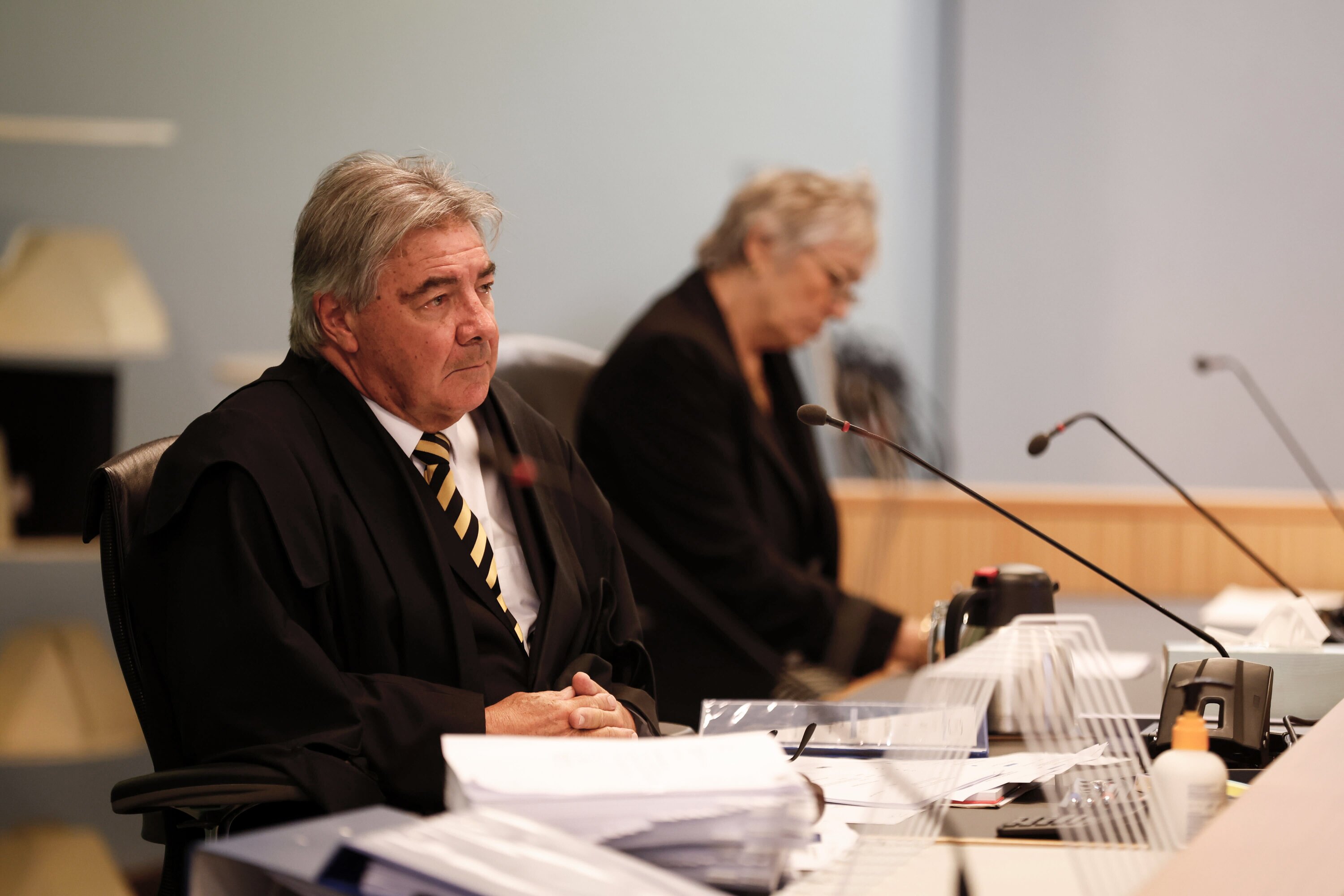
Testimony is set to resume tomorrow when the trial continues before Justice Graham Lang and the jury.
Craig Kapitan is an Auckland-based journalist covering courts and justice. He joined the Herald in 2021 and has reported on courts since 2002 in three newsrooms in the US and New Zealand.