Philip Polkinghorne murder trial live updates: Forensic accountant gives evidence on accused murderer’s finances
WARNING: DISTRESSING CONTENT
On a Monday morning in October 2020, Auckland Eye employee Janet Wigmore was “showing the ropes” to two staff members when she walked into the office complex’s retinal laser room and found something she’d never before seen: a methamphetamine pipe and lighter on a table immediately to the right of the entrance.
“I backtracked and closed the door,” the registered nurse told jurors today as a fourth week of evidence kicked off in the ongoing murder trial of eye surgeon Philip Polkinghorne.
Methamphetamine use has become a major part of the Crown’s narrative for the circumstantial case against the 71-year-old now-retired ophthalmologist, who is accused of having fatally strangled wife Pauline Hanna, 63, inside their Remuera home before staging the scene on April 5, 2021, to look like a suicide by hanging.
Prosecutors allege Polkinghorne was high on the drug when he killed her. An expert witness is expected to testify later in the trial that the drug is known to cause erratic and sometimes aggressive behaviour.
The defence has vigorously insisted her death was exactly as it initially looked: a suicide. And although Polkinghorne began the trial by pleading guilty to possession of methamphetamine and a meth pipe found in his home as police investigated the suspicious death, his lawyer has suggested through cross-examination the pipe found at his workplace five months before Hanna’s death was not his.
STORY CONTINUES AFTER LIVE BLOG
Forensic accountant describes Polkinghorne's accounts
Andrew Laxon
Now Polkinghorne's accounts.
He had two ASB accounts, solely in his name, an ANZ account in his name, and another ANZ account in the name of 2020 Ltd, a company of which Polkinghorne and a trust were the shareholders. That trust was "Ophthalmic Trust Number 2".
Hanna had two accounts in her own name, both at ASB.
There was an ASB joint account as well. Her salary was paid into that joint account.
The daily user of that account was primarily Hanna, Skilton said.
There was an ANZ account in the name of the Hanna Polkinghorne Trust. The trustees were Hanna, Polkinghorne and another man.
There was also an ANZ account called the Emily Hughes Trust. The trustees were Polkinghorne and Emily Hughes.
Justice Graham Lang says it has been a long day and has called time on proceedings.
Court will resume at 10am tomorrow with more evidence from police forensic accountant Margaret Skilton, who examined Polkinghorne and Hanna's finances.
Her evidence has been a preamble about who controlled how many and what accounts but it is expected to delve into many more details tomorrow.
Forensic accountant gives evidence on Polkinghorne's finances
Andrew Laxon
The Crown calls Margaret Skilton.
Skilton is a forensic accountant working for the New Zealand Police, a civilian attached to the financial crime group.
She started working in a bank at age 18 and stayed in banking for 30 years, she says.
Her current role involves conducting analysis on people committing fraud and money launderers, she tells prosecutor Brian Dickey.
The Crown has called her as an expert witness.
On Operation Kian, the inquiry into Hanna's death, she was asked a couple of weeks into the investigation to analyse five years' worth of banking records.
She was tasked with looking at the statements "and seeing what I could see".
The information she was given by a detective constable was ANZ and ASB bank records relating to Philip Polkinghorne and Pauline Hanna.
She also obtained information from JBWere wealth managers and some trust accountants.
They had to get a court order to compel the organisations to hand over their records, Skilton says.
"You tend to look for certain types of transactions," says Skilton.
She identified frequent or common payees in the bank accounts, she tells the court.
Skilton then produced a report of financial analysis.
Into the report.
Skilton looked at accounts held by Polkinghorne, Hanna, and the accounts they held jointly.
There were also credit and debit cards.
Were there any substantial debts? asks Dickey of Hanna's accounts.
No, there was a small overdraft on the joint ASB account and another small overdraft in a personal ASB account, Skilton says.
"What does 3.1 micrograms actually tell us?"
Andrew Laxon
The Crown calls Coco Hsueh.
She has about 10 years of lab experience and has a Bachelor's degree in science and technology, she tells prosecutor Pip McNabb.
Hsueh, like Harrison, was involved in reviewing the meth testing results from Auckland Eye.
Hsueh confirms they were tested in accordance with usual standards and in accordance with international best practice. She tells McNabb she confirmed their accuracy. McNabb has no further questions.
Ron Mansfield KC asks the same questions he asked Harrison and gets basically the same answers – that the witness can't help him.
"What does 3.1 micrograms actually tell us?"
A long pause from Hsueh. "That's the amount of meth detected in that sample that we tested."
"But what does that mean in real terms for us so far as how much methamphetamine that is that was in the environment?" Mansfield asks.
"I don't know," says Hsueh.
No further questions from Mansfield.
Some re-examination from McNabb. Hsueh confirms she has no expertise in taking the samples themselves.
Drug test reviewer gives evidence
Andrew Laxon
The Crown calls Kim Harrison. She reviewed drug testing results at Hill Laboratories in Hamilton, which the jury heard earlier assessed the swabs taken by Jeremy Hill from Auckland Eye.
Prosecutor Pip McNabb is leading her evidence. Harrison has over 20 years of laboratory experience and a Master's degree.
Harrison says the samples are extracted, shaken up, and an aliquot (a small sample of a sample) is extracted, then placed on to an instrument.
The samples were received on July 14, 2021 and reported on to the Drug Detection Agency the following day.
Defence lawyer Ron Mansfield begins his cross-examination, asking about a New Zealand standard for methamphetamine testing of contaminated properties.
She's not that familiar, Harrison says.
What about what your results mean, for example we've heard that for a low-use area, any result under 3.8 micrograms per 100cm2 isn't concerning, asks Mansfield. "What does 3.8 actually mean?"
"I don't know that information," Harrison says.
No further questions or re-examination. Harrison is free to go back to Hamilton after a short stint in the witness box.
More on meth readings, testing - and that printer
Andrew Laxon
Mansfield has now referred to Hill's report, for July 9, 2021, and is asking about how he defines a "limited use area".
It's defined as a property that can be easily accessed but is in limited use by people.
Any contamination of meth at over 1.5 micrograms per 100sq cm is deemed to necessitate cleaning, says Hill.
But for areas of ducting or similar, a higher level of contamination of 3.8 micrograms is required, says Hill.
Hill says exterior heat pump units aren't tested because of the risk of contamination. During Covid times, there was a lot of dust inside offices, which was a good source for swabbing for meth contamination.
The surface of the filter inside the consultation room was tested, but the exterior unit was not.
Back to the printer. Remember it had a reading of 100 micrograms, and it was tested months after the first test in July 2021 was taken, much higher than the level deemed concerning and requiring cleaning.
Following the first reading in July, Hill said he did not recommend further testing. When he returned in September, he again did not recommend further testing, he tells Mansfield.
However, his September 2021 report recommended a "detailed assessment". That did not cover the entire building though, says Hill.
Mansfield has no further questions for the witness.
Prosecutor Pip McNabb has a couple more though. It's about the high reading on the printer following the second test, in September. It was not tested in July at the first test, Hill says.
That's it. Hill is free to go.
Meth contamination found on printer
Andrew Laxon
The trial resumes.
Swab testing locations from the meth testing in July 2021 at Auckland Eye are on screen.
Hill has confirmed that when he retested the premises, there was 100 micrograms on a printer, well over the level deemed concerning.
Jurors see meth pipe photo
Andrew Laxon
Jurors were shown this photo today of the meth pipe found at Philip Polkinghorne's workplace in October 2020, five months before Pauline Hanna's death.
The pipe was thrown in the rubbish, following advice from police, before a law firm was hired to investigate the discovery.
Court adjournment - resuming in about 15 minutes
Andrew Laxon
The system for sharing images on to the screens at court isn't working so we are taking an early adjournment for afternoon tea.
Court will resume in 15 minutes or so.
'Concerning' meth level an 'arbitrary figure', says defence
Andrew Laxon
Ron Mansfield KC is beginning his cross-examination of the witness Jeremy Hill, who conducted the meth testing at Auckland Eye in 2021.
He is having the witness confirm that many other rooms in Auckland Eye were not swabbed at all, just two consultation rooms, a treatment room, and a toilet.
Mansfield is asking what might cause the level of meth found in the heat pump grill in consultation room 4, deemed concerning, such as how much would have been smoked and when it was smoked?
Hill says he can't.
Mansfield suggests the threshold for "concerning" contamination, 1.5 micrograms, is an arbitrary figure.
He then asks Hill who conducted the cleaning and whether it was his company.
Hill says he doesn't know and they don't undertake cleaning.
Mansfield is having the witness confirm the internal heat pump units are connected to an outdoor unit.
Did he go outside and test the exterior units for contamination?
No, says Hill.
He confirms to Mansfield he did not know if there was any contamination from exterior units.
"Can you even tell us where the exterior units were?" Mansfield asks.
"No," says Hill.
He conducted a further test later, a "post-clean analysis".
'Concerning' level of meth contamination in Polkinghorne's eye clinic
Andrew Laxon
Hill says he swabbed two consultation rooms, another room, and the toilets, taking 10 swabs in total.
One of the rooms swabbed was consult room 4, which the jury earlier heard was used by Polkinghorne, among others.
Once he entered the room, wearing his Hazmat gear, he'd assess where he should test, Hill says. Then, he would write the time, source and date of the sample on each tube containing the swabs.
He took several swabs from the first room: on the heat pump air vent, the keyboard and desk area and the phone keypad. Similar swabs were taken in other rooms.
In the toilet, wearing his hazmat gear, Hill swabbed the top of the paper towel dispenser, and the air vent. In fact, Hill remembers, it was 14 swabs he took, not 10.
He took the swabs back to base and packaged them up to be couriered to the lab in Hamilton.
A chain of custody form accompanied the swabs. Hill Laboratories, as always, turned it around quite quickly, within a few days, says Hill.
Of the 14 samples, Hill says there was one particular area with a "level of concerning contamination".
That was the heat pump grill in consult room 4.
But all 14 samples had some level of methamphetamine.
The other 13 results were below the level denoting a concerning level of environmental meth contamination.
Drug testing technician called as witness
Andrew Laxon
The Crown has called Jeremy Hill. He's an operations co-ordinator at the Drug Detection Agency in Auckland.
In 2021, he was a testing technician with the Auckland franchise of the Drug Detection Agency (a private company, not a government agency).
They are contracted by companies to conduct drug testing and environmental sampling for meth.
Prosecutor Pip McNabb is leading his evidence.
Hill says the samples are taken away to Hill Laboratories in Hamilton for analysis.
He says they sometimes wear full hazmat (hazardous material) gear when conducting their meth testing, including a respirator.
A previous witness, then Auckland Eye chief executive Deborah Boyd, said she arranged for meth testing at Auckland Eye following Hanna's death, when some at the clinic learned Polkinghorne had been using methamphetamine.
The first contact was made in June 2021 and the test was conducted by the witness on July 9, "quite late at night".
They had to wait until the clinic had emptied because they wanted a confidential test.
As a result, the drug testers used an unmarked car.
He recalls meeting Boyd at the Remuera clinic. Boyd told him it was going to be a couple of rooms.
He swabbed two consultation rooms, another room and the toilets, taking 10 swabs in total.
One of the rooms swabbed was consult room 4, which the jury earlier heard was used by Polkinghorne, among others.
Polkinghorne was at his eye clinic to 10pm Saturday night before meth pipe found, witness says
Andrew Laxon
Defence lawyer Ron Mansfield is traversing his client's roster with the witness, Tracey Molloy, the operations manager at Auckland Eye.
She is saying she doesn't know his roster. Justice Graham Lang says "I'm not sure we're getting anywhere with this" and we move on.
Once more, Mansfield is asking if Molloy is aware of Polkinghorne's work at the Papatoetoe clinic, half-days on Thursday and Friday. She is.
The witness confirms Polkinghorne regularly used consult room 4, and that a sign with the doctor's name goes up when they're using it.
Mansfield now asks about all the other staff who are at the clinic, including IT staff, responsible for placing computer equipment through Auckland Eye. Molloy confirms they would service the IT equipment in the consultation rooms.
Earlier today, the jury heard how meth was found in the air conditioning unit of a consultation room used by Polkinghorne, following a test some months after he left.
Mansfield is showing via cross-examination the amount of other people who could have used this room.
And there are no further questions.
Prosecutor Pip McNabb has one question in reply.
It's about the security system records from Saturday night, showing a warning saying "late close" on October 16, 2020, two days before the meth pipe was found inside the clinic.
Are you able to tell the time Polkinghorne closed the premises that evening? asks McNabb.
Molloy says she has a written record showing it was after 10pm.
Andrew Laxon
The jury has returned for more cross-examination by Ron Mansfield KC of the Crown's latest witness, Tracey Molloy, the operations manager at Auckland Eye.
Before lunch, she was quizzed on CCTV at the Remuera clinic showing Polkinghorne and two others – a man and a woman – inside the clinic on a Saturday evening in October 2020.
The following Monday, a meth pipe was found in a laser room at Auckland Eye. An investigation into who left it there was inconclusive.
On to questions about Polkinghorne's last day at Auckland Eye, on April 1, 2021. He called 111 to report his wife dead on April 5.
Defence and witness discuss floor plans, judge calls for lunch break
Vera Alves
Auckland Eye operations manager Tracey Molloy again says it appeared to be the same people with Polkinghorne on Saturday and Sunday. But she agrees that might not be a surprise if there was a need to check or re-check a certain procedure.
Defence lawyer Ron Mansfield asks if she's ever made inquiries about the glass pipe her colleague found, which had "sweet puff" written on the side.
"I cannot recall ever googling something about a sweet puff pipe," she says, to laughs from the gallery.
Molloy confirms the CCTV footage shows the direction people were going in the building but not whether they went into the room where the pipe was found.
She again says she saw Polkinghorne with the same two people in the clinic on both the Saturday and the Sunday.
Molloy says she had had a look at the CCTV footage today with two detectives to refresh her memory. Two went into consult room 4 and the other went the other way.
Mansfield says and Molloy agrees that was consistent with Polkinghorne seeing a patient and another person accompanying them waiting in another area.
Molloy says she then saw them going back the way they came.
Both Mansfield and the witness are each referring to floor plans of the building. "I'm terrible at plans," says Molloy. "You and me both," says Mansfield. They're both trying to work out where the building's main doors are.
Justice Graham Lang has just looked at the clock.
Mansfield has asked the witness to hold up the plans "like you're on the weather". She's pointing to where she believes she saw Polkinghorne and the two others go in the CCTV footage on the weekend before the meth pipe was found.
Justice Lang asks: "Is that a convenient time, Mr Mansfield?"
It is, and we are taking lunch.
Court will resume at 2.15pm.
Defence cross-examines witness
Vera Alves
Defence lawyer Ron Mansfield begins his cross-examination of Tracey Molloy, operations manager at Auckland Eye.
He asks Molloy about her role in the investigation. She says she didn't really have a role in it other than what she'd already told the court.
Was she aware the cleaners were interviewed? Mansfield asks.
No. But Molloy says she did call the cleaners on that day to ask if they'd seen anything.
Did you see the Wynn Williams report? Mansfield asks.
Only recently, says Molloy.
Did she know Polkinghorne was found to have attended to a patient on both the Saturday and the Sunday? Mansfield asks.
She is unclear.
But she does recall seeing the same people coming back a second time, on the Sunday.
Mansfield asks, and Molloy confirms, Polkinghorne's work involved weekend and after-hours work for acute and urgent issues. Sometimes his clinical work had to be done at all hours to avoid patients losing their sight, Molloy agrees.
Molloy agrees Polkinghorne worked long hours, including half-days at the Papatoetoe clinic, days in Whangārei and long hours at the main Auckland Eye clinic in Remuera.
She agrees he was hardworking and highly regarded and appreciated by patients.
Polkinghorne repeatedly entered the clinic on the Saturday, once a little after 8pm.
Meth pipe remains focus of questioning
Vera Alves
The next Crown witness is Tracey Molloy. She's the operations manager at Auckland Eye and has been there for 16 years.
Prosecutor Pip McNabb launches into questions about the meth pipe discovery. She remembers the previous witness, Wigmore, coming back to her office to tell her she'd found the glass pipe and lighter in the retinal laser room.
The pair went back to the laser room and took the meth pipe back to her office.
Molloy says she then contacted Deborah Boyd, the then Auckland Eye chief executive, who gave evidence earlier today.
"Deb and I called the police," she says.
Police asked if there'd been a break-in. Molloy says she told them there hadn't been.
"They said return it to the person who it belongs to," Molloy remembers.
She later threw it in a bin outside.
The pipe had markings saying "sweet puff" on the side, she says.
Molloy says she reviewed the CCTV footage from the previous weekend. The meth pipe was found on a Monday morning in October 2020, months before Hanna's death.
Earlier, the jury heard Polkinghorne was one of several people who went into Auckland Eye in Remuera over the weekend. He was captured on CCTV in the clinic with a man and a woman. It's unclear if they were patients and an investigation into the provenance of the pipe was inconclusive. Polkinghorne admitted charges at the start of this trial relating to meth and a pipe found at his Remuera home.
Molloy remembers seeing the cleaners on the CCTV. And she saw Polkinghorne and two others. She cannot recall who they were and did not recognise them.
She says he was in the clinic with these two people at night and it was dark.
Defence lawyer cross-examines witness
Vera Alves
Defence lawyer Ron Mansfield begins his cross-examination of Janet Wigmore, the clinical services manager at Auckland Eye.
Were you aware the law firm Wynn William was conducting an investigation into the meth pipe? Mansfield asks.
No, says Wigmore, she knows nothing of the investigation.
She confirms she does not know if the man and woman Polkinghorne was seen walking down the corridor with towards the room where the meth pipe was found were patients, because she did not review patient records.
No further questions from Mansfield or McNabb, so Wigmore is free to go after a short stint in the witness box. She takes her water with her and Mansfield says "it's complimentary" and Wigmore laughs.
Polkinghorne spotted on CCTV on weekend meth pipe was found
Vera Alves
Janet Wigmore, the clinical services manager at Auckland Eye, went into the clinic on October 19, 2020, she remembers.
There's a table immediately as you go into the room, Wigmore says.
"There was a glass pipe and a lighter."
The lighter was a large lighter, bigger than a Bic, she says.
When she saw the glass pipe, she backtracked out of the room then told an Auckland Eye manager what had happened.
"We weren't quite sure what to do," Wigmore says.
They decided to remove the pipe and lighter from the room.
They were on a paper towel, she says.
The premises has an alarm controlled by a code and monitored by an app, the witness says.
They checked from the Friday to the Monday morning when the meth pipe was found.
"We wouldn't have thought that that would have been there during working hours," she said.
The alarm app shows who has come into and out of the clinic.
It shows Polkinghorne was among several people who went into the clinic over the weekend.
He went in during the day and again about 8pm on Saturday. The app then said "late close", which indicated to the staff the building's security system had not been closed down for the night.
Polkinghorne went back into the clinic on Sunday.
Wigmore says she was involved in reviewing the CCTV evidence. You could see about halfway down the corridor to the door to the retinal laser room, where the meth pipe was found.
Polkinghorne was captured walking down the corridor with a man and a woman on CCTV at the weekend, Wigmore says.
Manager who found meth pipe takes the witness stand
Vera Alves
The next Crown witness is Janet Wigmore, the clinical services manager at Auckland Eye. She's a registered nurse with an ophthalmology certificate who has worked at the practice for 19 years.
Prosecutor Pip McNabb is leading her evidence.
Wigmore says she found the meth pipe just inside the door of the retinal laser room. She is a health and safety rep and was doing routine checks of the clinic before work started. Two people were with her.
Vera Alves
On to the change in diet and weight loss around 2018.
Former Auckland Eye CEO Deborah Boyd says she remembered Polkinghorne saying at that point that Hanna had him on a diet.
She recalls that at some shareholder meetings there'd be food provided, and Polkinghorne would bring his own, sticking to his diet.
From 2018, he seemed to maintain the same body weight, says Boyd.
Prosecutor Pip McNabb has some further questions for the Crown. She asks if patient records are the only way if patient records are the way to know if someone at Auckland Eye had used a certain room. Boyd confirms that is right.
"So if somebody used a room without a patient would that be recorded anywhere?" asks McNabb.
"No," says Boyd.
Earlier, the jury heard meth testing uncovered traces of the drug in a consultation room used by Polkinghorne.
If someone had used the retinal laser room, where the meth pipe was found, would there be a record of that? asks McNabb.
No, says Boyd.
But in response to another question, she says she couldn't comment about whether you could be sure if someone had gone into the room over the weekend, as it was so long ago.
'Clearly agitated': Witness recalls Polkinghorne behaviour during meeting
Vera Alves
Defence lawyer Ron Mansfield continues his cross-examination of former Auckland Eye CEO Deborah Boyd.
The cross-examination is mired in questions on at what point documents are available to board members ahead of meetings.
Boyd says they are available as soon as they are uploaded into a shared file system.
Mansfield is asking if Boyd earlier said Polkinghorne had not engaged at the six-weekly meetings in 2020. Boyd says that was not what she was suggesting. Instead, he behaved differently at the planning day in October 2020 and the board meeting early in 2021.
Mansfield returns to Polkinghorne's monthly clinic in Whangārei. He'd drive up on the Sundays, work all through Monday then drive back. At the Monday evening board meeting early in 2021, where the trial heard earlier Polkinghorne was angry and hadn't read the minutes, Mansfield says Polkinghorne would have already had a long day. Boyd agrees.
The board bundle for that meeting had again arrived late, Boyd agrees.
She does not remember Polkinghorne expressing his frustration at the late arrival of the board materials, but concedes he may have.
Can you remember exactly what Polkinghorne said at the meeting? asks Mansfield, as the cross-examination grows a bit more tense.
No, says Boyd, I remember his behaviour more than his words.
Polkinghorne appeared via Zoom at the meeting.
"He was clearly agitated and standing rather than sitting which was unusual for a board meeting," says Boyd.
"He'd just got back from Whangārei after working all day, correct?" asks Mansfield.
"Correct," says Boyd.
"He was in his office at home?" asks Mansfield.
"I don't know where he was," says Boyd.
Trial resumes after short morning adjournment
Vera Alves
Justice Graham Lang has entered from the door at the right of the court, and in comes the jury from the left-hand door connecting to the jury room.
The court's new, temporary home overlooks Parnell and is on the opposite end of the Auckland High Court to Courtroom 11, currently set up for a sitting of the five judges of the Supreme Court for the week.
The trial has resumed, with more questions from defence lawyer Ron Mansfield to former Auckland Eye chief executive Deborah Boyd.
Defence questions Polkinghorne's workload
Vera Alves
Defence lawyer Ron Mansfield asks former Auckland Eye CEO Deborah Boyd if Polkinghorne worked through all the Covid lockdowns.
He would work as he was required to, says Boyd.
"Righto," says Mansfield, who moves on to a part of the shareholders' agreement from 2016.
It sets out that management shall ensure that the plan and budget are forwarded to directors at least 10 working days before the meeting.
Was that the expectation?
It was, says Boyd.
But she agrees that during lockdowns it was hard to meet such requirements amid changing Government requirements.
Mansfield says it is an example of the amount of material people had to review overnight after a busy work day.
Vera Alves
Vera Alves
This cross-examination by defence lawyer Ron Mansfield reveals the level of research required of lawyers in a trial such as this.
It shows the defence went as far as requesting the emails sent to board directors at Auckland Eye to calculate how far before board meetings they were sent out, and thereby challenge Crown accusations about his behaviour at meetings.
The defence team also has researched the temperature on a certain day several years ago to show, according to Mansfield, that it's no surprise someone would fall asleep during a meeting.
Lawyer suggests Polkinghorne fell asleep because meeting wasn't of interest to him
Vera Alves
Defence lawyer Ron Mansfield is asking Deborah Boyd about a part of the Auckland Eye minutes headed "Reinventing ourselves" during the strategic planning day.
What does BHAGs stand for? he asks.
Boyd eventually confirms it stands for "big hairy audacious goals".
Another part of the day focused on whether it was best to retain their central location in Remuera, or follow the more commonly focused view in health that they might be better to have smaller hubs in different locations.
Mansfield's point here is that the day featured a lot of material that was, to say the least, not of interest to Polkinghorne given his pending retirement, and to suggest it is no wonder he may have dozed off.
Defence continues cross-examination of witness
Vera Alves
Deborah Boyd, former CEO of Auckland Eye, doesn't recall if the police recommended she undertake the drug testing.
Boyd contacted the drug detection agency in June 2021, shortly after the Wynn Williams meth pipe investigation report was handed to the police.
"I don't think it had anything to do with the police," said Boyd of her decision to get the clinic drug-tested.
Boyd was interviewed on July 22, 2021 as part of their inquiry into Hanna's death.
At the time, she was asked questions about changes in Polkinghorne's behaviour.
During her interview, she talked about the board meeting in late March.
"But that is the only meeting that you specifically talked about?" defence lawyer Ron Mansfield asks.
"It was probably the latest meeting I could recall following on from that shareholder session in October 2020," Boyd says.
In the interview, she talked about Polkinghorne falling asleep at the strategic shareholders planning.
"He wasn't snoring or doing anything like that was he?" Mansfield asks.
"Well he was definitely slumped in his chair," says Boyd.
Boyd confirms she thought it was an important meeting for Polkinghorne because decisions made then would affect his retirement.
But had the decision on the changes to Auckland Eye already been discussed at earlier board meetings? asks Mansfield.
Boyd says she can't recall.
"Everything to do with the reshaping of the shareholders' agreement... it took a long period of time," she said, adding it wasn't even finished by the time she left.
So there was nothing new for Polkinghorne at this strategic planning day? asks Mansfield.
Boyd doesn't entirely agree, saying all the shareholders were being given a chance to provide feedback at the meeting.
Mansfield has just produced the minutes for the shareholder meeting.
The defence lawyer is once again referring to the fact Polkinghorne worked long hours in a challenging speciality, on weekends and at satellite clinics in Whangārei and Papatoetoe.
Boyd agrees he was well-liked by his patients and had a deep concern for their health.
Mansfield said the strategic planning day was run at Findex, their accountants' premises, and their boardroom was used.
He has done his research in this trial and reveals it was a hot day on the day of the meeting. Boyd agrees it was, and it was a long day as well.
Meth detected in air con vent of consultation room used by Polkinghorne
Vera Alves
Defence lawyer Ron Mansfield is beginning his cross-examination of the witness, former Auckland Eye CEO Deborah Boyd.
He asks if the consulting room was the only room where meth was found in the air conditioning unit.
"Was there any further testing undertaken?" he asks.
He suggests some re-testing was conducted.
Boyd confirms she never saw the meth pipe where it was actually located.
Mansfield: The last time the laser room was used, was that on the Thursday before the weekend?
Boyd said it's hard to know who may have gone into that room given the doctors were in over the weekend.
Wynn Williams, a law firm, investigated the P pipe for Auckland Eye and produced a report on their inquiry, later handed to police.
Mansfield is referring to a copy of that report.
The report said the room where the pipe was found was last recorded to have been used for a teenage male patient on the Thursday.
"Had you seen the CCTV footage? The Auckland Eye CCTV footage?" asks Mansfield.
"From the Thursday? I don't recall."
"As the CEO, why didn't you ensure that the CCTV footage was retained?"
When the police didn't seem interested in further inquiries regarding the pipe, they decided they did not need to retain the footage, Boyd said.
"If the pipe was there from Thursday, it would have been found on Friday," said Boyd.
That's because the rooms are all checked between each day, she said.
Mansfield said that was an assumption.
A pause, and Mansfield said he's just been reminded the CCTV footage does exist and has been provided as part of disclosure.
Another pause.
Moving on. The people who came in over the weekend included a number of cleaners, who were unable to provide investigators any useful information on when the room was serviced or if they'd seen the meth pipe or lighter, Boyd confirms.
But Wynn Williams did establish Polkinghorne had attended to a patient on both days of the weekend, Boyd agrees.
Boyd agrees she can't provide further information on the discovery beyond what was provided in the report.
Mansfield asks if it was left as a possibility that the meth pipe could have been left behind when the laser room was last confirmed to have been used, to treat a teenage male patient, on the Thursday before the weekend.
"Well we were unsure what had occurred so we didn't think about it any further really," said Boyd.
The room where the meth was later detected in the air conditioning was a consult room which could be used by anyone, and wasn't specific to Polkinghorne, Boyd agrees.
But custom and practice showed Polkinghorne always worked out of a certain room, she said.
Mansfield continues, suggesting staff or the public would have smelled if someone was smoking meth in that consultation room.
"So if someone was smoking up a storm, there are smoke sensors in the consult rooms correct?"
Boyd is unsure but said it was completed 2016, which Mansfield said showed it would of course have had detectors.
Boyd confirms there was no record of who used the consult room or when.
So while Polkinghorne liked to use the consultation room where the meth was found in the air conditioning, he was far from the only one who used that room? asks Mansfield.
Boyd agrees.
The air conditioning unit had been there since the building was opened in 2016, Boyd said.
She doesn't know where the filters were sourced either.
Crown asks about the meth pipe found at Auckland Eye
Vera Alves
Prosecutor Pip McNabb is now on to the meth pipe found at Auckland Eye in October 2020.
Former Auckland Eye CEO Deborah Boyd said she was one of those who went into the clinic over the weekend before it was found on a Monday morning.
"It was found on the Monday by the team when they were setting up the clinic for the start of the day."
They checked the CCTV footage and saw there were several doctors, Boyd and a finance manager who had entered the clinic that weekend.
She recused herself from the investigation because she'd been into the clinic. A lawyer handled the inquiry.
Polkinghorne and two of the other shareholders had gone in over the weekend.
There is some lack of clarity over where the pipe was seen. Boyd says she thought it was found in the retinal laser room but a witness last week, board chair Mark Conelly, said it was found in a prep room. Boyd is now unclear and says she didn't find or see the pipe.
CCTV didn't show who went onto the rooms in question over that period, Boyd says.
But it did show the direction people were taking inside the clinic. Boyd says Polkinghorne had gone in the direction of the laser room, as well as another doctor, and the cleaners. Boyd, the finance manager and another doctor didn't go towards the room.
"What ended up happening to the pipe?" asks McNabb.
Boyd says their lawyer took it to the Newmarket police station.
She says it was never established who had left the pipe in the clinic.
Boyd says they were unaware anyone at Auckland Eye was taking drugs.
The witness says she was present at a meeting where it emerged Polkinghorne had admitted using meth.
They later engaged a drug testing company, who assessed the retinal areas of the practice for meth.
The testing was done in July 2021.
The results showed a consulting room tested positive for meth in an air conditioning vent.
No more questions from the Crown.
Witness recounts hearing of Pauline Hanna's death
Vera Alves
Deborah Boyd, former CEO of Auckland Eye, says she was away in Hawke's Bay on Easter weekend in 2021 when she received a call about the death of Pauline Hanna.
She later spoke to him.
"He said that Pauline had died and that she'd hung herself," Boyd says.
She says he sounded "very distressed".
Boyd says she then saw him back at the practice fairly soon after, to see how he was doing.
"He was wearing dark glasses, very upset, understandably so."
He was then put on bereavement leave for several months, Boyd confirms.
Former Auckland Eye CEO says she saw changes to Polkinghorne's behaviour
Vera Alves
Deborah Boyd, former CEO of Auckland Eye, is now in the witness box.
Boyd says she has now left Auckland Eye, the Remuera clinic she joined in 2016. The previous year, she met Polkinghorne, who was on the interview panel.
"Extremely professional. He's highly regarded in his field, I'd say world-renowned," Boyd says.
Boyd says she started noticing a change in Polkinghorne's behaviour from 2018.
She first noticed a weight loss attributed to his and his wife's fitness and diet regimen.
Then she started receiving emails in the early hours of the morning, she says.
Boyd says she later noticed Polkinghorne falling asleep in board meetings.
Polkinghorne had said in 2018 that "Pauline had him on a diet," Boyd says.
Asked about the falling asleep, Boyd says they would noticed he had done so at board and shareholder meetings.
"He wasn't participating in the meeting."
He did not appear to be engaged, Boyd says.
"Certainly his eyes were shut and he was not participating in the conversation."
It was happening at most of the six-weekly meetings in 2020, Boyd says. That's the year before Hanna's death.
At a planning day, setting the strategic direction of the practice, he was disengaged. This was in October 2020, Boyd says.
The emails from him would come at 2am or 3am.
"A lot of them were to do with changes to the shareholders' agreement."
To recap, the jury has repeatedly heard how Polkinghorne was aggrieved at how he was set to receive a much lower payout than two other eye doctors who left in acrimonious circumstances to set up a clinic across the road, given he had helped found the clinic and had remained loyal for decades.
On to a board meeting in early 2021.
Boyd echoes the comments of the board chair who gave evidence who said he appeared agitated and was frequently up on his feet.
She says she had not seen behaviour like that from him before.
First witness of the day takes the stand
Vera Alves
Members of the public began gathering outside the trial's new home for the week – the smaller courtroom 13 of the Auckland High Court – from at least an hour before proceedings were set to start, to ensure they could grab a seat.
They include several who have turned up to most of the previous 15 days of proceedings. There is limited space on the press benches in here and there is competition between media outlets for a spot, to avoid being relegated to the gallery.
A registrar turns on the recording system, Justice Graham Lang walks up to the bench, and the nine women and three men who will decide this case enter from the jury room. As they filter into their seats, Polkinghorne stands. He is setting in the second row beside his legal team.
The Crown has called Deborah Boyd. She is the former chief executive of Auckland Eye mentioned in evidence on Friday, when the jury heard colleagues discuss Polkinghorne's behaviour at work and how a P pipe was found in the clinic.
Prosecutor Pip McNabb is leading her evidence.
Polkinghorne arrives back in court
Vera Alves
Trial resumes this morning
Vera Alves
Welcome to the Herald's live coverage of day 16 of the Philip Polkinghorne murder trial, the Remuera eye surgeon accused of killing his wife Pauline Hanna and staging the scene to look like a suicide. His defence maintains she killed herself while on a cocktail of medications combined with the stress, alleged bullying and long hours of her role in Covid vaccine logistics.
We are into week four of the six weeks set aside for the keenly watched trial, which did not sit yesterday because Polkinghorne's lawyer Ron Mansfield KC was in the Supreme Court.
The Crown case continues at 10am with a new witness. The jury of nine women and three men have not been told whom the prosecution will call. Mansfield has foreshadowed via cross-examination that the defence will call several expert witnesses so it remains an open question whether the trial will finish inside the six weeks allotted. As is usual, he has not signalled whether or not Polkinghorne will enter the witness box and give evidence in his own defence.
Justice Graham Lang told the jury on Friday the case was broadly on track but things would be clearer at the end of this week.
Major revelations in week three included Hanna’s friends John and Pheasant Riordan revealing she had told them Polkinghorne had put his hands around her neck and threatened he could do it again.
Another friend, Alison Ring, said Polkinghorne had arrived at her home after he was charged, well over a year following his wife’s death and produced a piece of paper he claimed was her suicide note. Police never found a note during their days at the home. Ring said she wasn’t convinced by the note, and claimed Polkinghorne had made a series of derogatory comments about his late wife to her.
Hanna’s GP, who is seeking name suppression, said she had called her late in 2019 to report suicidal thoughts because her mother was unwell and she believed her husband was leaving her. She had thought about driving into an oncoming truck but didn’t want to do so because of her grandchildren, the jury heard.
Week one of the trial, following the openings, centred around the orange rope Polkinghorne says his wife used to hang herself.
Could it have supported her weight to the extent needed for suicide by hanging? No, said the police.
Detective Christian Iogha had pulled the rope after arriving at the Polkinghorne home on the morning of April 5, 2021 and found it unravelled easily.
The Crown’s forensic analyst of knots, ropes and ligatures, Robert Chisnall, agreed it could not have supported a person’s weight. Police did not video or otherwise record this “tension test” or use a force metre, such as a suitcase measuring device, sparking criticism from Mansfield, who suggested the detective just yanked what was an already loosened rope.
Of course it was loose and slack, said Mansfield. His client had been told to loosen the rope by a call-taker after he rang 111 to report his wife had hanged herself. That day, he told a detective he loosened the knot tied to the balustrade because it looked “hideous” hanging above his dead wife in their hallway.
Chisnall conceded the rope showed shapes suggesting “memory” of knots recently untied, and agreed surgeons would know how to tie more sophisticated and stronger knots than the granny knots used to secure the rope to the balustrade.
The tempo of the evidence increased in the second week, culminating in a visit by the jury to Polkinghorne’s sprawling home on Remuera’s northern slopes.
The jury also heard how detectives had raided a chalet in Mt Cook in the South Island where Polkinghorne was staying with an Australian escort, Madison Ashton, about 25 days after his wife’s death. A detective seized her phones but she would not hand over the passcodes.
Prosecutors played the “Longlands recording", so called because it was captured at the Hanna family property in Longlands in the Hawke’s Bay. Her niece used her phone to record Pauline Hanna speaking with family about her marital problems, at one point describing Polkinghorne as a “sex fiend”. She disclosed to family members that she had reluctantly joined in group sex sessions with her husband and other women, but no longer wanted to be involved. In the recording, Hanna said Polkinghorne would at times become enraged, which she called him being “on the roof”.
Read a full recap of week three's evidence here: Philip Polkinghorne murder trial week three wrap: Fear, strangulation, a curious note and pathologist dominate evidence
Or for something a bit different listen to Steve Braunias talk about the case with Matt Heath and Jeremy Wells on the Matt & Jerry Show podcast, on iHeartRadio, Apple Podcasts and Spotify.
🎧 LISTEN | Accused: The Polkinghorne Trial
Vera Alves
STORY CONTINUES
Wigmore was one of three Auckland Eye employees called to the witness box this morning by prosecutor Pip McNabb, who is trying the case alongside current Crown Solicitor Alysha McClintock and former Crown solicitor Brian Dickey.
“We weren’t quite sure what to do,” Wigmore said of the discovery, explaining that she alerted operations manager Tracey Malloy shortly after the meth pipe discovery.
Malloy, who followed her in giving evidence, explained that they moved the pipe into her office and called police, who asked if there had been a break-in.
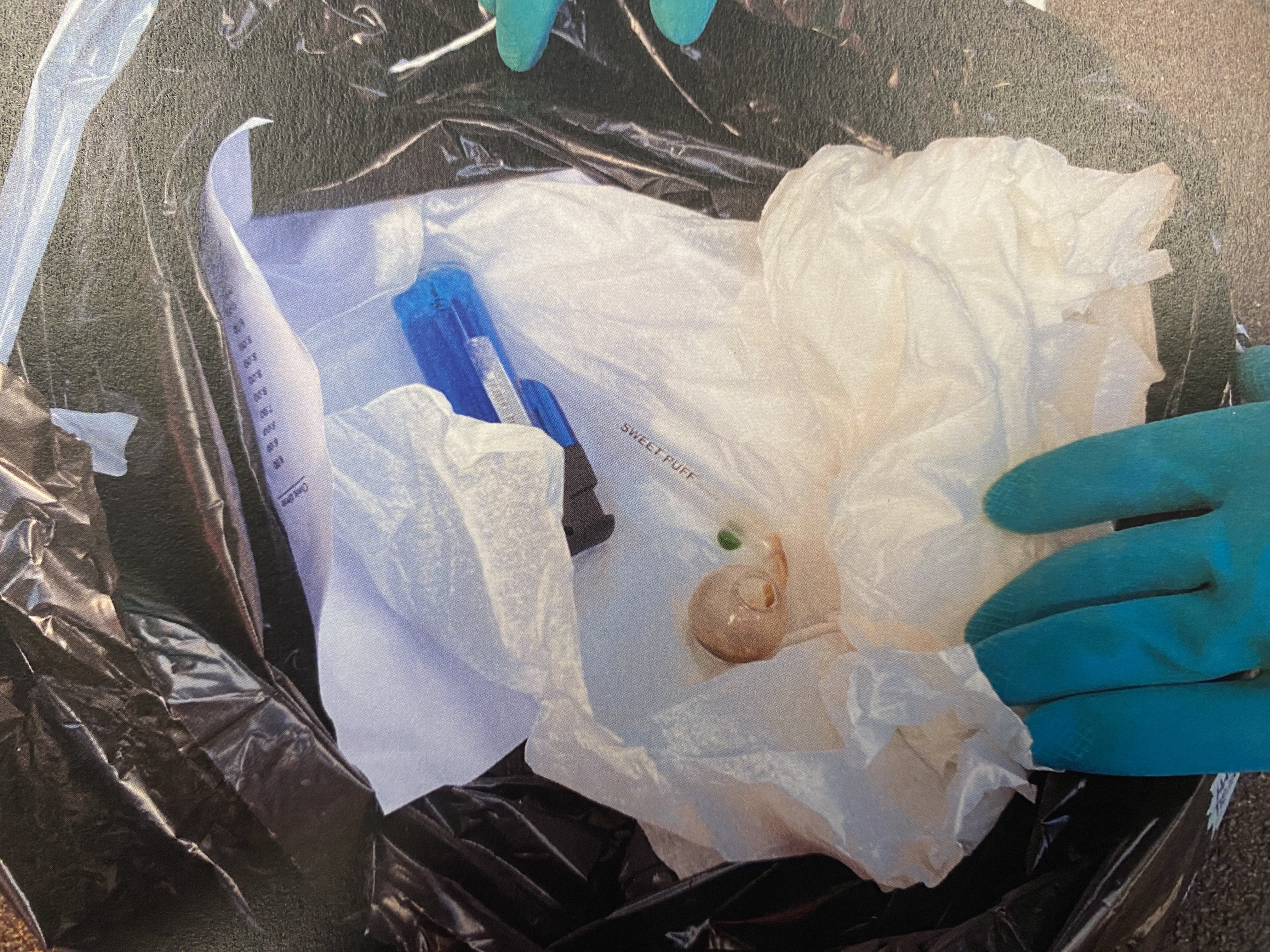
“Return it to the person it belongs to,” Malloy recalled police advising her, to which she responded that she didn’t know who the drug paraphernalia belonged to. They responded: “Well, throw it out.”
Malloy did toss the pipe, with the words “sweet puff” etched on the side, in the non-recycling bin. It was later retrieved after Auckland Eye hired an employment law firm to conduct an independent investigation. The owner of the pipe was never determined.
CCTV footage showed Polkinghorne entering the clinic with a man and a woman on the Saturday and again on the Sunday before the pipe was found, but others had also entered the clinic over the weekend. The defence suggested it could have been left by a 17-year-old who had been seen in the office the prior Thursday, although witnesses expressed doubt it would have remained undetected for so long if that was the case.
During cross-examination of Malloy, defence lawyer Ron Mansfield KC asked her if she was aware that “sweet puff” pipes were readily available for purchase on the internet.
“I’m sorry, I’ve never googled looking for a ‘sweet puff’ pipe,” the operations manager replied, evoking laughter in the courtroom gallery.
Today’s evidence follows recollections from other Auckland Eye colleagues last week about the discovery of the meth pipe and incidents of strange behaviour by Polkinghorne.
Ophthalmologist Susan Ormonde said Polkinghorne admitted meth use to her the day before Hanna’s funeral, even going as far as to recommend Ormonde give it a try. Others described Polkinghorne appearing to have fallen asleep at meetings and one finance committee meeting weeks before Hanna’s death in which his behaviour was recalled to have stood out as especially erratic.
“He was just extremely agitated,” former Auckland Eye chief executive Deborah Boyd told the court today about that same meeting, in which he appeared via Zoom.
She described the surgeon as “often up on his feet” and displaying “quite hyperactive behaviour” that at times seemed “aggressive” to the point that several other directors commented on it.
“It was very odd,” Boyd said.
Polkinghorne’s lawyer suggested his client had been angry about receiving the materials for the meeting so late. He was connecting to the meeting via his home, so it might not be so strange that he was standing from time to time, Mansfield said.
Boyd and other witnesses all agreed Polkinghorne was dedicated to his job and his patients, and that coming in on weekends was not unusual.
“He’s highly regarded in his field - world-renowned, really,” Boyd said.
Auckland Eye eventually hired a company to test the offices for methamphetamine, but it was months after the discovery of the pipe - after Polkinghorne’s alleged admission about using methamphetamine was brought to the board’s attention.
Testing found traces of methamphetamine in an air vent in consulting room 4, among other areas. While consulting rooms are not officially assigned to each doctor, “custom and practice” was for Polkinghorne to use that room most of the time because it was closest to the equipment that he would frequently use, Boyd said.
Evidence is set to resume this afternoon before Justice Lang and the jury.
Craig Kapitan is an Auckland-based journalist covering courts and justice. He joined the Herald in 2021 and has reported on courts since 2002 in three newsrooms in the US and New Zealand.
The Herald will be covering the case in a daily podcast, Accused: The Polkinghorne Trial. You can follow the podcast at iHeartRadio, Apple Podcasts, Spotify, through The Front Page feed, or wherever you get your podcasts.