First round of Northland power pylon collapse case to begin in court
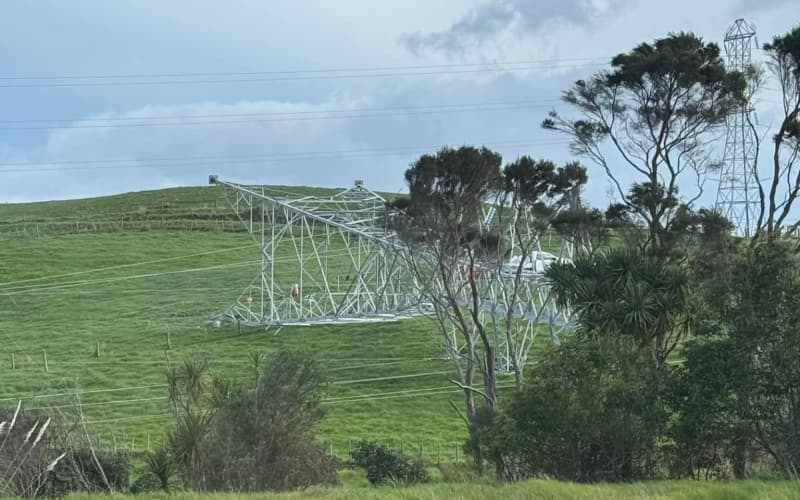
The first round in a class action case relating to a pylon collapse that cut power to Northland is due to start in the High Court in Wellington on Thursday.
An investigation found the pylon toppled over in June 2024 when contractors unbolted three of the tower’s four legs at once.
The resulting outage left 180,000 people and around 20,000 businesses without power, in some cases for several days.
Legal firms Lee Salmon Long and Piper Alderman have launched a class action on behalf of Northland businesses to recoup their losses, on a no win, no fee basis.
The defendants are Transpower, the state-owned national grid operator, and Omexom, the French-owned maintenance contractor.
This week’s hearing will determine whether the case is “opt-in” or “opt-out”.
If it is opt-out, all Northland businesses will automatically be part of the proceedings.
If it is opt-in, businesses will have to actively sign up to take part.
Among those who have affidavits supporting the claim, and the opt-out order, are iwi leaders Dame Naida Glavish and Harry Burkhardt.
Glavish said the pylon fell next to her marae, Puatahi, north of Auckland.

“It was completely avoidable. When infrastructure of this scale fails because of negligence, there must be consequences. We need to lift the standard of accountability nationally, so this never happens again,” she said.
Burkhardt said Northland was home to many Māori-owned and operated businesses without access to significant funding.
Without class action, those businesses would be unable to challenge large companies such as Transpower and Omexom.
Burkhardt said backing the class action was about strengthening standards for the future.
“We talk about deliberate investment in Northland, in our people and our infrastructure. What happened here was the opposite. It reflected complacency and a lack of care,” he said.
The iwi leaders’ affidavit stated an opt-out case would provide greater access to justice, given Northland’s isolation.
It said it would be difficult to make Māori business owners in remote areas aware of the claim and what they needed to do to join it.
The defendants were seeking an opt-in case.
The legal firms pursuing the class action did not say how much money they were seeking.
The losses suffered by Northland businesses were estimated at $60 million by economic consultants Infometrics, and $80m by the Northland Chamber of Commerce.
The class action was being paid for by litigation funding company Omni Bridgeway.
Transpower declined to comment given the case was before the courts.