Israel-Hamas war: At least 90 killed in Israeli strike targeting Hamas military leader
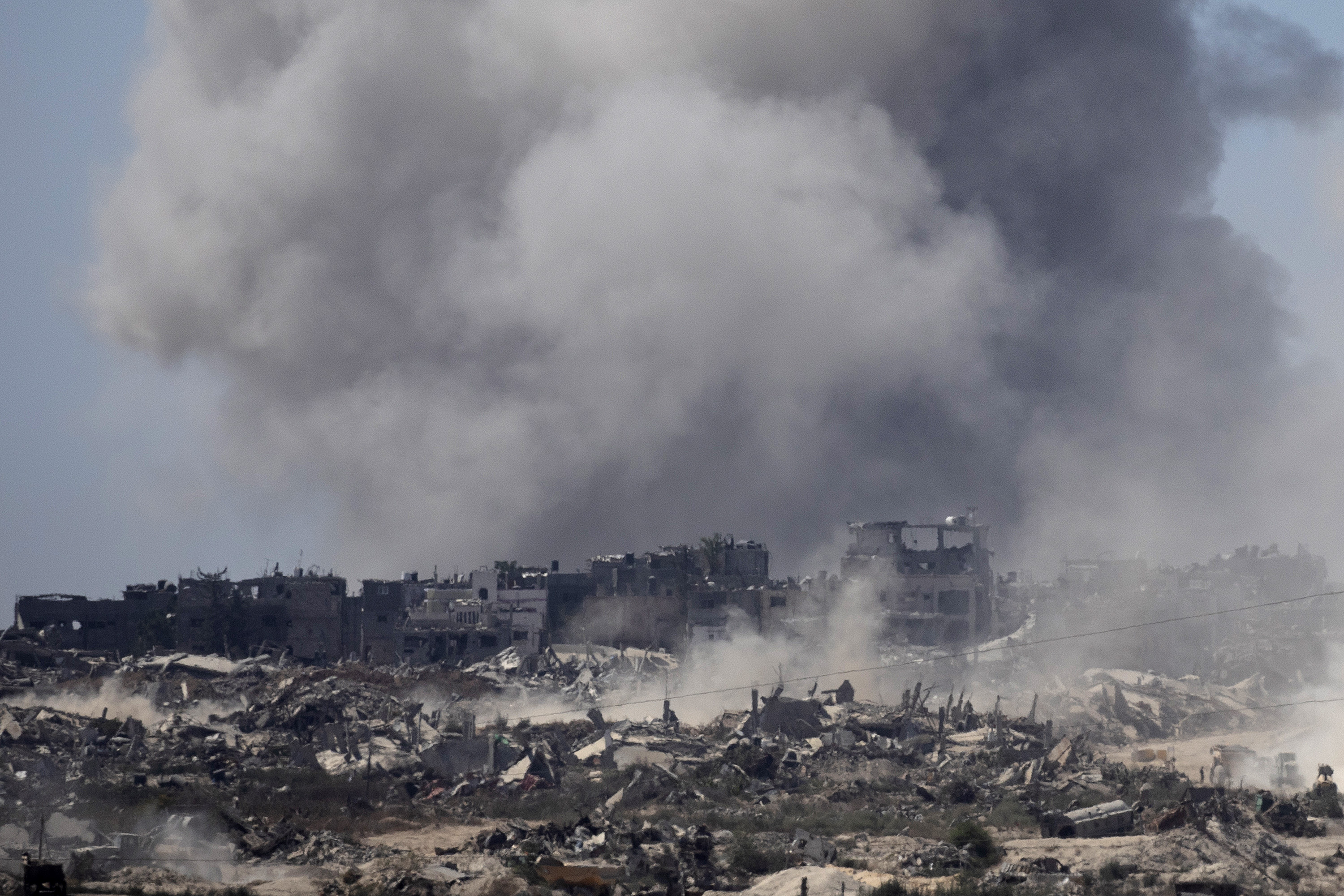
Israel targeted Hamas military leader Mohammed Deif in a series of strikes in southern Gaza on Saturday, an operation that killed at least 90 people and injured 300 more, according to the Gaza Health Ministry.
“There is still no absolute certainty” that Deif was killed, Israeli Prime Minister Benjamin Netanyahu said at a news conference. “But one way or another, we will reach every senior member of Hamas.”
An Israeli military official, speaking on the background in line with protocol, said the Israel Defence Forces had “precise intelligence” that Deif, the head of the Izzedine al-Qassam Brigades, was in a “compound” in the Mawasi area west of Khan Younis.
Netanyahu said intelligence suggested “there were no signs” Israeli hostages were in the area of the strike, which aid agencies and Gaza’s civil defence force said took place within Israel’s designated “humanitarian zone” in Mawasi.
“If Hamas senior leaders think they’ll build a compound and hide in a compound in an area where we called for them [civilians] to move to, we will hunt them down,” the military official said in a briefing with reporters. The strike also targeted Rafa Salama, a Hamas commander in Khan Younis, the military said.
“Killing any Hamas commander brings us closer to achieving our objectives” in Gaza, including freeing the hostages and eliminating “any future threat”, Netanyahu said.
The Gaza Health Ministry said on Saturday that at least 90 people were killed and 300 injured in the bombardment, with hospitals, clinics and emergency personnel struggling to treat the wounded. Hundreds of thousands of displaced people are staying in Mawasi – many of them in tents – after Israel issued evacuation orders for parts of Rafah, Gaza’s southernmost city, in May, and told civilians to seek shelter there.
“Paramedics are still trying to rescue people from under the sand,” Raed al-Nems, a spokesman for the Palestine Red Crescent Society, said. The first of several reported strikes began around 10.30am local time, witnesses said.
Hatem al-Attar, 25, is a member of Gaza’s civil defence force. He said he was injured by shrapnel when a missile hit the area around 11am, as he worked with colleagues to try to evacuate people from the site of the initial strike.
“We saw people’s legs, hands and other body parts flying in the air because of the force of the explosion,” Attar said by phone, adding that the area where the strike landed was “a lively street with thousands of displaced people”.
Israeli officials, speaking on condition of anonymity because they were not authorised to discuss the strike, described Deif and Salama as “two of the masterminds” of the October 7 attack. They did not provide details on the roles the commanders played.
In May, the chief prosecutor of the International Criminal Court, Karim Khan, announced that he was applying for an arrest warrant for Deif, along with other Hamas leaders, for war crimes and crimes against humanity. Among the charges Khan is seeking are rape, extermination and taking hostages.
Khan also requested arrest warrants for Israeli Prime Minister Netanyahu and Defence Minister Yoav Gallant, alleging the two leaders have used starvation of civilians as a method of warfare and intentionally directed attacks against civilians in Gaza.
Netanyahu said when Israel’s security service proposed the plan, he wanted to know “the extent of the collateral damage” and “the type of munitions that would be used”. The Israeli military official who briefed reporters on Saturday declined to say what munitions were used in the attack.
Deif, who was designated as a terrorist by the State Department in 2015, has survived multiple assassination attempts, although some of his family members have been killed in the operations.
Israeli forces see the targeting of Hamas leaders as key to eliminating the group, even as experts warn that there’s no single figurehead whose death would serve as a knockout blow to the movement.
Israel has killed several high-ranking Hamas officials since in October. Earlier this year, an Israeli drone strike in Beirut killed Saleh Arouri, deputy Hamas leader and one of the founders of the armed wing, the Izzedine al-Qassam Brigades. In March, an Israeli strike in Gaza’s Nuseirat refugee camp killed deputy military commander Marwan Issa.
In a statement on Saturday, Hamas denied reports that Israel targeted its leadership, saying that “these false allegations are merely to cover up the scale of the horrific massacre” and describing the attack as “a dangerous escalation”.
The Qassam Brigades alluded to the strike on Deif in a statement on Telegram, but did not explicitly confirm the leader’s death.
“There is no voice louder than the voice of Deif... There is no weapon like Deif’s weapon,” the post said. “May God reward you for this entire nation... may God continue his shadow and the fear that he strikes.”