Did Donald Trump cave on his Canada and Mexico tariffs?
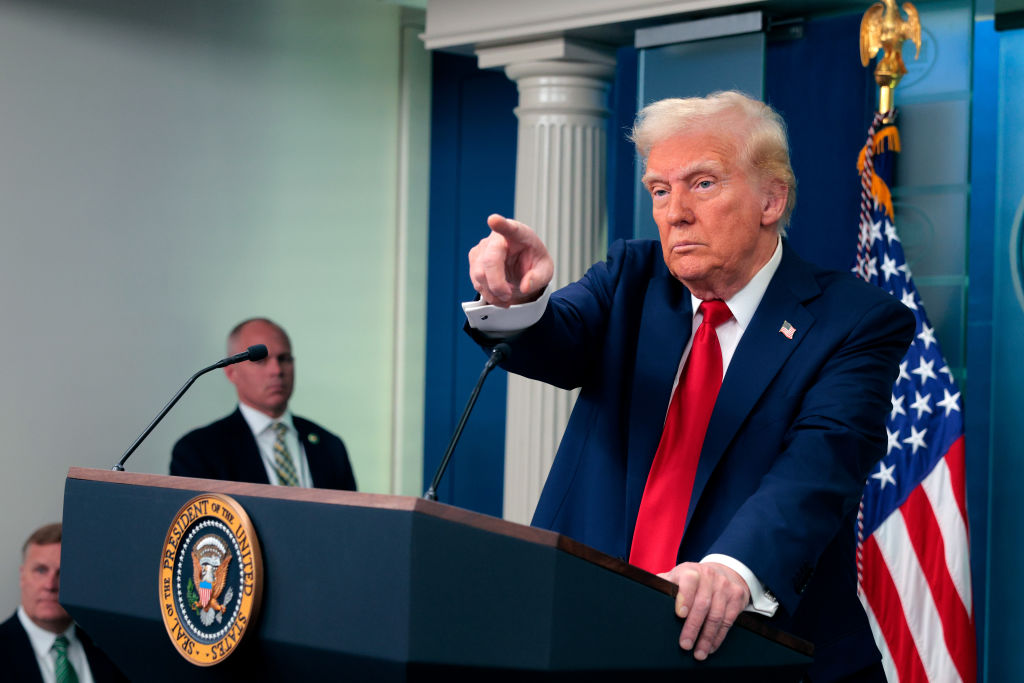
On Friday, President Donald Trump assured that his promise of 25% tariffs on goods from Canada and Mexico was ironclad.
When asked if the countries could do anything to prevent them, Trump said: “No. Nothing. Not right now, no”.
He said it was not a negotiating tool. “We’re not looking for a concession,” he added.
It turns out that wasn’t true. Just three days later, Trump paused the tariffs on both countries for 30 days, citing concessions they had made.
He did so as his tariffs – taxes on imported goods that are generally passed along to consumers – threatened to exacerbate inflation and spooked the stock market. Trump had repeatedly suggested before the deals that Americans should be prepared for some potential economic “pain”.
The immediate question is whether Trump’s pullback has more to do with that looming economic pain than with the concessions.
In other words: Did Trump cave?
It’s not just an academic question. Perceptions of Trump’s handling of his first big foray into potential trade wars in his second term have implications for how other countries deal with future threats. (Trump has put new tariffs on China that Beijing has now retaliated against, and he’s also threatening the European Union.) That includes what ultimately happens with the Canada and Mexico tariffs after the 30-day pause.
Even Trump’s brinkmanship has implications, such as whether other countries may come to believe the United States isn’t a steady and reliable trading partner that can be counted on in the years to come. Trump’s threat has also engendered significant ill will from our northern neighbour, as evidenced by Canadian sports fans booing the US national anthem.
There is also the fact that Trump, dating back to his days in real estate, often seems as or more interested in claiming victory than actually achieving it. The deliverables – to the extent they exist – matter, too.
Let’s dig into the specifics.
The Mexico deal appears to include two major pieces, according to Trump and Mexican President Claudia Sheinbaum:
The big one here is the 10,000 troops. Many sceptics of the deal quickly noted that Mexico previously dispatched large numbers of troops to deal with migrants – 15,000 to the US-Mexico border in 2019, and 10,000 to its own southern border in 2021 to stem the flow from Central American countries.
Neither was the direct result of a tariff threat. And the 2021 move was part of a deal with the Biden administration, which over the past year had made significant headway in getting Mexico to crack down on would-be border crossers without such apparent economic brinkmanship.
In addition, Mexico already had about 15,000 troops on its northern border, according to Mexico’s Defence Ministry.
If the 10,000 troops announced Monday are in addition to those who are already there, that could be significant. But it’s worth emphasising that US-Mexico border crossings surged to record highs even after Mexico mobilised 10,000 troops in 2021.
The particulars of Canada are thus, as relayed by Canadian Prime Minister Justin Trudeau and Trump, who quoted Trudeau’s version of events on social media:
The first thing to note is that the first two aren’t really new. Canada had already announced the $1.3 billion border plan in December. Part of that plan was proposing the joint strike force.
Canada also said in December that it already had 8500 personnel on the border. (Which appears to be why Trudeau said these people “are and will be” on the border – the vast majority are already there.)
It’s clear that both moves were done with potential future tariffs in mind; Trump has been threatening them, and Canada has been fearing them for many months. But these things were clearly already on the table when Trump made his specific threat.
That means the actually new things that came after Trump’s threat, apparently, are the fentanyl czar, labelling cartels terrorists, the $200 million and 24/7 eyes on the border.
Most of these are geared toward fentanyl. But it’s worth emphasising that the flow of fentanyl from Canada is a tiny percentage of the drug that’s seized at US borders – about 0.2%. Border authorities seized about 43 pounds in 2024, compared to more than 21,000 pounds from the Mexico border. And data shows that the vast majority of fentanyl seized from Canada – about 80% – was brought by US citizens.
That’s not to say halting however much of the deadly drug that can be halted wouldn’t be significant. US authorities have been concerned in recent years about fentanyl “super labs” in Canada. But Canada already appears to have made significant headway in cracking down, including dismantling what Canadian authorities say was the nation’s largest drug lab a few months ago.
And it’s a far cry from how Trump has sold the import of halting fentanyl from Canada, which often includes false statistics.
In other words, Trump has tried to set this up to look like a much bigger win than it really was – which, as ever, appears to be one of his overriding priorities.