Why Christchurch killer Nathan Boulter avoided facing victim’s family at sentencing
When recidivist violent offender Nathan Boulter was jailed for life for murdering his ex-girlfriend Chantal McDonald in front of her children at their Christchurch home, he refused to appear in court in person.
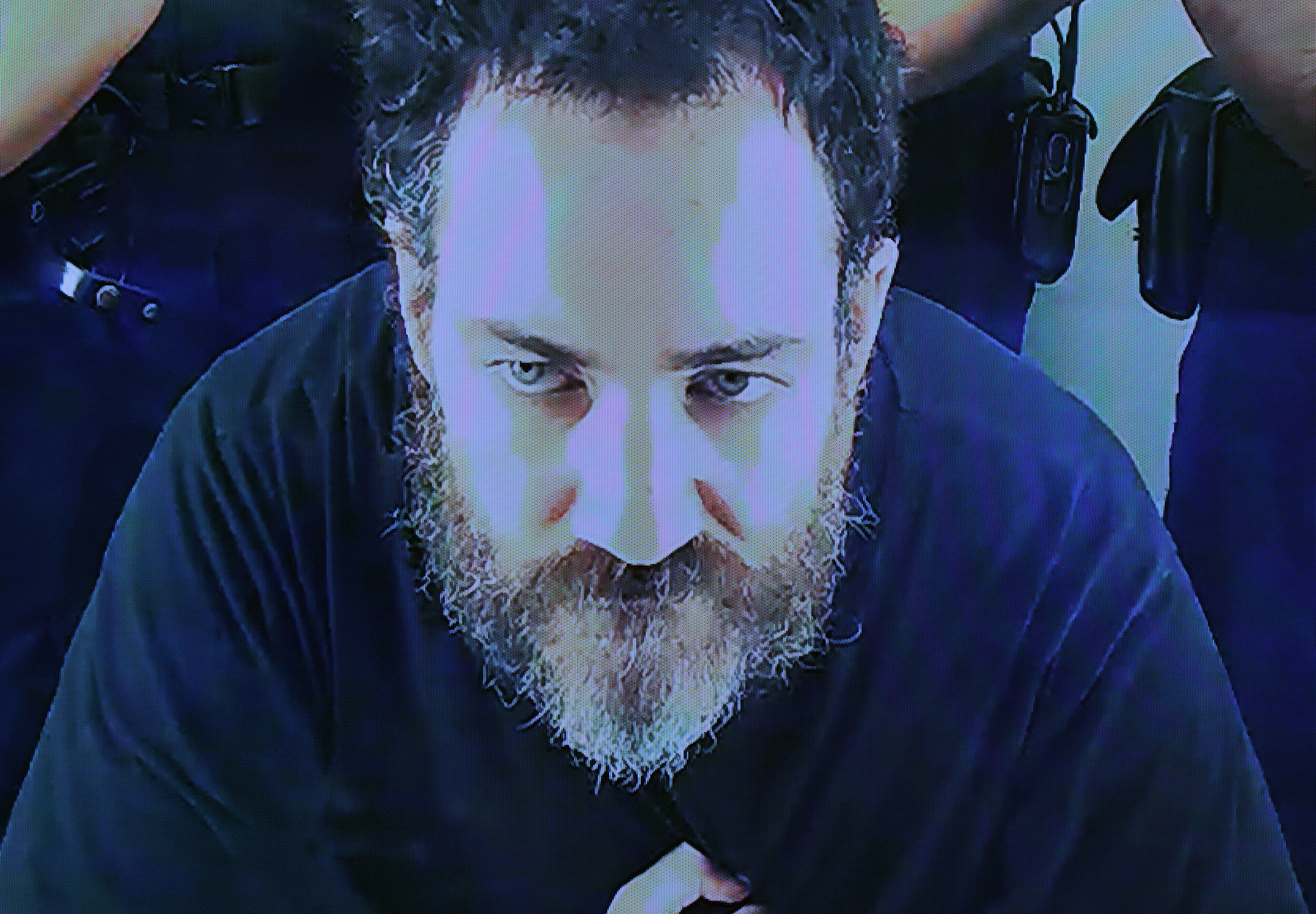
Instead of standing in front of his victim’s family – including her teenage daughter who spoke for the first time about witnessing the murder – Boulter appeared by audio-visual link from another room in the court precinct.
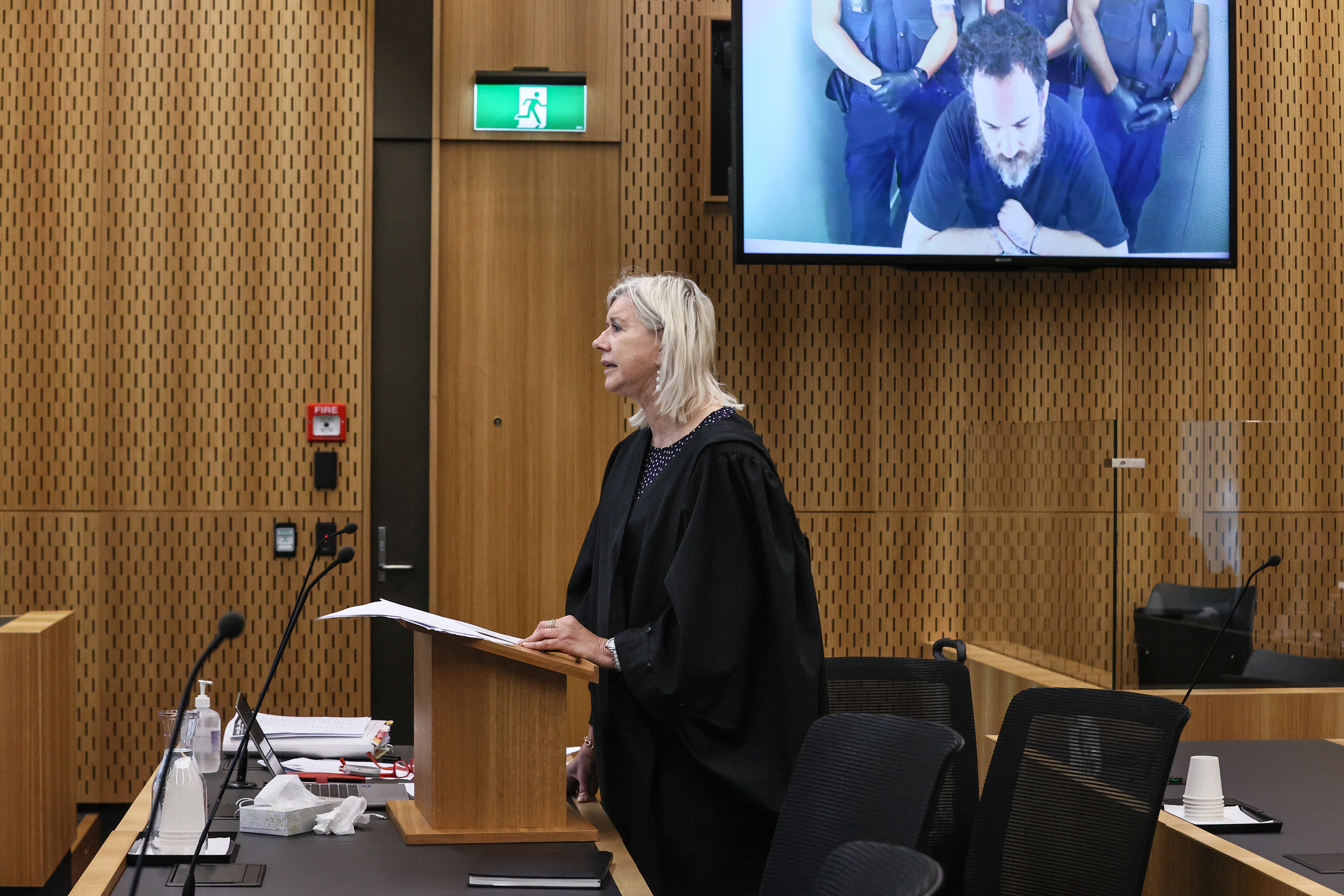
The Herald has been reporting on Boulter’s horrifying offending since 2011 – after his high-profile stalking, kidnapping and assault of his ex-girlfriend on Great Barrier Island.
Since then, he has been jailed repeatedly for violent offending against women.
Boulter, 36, stabbed McDonald, 37, to death in her Parklands driveway in July last year as she arrived home from the supermarket with her teenage daughter and 7-year-old son.
He had been released from prison just 13 days earlier.
Boulter pleaded guilty to murder in November and was sentenced in February by Justice Owen Paulsen.
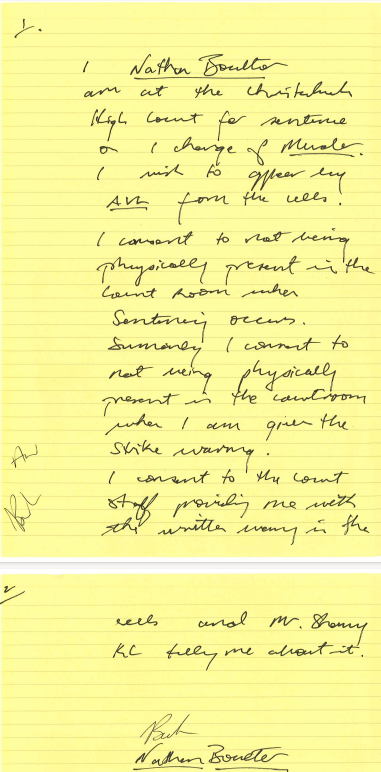
He allowed Boulter to appear by video link after receiving a handwritten waiver from the killer.
The Herald has been provided with a copy of that waiver.
“I consent to not being physically present in the courtroom when sentencing occurs,” his handwritten waiver states.
“Summarily, I consent to not being present in the courtroom when I am given the strike warning.”
Other serious offenders have been permitted to appear by video link or removed from courtrooms for bad behaviour.
But Boulter may be the only convicted murderer allowed to attend his sentencing this way.
Under New Zealand’s Criminal Procedure Act 2011, offenders are generally required to be present in court when they are sentenced, particularly for more serious offences.
However, the law also allows judges to permit offenders to appear by audio-visual link instead of attending in person – from either the prison where they are being held or another room in the court building.
“It’s unusual for someone to simply refuse to attend their own sentencing,” said University of Canterbury adjunct senior research fellow and barrister Dr Thomas Harré.
“Courts deal fairly often with defendants who have to be removed for disruptive behaviour, but an offender choosing not to be there in person is a different thing, and much less common – although certainly not unheard of.”

Harré said three specific criteria had to be met before a judge could allow someone to appear remotely.
The offender had to be in prison, the technology had to be available, and the sentencing judge had to be satisfied that “doing it this way isn’t contrary to the interests of justice”.
“The key thing the judge is protecting is actually the offender’s own rights,” Harré explained.
“Everyone has the right to be present at their trial and sentencing under the Bill of Rights Act. So the concern isn’t usually that the offender is getting away with something – it’s making sure they aren’t disadvantaged by not being in the room.”
Harré explained how such a sentencing might work.
“It helps to picture how a court like we have in Christchurch is actually laid out. There are custody cells separate from the courtrooms, and a prisoner brought over from prison is held there before and after their appearance – so they’re physically present within the court building the whole time,” he said.
“In many cases a defendant would appear in the courtroom by video link from those custody cells. So, when we talk about someone refusing to come ‘into court’, that person hasn’t necessarily stayed away, but rather they are downstairs, taking part remotely rather than sitting in the dock upstairs.
“So that broader understanding of being present is how these kinds of cases have been dealt with previously – the defendant has signed a waiver saying that they choose not to come into the courtroom, and consent to the hearing proceeding without them. The Judge then weighs up the merits of having the defendant brought into court by force, as against having them remain in the court precinct until the sentence can be passed.”

Harré said there was a strong public interest in people facing the consequences of their actions in open court.
“But the right to be present exists to protect the defendant, so there’s a reasonable argument that a person can choose not to exercise it if they wish,” he countered.
“It’s worth remembering the presence requirement isn’t only about the defendant. It also gives effect to victims’ participation – for instance, making sure the offender is actually there to hear a victim impact statement read aloud. So when someone refuses to attend, there’s a real question about the victims’ interest in being heard, not just the offender’s own rights.
“In practice, though, the flexibility usually serves justice rather than undermines it. I’ve acted for people who wanted to appear by video simply to avoid a long trip in a prison van to a distant court, and others who insisted on being physically present against Corrections’ wishes.”
In 2025, the man who murdered Christchurch real estate agent Yanfei Bao was kicked out of his own sentencing hearing after constantly interrupting proceedings with angry outbursts and refusing to listen to the judge.

Chinese national Tingjun Cao was moved to another courtroom to watch proceedings on a screen after he repeatedly shouted, yelled, and waved his fist, interrupting the judge and directing comments at the public gallery.
In February 2024, Damon Exley refused to attend his sentencing for rape, abduction for sexual connection and assault with a weapon after he threatened and raped a woman who picked him up while he was hitchhiking after escaping from Rimutaka Prison.
In his initial waiver, Exley wrote: “I strongly maintain my innocence regarding the convictions … As such, I would like to advise you of my refusal to be present during sentencing for these matters. I am requesting that the Court complete the final sentencing in my absence.”
Exley said if the court insisted he attend sentencing in person he would “participate in a dirty protest, using my own faeces”.
“I would prefer not to do this, but I will not participate in sentencing for offences I have not committed. If I am forced to attend court in person, I will commence my dirty protest in the court cells. If I am forced to attend court by AVL, I will commence my dirty protest in my cell or the AVL booth at prison.”
He eventually said the “dirty protest” would not go ahead, but he would “remain silent” during the hearing.
He sat with his back to the camera, the words “not guilty fk u” scrawled on the back of his shirt.
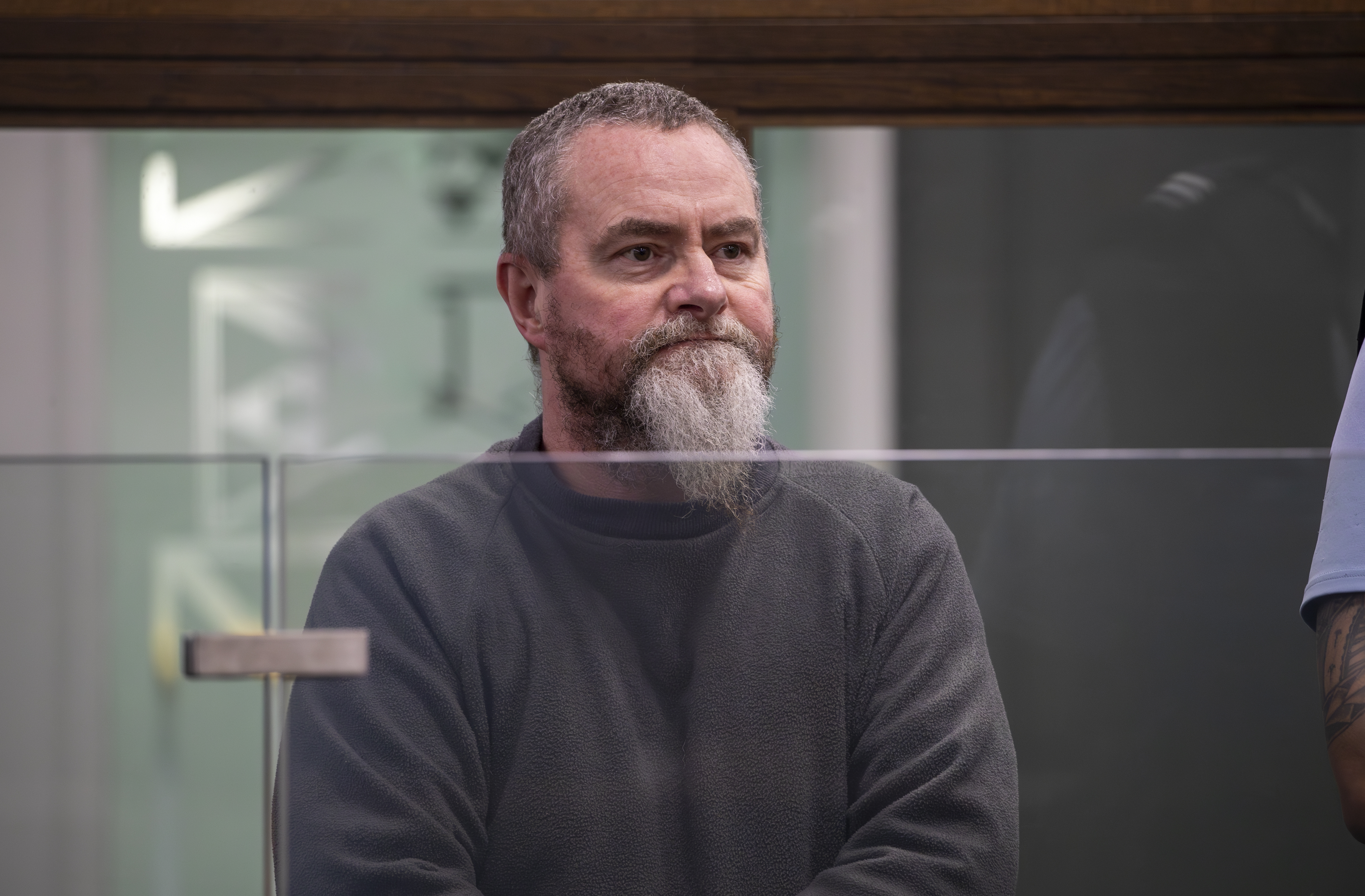
In July 2020, Neville Edgerton was sentenced in the High Court at Auckland after admitting charges of sexual connection with a young person, supplying methamphetamine to that young person and receiving stolen property.
At 9am on the day of the hearing, he told the court “he was not prepared to leave his cell” and signed a waiver.
“I consent to the sentencing going ahead in my absence … I have told my lawyer that I am going to stay in the cells and that the Judge can sentence me in my absence.”
Justice Ailsa Duffy was “initially concerned” about proceeding with sentencing without Edgerton in court.
“I am satisfied, however, that Mr Edgerton is not absent. He is present in the Court precincts and, if necessary, I could have him brought to the courtroom by force,” she said.
“I am, however, not prepared to do that today and instead will accede to Mr Edgerton’s wishes and sentence him in his absence from the courtroom today.”
In 2018, recidivist Samuel Utatao was found guilty of “numerous” charges relating to sexual and violent attacks on two people.
On the morning of his sentencing, he travelled from prison to the High Court at Auckland and then told his lawyer he would not leave his cell.
“I do not wish to attend my sentencing hearing. I consent to sentencing going ahead in my absence,” he said in a waiver.
“I am going to stay in the cells, and the judge can read it out in my absence. My lawyer … can relay it to me.”
Justice Graham Lang ruled that Utatao was “present in the Court precincts” and sentencing could go ahead.
Anna Leask is a senior journalist who covers Christchurch issues and national crime and justice. She joined the Herald in 2008 and has worked as a journalist for more than 20 years with a particular focus on family and gender-based violence, child abuse, sexual violence and homicides. She writes, hosts and produces the award-winning podcast A Moment In Crime, released monthly on nzherald.co.nz.