Transport Minister Simeon Brown unveils $32.9b National Land Transport Programme
NZ Transport Agency Waka Kotahi (NZTA) has put road maintenance and building new roads and public transport infrastructure at the centre of its $32.9 billion National Land Transport Plan for 2024-2027.
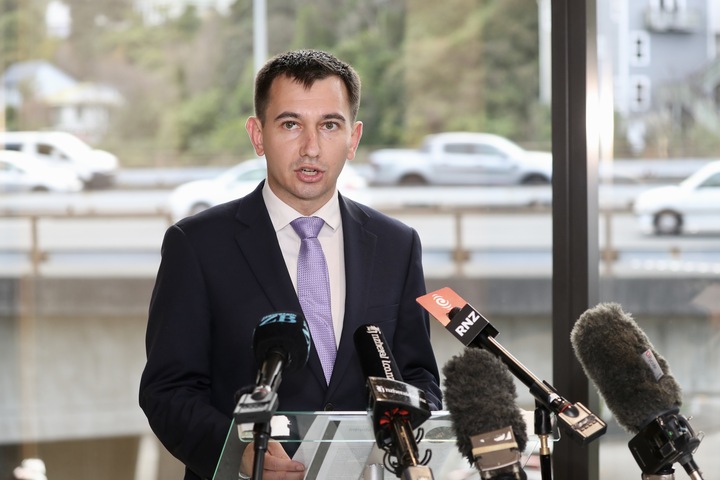
Transport Minister Simeon Brown made the announcement at a press conference this afternoon. He says the Government’s transport priorities include safety, value for money, economic growth and productivity.
Pothole prevention gets $5.5b over the three years, while maintenance and operations of state highways and local roads (which are jointly funded by councils) gets $4.6b.
NZTA will spend $7b on state highway improvements – that means building new roads for the state highway network and $6.4b on building new public transport infrastructure and paying subsidies to local councils to operate the network.
STORY CONTINUES AFTER LIVE BLOG
Brown attacks cycleways
Scott Palmer
Brown said there needed to be less money going into cycleways – and New Zealanders were "sick and tired" in seeing how much money was going into cycleways in recent years.
He told reporters "speed bumps have been infesting our streets" while potholes were not being filled.
He said this plan was about "rebalancing" the funding for roads versus that for things like walking and cycling.
Asked if he would be seeking political consensus on some of these roading initiatives, he said: "Absolutely."
He said a lot of the projects or initiatives were things he thought the opposition agreed with.
Auckland the big winner
Scott Palmer
Auckland is a big winner, getting about a quarter of the funding at $8.4b, and more than half the public transport spend with $3.7b set aside for the super city.
The plan promises four new roads of national significance in Auckland.
NZTA said the roads had been broken into “waves”.
Work will begin on three in this plan, although the roads will only be completed in future plans.
Work on SH16 north-west alternative will mainly fall in a future NLTP.
State highway 1 from Warkworth to Wellsford will have property purchased for the new road as well as design and consenting to start construction completed in the next three years, however the actual construction will begin in a later plan.
Improvements along the Mill road corridor will be progressed in the next three years, however the road will only be substantially begun later.
The East-West Link will have “project development and property purchase” underway in the current plan.
'Biggest investment yet'
Scott Palmer
Nicole Rosie, Waka Kotahi chief executive, said this was "our biggest investment yet, in dollar terms."
Rosie said the roads of regional and national significance would improve safety and build greater resilience into the roading network while helping move goods faster.
"We only have a limited pot of funding available," she said, adding there would always be more bids than the funding available.
"We have a big programme of work ahead of us."
Transport winners and losers
Scott Palmer
Pothole prevention gets $5.5b over the three years, while maintenance and operations of state highways and local roads (which are jointly funded by councils) gets $4.6b.
The NZTA will spend a $7b on state highway improvements - that means building new roads for the state highway network and $6.4b on building new public transport infrastructure and paying subsidies to local councils to operate the network.
Public transport has not been entirely neglected. Public transport services and infrastructure investment increased from $4.9b in the last plan to $6.4b.
Not all types of transport win. The walking and cycling budget has been more than halved in nominal terms from $1b in the last plan to $460m in this plan - a large cut when factoring in inflation.
Rail has also been cut from $1.3b in the last plan to $1b in this one.
The big winner appears to be funding for constructing new roads. In the last plan, $6.6b was set aside for new local roads and state highways. This has been increased to $8.3b in the current plan.
What's in the transport plan?
Scott Palmer
Transport Minister Simeon Brown says the Government's transport priorities included safety, value for money, economic growth and productivity.
Brown says "the Roads of National Significance are back" and being prioritised in this new plan.
Public transport was getting a boost, Brown said.
Transport plan unveiling
Scott Palmer
Transport Minister Simeon Brown is set to unveil the Government’s national transport plan for the next three years.
The 2024-2027 National Land Transport Programme sets out how Waka Kotahi will spend funding to improve or maintain the country’s transport network.
The programme will mirror the Government’s land transport policy statement, released earlier this year.
STORY CONTINUES
The 2024-2027 National Land Transport Programme sets out how NZTA will spend its funding to improve or maintain the country’s transport network.
The programme reflects the Government’s land transport policy statement, released earlier this year.
Money for these investments comes from the National Land Transport Fund – a pool of transport funding drawn mainly from fuel taxes and Road User Charges (RUCs).
The Government’s policy statement, released in June, includes the Government’s priorities for investment, including a pledge to crackdown on drunk and drugged drivers with a target to perform 3.3 million roadside alcohol tests, and 50,000 roadside drug tests, per year.
Legislation to enable roadside drug testing is currently before a Parliamentary select committee.
The Government has also reintroduced the Roads of National Significance programme, which was started under the previous National Government in 2009.
A Roads of Regional Significance programme was also released earlier this year. Similar to Roads of National Significance, this scheme focuses on roads important to the regions.
The Government’s draft policy statement confirmed 17 roads of national significance, and 11 of regional significance were on the slate.
Brown has also implied fuel taxes could be gone sooner than we think. The Herald reported last week the 75 cents in tax per litre of fuel could end “as soon as” 2027 for all light vehicles.
However drivers should not expect a tax cut, as fuel taxes are set to be replaced with RUCs, meaning most drivers would still be paying tax at near the same rate – which is currently expected to increase 12c a litre in 2027.
Speed limits have also been a focus of the coalition Government. Reversing the previous Labour Government’s speed limit reductions were part of National’s coalition agreement with Act and part of the Government’s 100-day plan.
National accused Labour of ignoring the economic impacts of lowering speeds, saying its approach to speed limit reductions did not make sense.
Meanwhile, on Sunday, Brown announced a proposal to raise the speed limit along a 25km stretch of highway between Ōrewa and Warkworth to 110km/h.
Brown told a press conference in Warkworth the increased limit would help “unlock economic growth and productivity by moving people and freight quickly and safely between regions”.