Minister Shane Jones threatens to stop funding for Waitangi National Trust after pōwhiri ‘circus’
New Zealand First minister Shane Jones says future Government funding for the Waitangi National Trust should not be given unless they “buck their ideas up” after what he described as a “circus” pōwhiri for Parliament.
Speaking to the Herald after the pōwhiri, Jones said he would be taking it to his party’s caucus before discussing it with Prime Minister Christopher Luxon and Act’s David Seymour to avoid a repeat next year.
National minister Paul Goldsmith said he did not support the idea of restricting funding based on such a premise, while Green Party co-leader Marama Davidson described it as an “abuse of power” but did not call for Jones’ sacking.
Trust board chairman Pita Tipene said Jones’ comments were “very unfortunate” and he would seek discussions with the minister about his view.
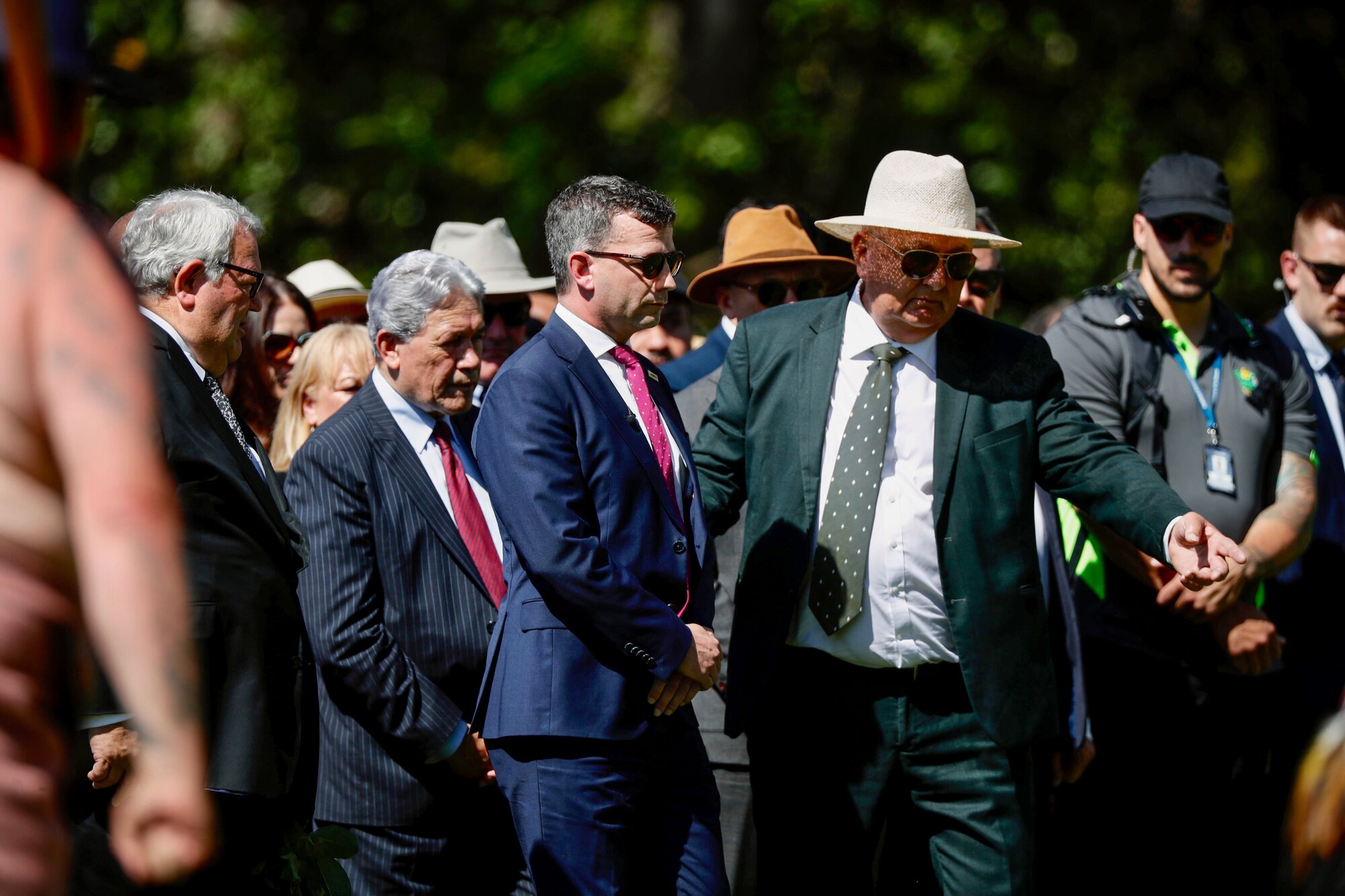
Jones, the Minister for Regional Development and a known advocate for Northland, made the comments to journalists after he and other Parliamentarians were welcomed on to the Treaty Grounds at Waitangi — the group included Act leader David Seymour, who had his microphone taken from him twice by Ngātiwai leader Aperahama Edwards during his speech.
Nazahryth Bernard
More photos of the Royal New Zealand Navy at the retreat ceremony held on the Waitangi Treaty Grounds. Photos by the Herald's Dean Purcell:
Nazahryth Bernard
Royal New Zealand Navy at the retreat ceremony held on the Waitangi Treaty Grounds. Photos by the Herald's Dean Purcell:
Nazahryth Bernard
Rawiri Waititi's reaction to David Seymour's microphone being taken away:
James Wheeler
More photos from Waitangi from the Herald's Dean Purcell:
James Wheeler
Speaking of photos, here are some from Herald photographer Dean Purcell:
James Wheeler
James Wheeler
Chris Hipkins' reaction to Shane Jones' comments:
David Seymour on his mic being taken away
James Wheeler
More from David Seymour: "You know, you can try and suppress ideas, but actually, people have an ability to decide what they think for themselves...I think it's important that the message gets out, regardless of people trying to interfere with your ability."
When asked if he understood that some people felt like the free speech that he thinks he's expressing is threatening and inflammatory to them, Seymour responded he didn't understand how they think it's threatening to them.
"Actually, ideas don't hurt.
"It's trying to intimidate people, take away their ability to speak, threaten them with war dancers. Some people might say that that was threatening, but I go along with it because that's tikanga.
"I think once people say you can't have an opinion because I feel upset, what you're really doing is bringing death to a democratic and free society."
Seymour speaks after Treaty Grounds speech
James Wheeler
Speaking to media after his speech on the Treaty Grounds today, Act's David Seymour said you can take away his microphone, but you can't take away his idea.
"And ultimately, this country will have something very much like the Treaty Principles Bill, because the idea of equal rights is what the Treaty promised, and it's also what allows all people to flourish.
"And so I'm very proud to be here today. Some people can turn their back, but they can't turn their back on the very real challenges that we face, giving every kid in this country equal rights and equal opportunity."
"I'm going to be spending Waitangi Day tomorrow, opening a charter school that teaches in Te Reo Maori, actually the second this week, that has opened.
"And if you look across the Government's agenda, we are doing more to solve some of the challenges for all young New Zealanders, including young Maori, than perhaps some of the people who could only turn their back or take away microphones today."
Seymour said he couldn't help but notice in a speech by Chris Hipkins, which mentioned the idea that coming together doesn't mean being the same.
"In fact, we should be together and celebrate all the faces of Aotearoa," Seymour said.
"Well, that sounds awfully like a speech I could give and a reason for Labour to support my Bill and its values."
Threat to stop funding after pōwhiri 'circus'
James Wheeler
New Zealand First minister Shane Jones says future government funding for the Waitangi National Trust shouldn’t be given unless they “buck their ideas up” after what he described as a “circus” pōwhiri for Parliament.
You can read more below:
'When he didn't listen, I took the microphone'
James Wheeler
From our reporter on the ground at Waitangi, David Fisher:
For Aperahama Edwards, Act leader David Seymour had plenty of chances to sit down and stay silent.
The Ngāti Wai leader spoke of Seymour being apparently oblivious – and so he rose and crossed the marae ātea and symbolically took his voice away by removing the microphone.
It was another Ngāpuhi leader, Waihoroi Shortland, who gave it back.
The message delivered was fierce and heartfelt for Edwards. Equally, Shortland's return of the microphone was, he says, in keeping with marae proceedings, injecting a little levity into an event rife with emotion.
Edwards had spoken as part of the welcome, saying how difficult it was to offer welcome to those who threatened so much.
Edwards: “He was told not to speak. He was asked by his hapū not to attend. His presence caused a lot of angst and discomfort.”
Seymour, he said, continued to deny Māori tino rangatiratanga through his words at Waita today.
“On marae, speakers can be made to sit down in different ways.”
One means immediately directed at Seymour was the turning of backs as he spoke.
“When he didn't listen, I took the microphone.”
Shortland: “I brought it back. Then they went and took it away again. So I brought it back again.
“In some ways, it took the sting out of the day.”
Shortland said planning for the day had involved much strategic thinking on how to greet and respond to those whose policies had placed such pressure on Māori.
“Everything we have wanted to say about the (Treaty Principles) Bill has been said. Everything he has had to say has been said. We're not going to hear anything new, so let's try silence.”
It wasn't entirely managed, Shortland said, but he believed “the message was much stronger than the words we could find”.
Shortland said it was believed Seymour's visit to Waitangi this year was to take political advantage of the backdrop to drive the party's cause.
“I think he missed an opportunity to be inspiring. He could have taken the opportunity to say he understood, to say 'I'll take (the bill) out myself'.”
Shortland met Seymour face to face in the greeting line where the pair shared a hongi. Seymour said to him: “Thank you for being gracious.”
Further along the line, words were also briefly exchanged between Edwards and Seymour. There was no hongi and the Act leader moved on.
James Wheeler
Greens co-leader Marama Davidson said the powhiri today "changed on the fly" and she was prepared to deliver the speech for the Green Party, but that changed.
When asked if she supported the taking away of the microphone from David Seymour, she said: "I support the people sending a clear sign that they do not tolerate the hateful rhetoric."
She added: "I've been out of the game for a little bit, I know my voice has been missing, but it's here now and I have returned to support the incredible, incredible mahi that all of my colleagues have been doing for all of these months.
"And I am here to say kati te korero teka, stop the korero that is hateful, Whakamana Te Tiriti, uphold Te Tiriti as a beautiful relationship-based way of working in Aotearoa.
"It is working and is doing good, and we come here to front up as politicians to the people, to Ngāpuhi to Te Whare Rūnanga, and the Greens will continue to do that because we can see it offers us hope."
James Wheeler
Shane Jones, speaking to media, said there's an "unhelpful virus" that's crept into a lot of our Māori welcome ceremonies.
"They're starting to bark and they're starting to yell in the wero. That is never ever the culture."
On David Seymour's microphone being taken away twice, he said "switching the microphone off in all honesty is not going to switch the voice off."
"I put it to you, there's something seriously awry about the architecture of the whole day.
"And, this is something that I'm taking to our caucus and to identify in what way can we ensure that future pōhiri don't turn into a circus.
"I mean, really, chasing the microphone around, hardly elevates the pōhiri to the way in which, we were brought up to believe in."
Goldsmith: 'I found it disappointing'
James Wheeler
Māori Crown Relations minister Tama Potaka and Paul Goldsmith, Treaty of Waitangi Negotiations minister have spoken to media.
Goldsmith said was happened with David Seymour's microphone being taken away was "disappointing".
"Ultimately we came to, listen, and, have an exchange of views, but ultimately it's up to the host how to organize that. But you know, I found it disappointing."
Goldsmith added: "We have a coalition agreement. We have a bill that's being debated and words to express that. I think it's important we all should be able to express those views and to be heard and listened to and to be challenged."
"What we see on a day like this is there's always a very strong challenge, and there's always, an opportunity to, exchange views.
"So, I found that disappointing, but it's a unique blend coming to Waitangi, of confrontation, and also, an exchange of views, and then, the extraordinary harmony of the singing, and the coming together at the end, in peace.
"We're thinking about our national day tomorrow and the opportunity that we have to celebrate what we have in this country, and also the challenges that we face. And so this week is always that, unique blend of those things."
James Wheeler
Speaking to media on the way out after his speech on the Treaty Grounds, David Seymour said he was feeling "really great" and he was going to gather his caucus before his press stand up around 2pm.
James Wheeler
Act leader David Seymour leaving the Treaty Grounds.
Seymour escorted from Treaty Grounds
James Wheeler
David Seymour has been escorted from the Treaty Grounds.
Members of the public called out to him; “Go home David, you prick”.
One described him as “courageous”.
Seymour could be seen chuckling as he was heckled
James Wheeler
Act leader David Seymour exchanging hongi with other dignitaries. After a hongi with Waihoroi Shortland, Ngati Hine leader, he moved along the line to exchange words with Aperahama Edwards of Ngati Wai, moving on without sharing hongi.
Seymour greets Ngāpuhi representatives after mic taken away
James Wheeler
David Seymour is greeting Ngāpuhi representatives.
After a hongi with Waihoroi Shortland, Ngati Hine leader, he moved along the line to exchange words with Aperahama Edwards of Ngati Wai, who twice removed his microphone during his speech, Seymour shook his hand but did not lean in for the customary hongi.
Seymour spoke briefly to Edwards but he did not respond.
James Wheeler
Shane Jones has piped up during Ngāpuhi elder Hōne Sadler’s speech, to which Sadler told him he had waited for Jones to speak so Jones should do the same.
He then joked that it was the home side that was getting sunburnt, the sun beaming down on his face.
Ngāpuhi elder: A sacred document is being meddled with
James Wheeler
Ngāpuhi elder Hōne Sadler says the Treaty of Waitangi was a sacred document that is being meddled with.
“Why are we concerned with the principles that have already been created?” in reference to the Treaty Principles Bill.
“We must concentrate on things that raise the people up.”
Sadler said Ngāpuhi did not cede its sovereignty.
He said there were three heads of the monster that were guiding and leader the country.
“Where are they?”
Sadler has thanked Māori Crown Relations Minister Tama Potaka for his acknowledgments.
He said it hadn’t been a year of this Government and promises had been broken.
“We are the ones who have been injured severely, our children and our grandchildren.”
Ngāpuhi elder's tribute to Dame Tariana Turia, message to Govt
James Wheeler
Renowned Ngāpuhi elder Hōne Sadler is the next speaker.
Sadler says “to the Beehive, I say to you, greetings, I acknowledge your courage in coming forward.”
“To you all, in your different political divisions, welcome.”
He told them to come forward with the intention of working together in fairness.
“Come forth,” he said.
Sadler is paying tribute to the late Tariana Turia, the “stallion” who fought in the lion’s den of Parliament.
James Wheeler
The protesters are leaving.
Winston Peters: 'We have seen developments lately of concern'
James Wheeler
Winston Peters is now speaking.
The protesters are keeping their backs turned as Peters speaks.
He referenced how he has been coming to Waitangi for seven decades, saying there was a “tikanga of respect” and people being heard out.
“We have seen developments lately of concern.”
There are around 40 protesters with their backs turned to the speaker.
Recalling his speech to Rātana, Peters encouraged people not to start at shadows - his way of criticising the angst about the Treaty Principles Bill.
He ended his speech by predicting those protesting his Party and Government, those who had turned their backs, would soon want to talk to NZ First “far more than we want to talk to you”.
One protester responded: “Go home, Winny. It’s whiskey o’clock.”
Luxon speaks in Christchurch
Todd Murray
Prime Minister Christopher Luxon, speaking in Christchurch, said he didn't regret not being at Waitangi.
He repeated previous comments about how he has always wanted to spend the national day with other iwi around the country. He will be in Ōnuku Marae near Akaroa tomorrow, somewhere he said was special to him as he has spent a lot of time with his family there. It's also where the Treaty was signed by Ngāi Tahu.
He wasn't opposed to going to Waitangi next year, but will be keeping his options open.
Protesters face Shane Jones as he addresses the crowd
Todd Murray
Shane Jones started his speech with a reference to Māori leader Dame Whina Cooper.
He also spoke of Sir Āpirana Ngata, describing him as an “extraordinary person of the Māori world".
The Toitu supporters are facing Jones as he speaks, indicating they do not oppose his kōrero. Jones is Tangata whenua in the north.
Sharing an anecdote, Jones says there is an island in the bay where tūpuna had a dream that he was being dismembered by a enormous koura or lobster.
He said the “claws of the crayfish” could be applied today.
“There will be no support by my leader, myself or my party for the Treaty Principles ever to become law,” he said.
Toitu supporters have now turned their backs on Jones as he warns of Māori “dismembering” the Treaty in response to legislation like the Treaty Principles Bill.
“Sit down,” one protester called to Jones.
Jones said this was a “new dawn and a new time”.
'I will be here every year I am in politics'
Todd Murray
"That leadership needs to come from the top, and that’s why I am here and why I will be here every year I am in politics,” Hipkins said, an obvious nod to PM Christopher Luxon not attending.
Hipkins said every day he saw people trying to make a difference, one step at a time.
“When we come to Waitangi, I come with a spirit to celebrate all that brings us together.”
Act Party posts Seymour's full speech
Todd Murray
Todd Murray
Hipkins - leaders don't 'exploit division and fear'
Todd Murray
Hipkins believed responsible political leaders didn’t “exploit division and fear … that uncertainty creates”.
“Coming together doesn’t mean being the same ... but it means finding common ground on which we can move forward together,” he said, noting that was the spirit of the Treaty.
Chris Hipkins begins his speech - 'our ears are open'
Todd Murray
Labour leader Chris Hipkins is now speaking, a brief start in te reo.
He paid respect to his time on the waka yesterday, joking that it had taken quite a physical toll.
Hipkins didn’t have notes, explaining he hadn’t quite settled on what he would say.
“They are very real and very open,” Hipkins said of the ears of the Labour Party.
Todd Murray
Todd Murray
Todd Murray
Note: Turning your back on a speaker can have different interpretations.
One is they want the speaker to stop - or your time is up. At times, Māori will sing a waiata to close a speaker off.
Greens MP now speaking - hits out at Seymour
Todd Murray
Speaking now is Green MP Teanau Tuiono.
Tuiono began his speech by saying he would “need a shovel to get any lower”, in reference to Seymour’s speech.
Tuionoalso paid tribute to Māori leaders who had passed recently.
Tuiono acknowledged the local hapū and for opening “their beautiful house” to the manuhiri.
“The hangi was wonderful,” Tuiono said.
There was a place for everyone in kotahitanga, Tuiono said. There was also a place for protesters “who had a part to play” as did Parliamentarians.
All iwi and hapū have their own identities and objectives - and it was important to work together to reach unity, he said.
Tuiono wrapped up his speech by saying Ngāpuhi did not cede sovereignty to anybody else.
Todd Murray
The protester side is singing.
The manuhiri side is continuing on with their waiata nonetheless.
The protest group are slowly moving off the pae now.
Todd Murray
Aperahama Edwards has taken away the microphone again.
Waihoroi Shortland has again returned the microphone.
Oh, the drama!
Todd Murray
Ngāti Hine leader Waihoroi Shortland has brought a microphone back, so now Seymour can be heard.
Seymour continued with his speech without his microphone.
Todd Murray
The protesters are now lined up along the pae - and the hau kainga side (from the second row back) have stood up and also turned their backs to Seymour.
Seymour's microphone taken away
Todd Murray
Seymour is arguing many of his policies would bring benefits for all people, including Māori.
Aperahama Edwards, the first speaker, has taken away Seymour’s microphone.
The crowd has cheered.
Todd Murray
Hone Harawira has walked over the protester group.
He has ushered them on to the actual pae.
David Seymour now speaking
Todd Murray
Act Leader David Seymour is speaking now.
The protesters have begun clapping and making various sounds.
One woman has begun a karanga.
Seymour said people had “poured poison in the ears” of the young people about his bill, which the crowd murmured angrily.
Seymour has begun his speech in a way that is likely to aggravate the crowd, noting some of the descriptions of his bill have been “funny” because of how incorrect they are.
Todd Murray
Potaka ended his speech by saying “it must be a Ngāpuhi year".
Todd Murray
The protesters, who have their backs turned to Potaka, are singing so softly, that it’s almost a hum.
It isn’t disrupting Potaka, and is much quieter than the waiata heard last year that interrupted David Seymour and Winston Peters.
Todd Murray
Via a translator, Potaka said “tino Rangatiratanga will not die.”
He said he supported progress, including of iwi settlements.
“Governments, at times there’ll be ups and downs,” Potaka acknowledged, however, he said that there was a commitment to progressing the Ngāpuhi settlement.
Todd Murray
Todd Murray
Todd Murray
Potaka acknowledged the presence of Marama Davidson - who has just returned to politics eight months after stepping aside to battle breast cancer.
The Māori Development Minister said he was “amongst a rock and a hard place”, acknowledging the difficulties expressed by Aperahama Edwards in his speech.
Potaka the first of govt speakers
Todd Murray
The first speaker from the Government/manuhiri side is Minister Tama Potaka.
Potaka had acknowledged tane mahuta in his opening remarks, the “breath of life".
The protesters have turned their backs on Potaka as he is speaking.
They are holding banners reading Toitu Te Tiriti.
Todd Murray
Todd Murray
Todd Murray
Edwards likened the Parliament group as a bird, encouraging them not to simply stay then fly away.
The politicians are now receiving a Ngāpuhi haka.
'Our hearts have been weeping'
Todd Murray
Following a prayer, Ngātiwai’s Aperahama Edwards is beginning proceedings, saying it was a difficult time as “our hearts have been weeping”.
He is greeting the Parliament contingent on behalf of his side, asking them what they will bring today.
Edwards acknowledged those who had passed, including Dame Tariana Turia and Ta Bom Gillies.
He bid farewell to the Māori Health Authority, which had been scrapped by the coalition Government soon after taking over from the previous Labour Government.
“The noble language of this country is being suppressed,” Edwards said.
“Te Tiriti must endure, He Whakaputanga must endure.”
Todd Murray
Todd Murray
David Seymour has now picked up the wero, ushered forward by NZ First’s Shane Jones and accompanied by Speaker Gerry Brownlee.
The atmosphere was intense as Seymour bent down, just a couple of metres away from Ngāpuhi’s warriors.
Todd Murray
Parliament contingent arrives
Todd Murray
The Parliament contingent has arrived on the Treaty Grounds and is now receiving the challenge from Ngāpuhi.
Act leader David Seymour is standing next to NZ First leader Winston Peters and Shane Jones. Speaker of the House Gerry Brownlee has accepted the first wero. National’s Tama Potaka is also leading the Parliament group.
'My main rival John Campbell'
Todd Murray
Comedian Guy Williams interviewed TVNZ broadcaster John Campbell ahead of the hikoi arriving and the pōwhiri for Government guests.
He said he was motivated to attend because of what he considered was the dire state of the news industry, with job cuts and advertising revenue lost to global internet giants.
"I've never done a real story in my life," Williams told Campbell, asking for tips on reporting the event.
"Good luck for the journalism," he called after Campbell as they parted, turning to a camera operator with: "The journalism is heating up - that's my main rival John Campbell."
Toitū Te Tiriti supporters line Treaty Grounds
Todd Murray
Hundreds of members of the Toitū Te Tiriti supporters are lining the Treaty Grounds in anticipation of the Parliament pōwhiri.
Painter capturing 'the wairua'
Todd Murray
Painter Christopher Dews secured a prime position with his back to the Whare Runanga, facing the direction from which the hikoi is expected to arrive.
Dews, 30 of Ōtaki but living in the Bay of Plenty, said he wanted to capture events of the day in oil, reflecting his role as a painter and the family tradition it represented.
“There’s something about the atmosphere that draws the oils in plain air to capture the wairua.”
It was Dews' second time at Waitangi - his first last year was somewhat overwhelming but allowed for better planning this year, he said.
'Challenge and wero' - Tama Potaka
Todd Murray
National’s Tama Potaka arrived at Waitangi saying he expected to be “challenged” on the Government’s handling of Māori issues.
The Minister for Māori Development is attending the event while Prime Minister Christopher Luxon is at Ōnuku Marae near Akaroa, in Canterbury.
“I'm certainly expecting a challenge and wero,” Potaka said.
“People have concerns, and actually, we've got a lot of challenges in the country, and that's why we're working really hard on key issues.”
Potaka reaffirmed his party would not support the Treaty Principles Bill.
“We've heard pretty clearly what the views of many Māori are and we've also committed as the National Party that we will not be supporting the Treaty Principles.”
Shane Jones expects 'strong messages' at Waitangi
Todd Murray
NZ First’s Shane Jones arrived at Waitangi saying it was important the celebration moved beyond a “tally of woe and grievance”.
“I think it's really important that Waitangi Day move on beyond being a score sheet or a tally of woe and grievance,” Jones said.
“I think the vast majority of Kiwis, they're hoping that Waitangi Day will.”
Jones also addressed how he expected Act leader David Seymour to be treated at Waitangi in light of the controversial Treaty Principles Bill.
“The Ngapuhi orators, they're an unpredictable lot, but they're all very good at the language and no doubt they’ll lay down some strong messages,” he said.
“This is a piece of legislation that is never going to pass. It reflects some principles that whilst they may be important in broader philosophical debates, they are not a distillation of the Treaty.
“They are an attempt to reframe the debate, and David is entitled to bring that forth.”
Todd Murray
Todd Murray
Support for Māori economic development projects
Todd Murray
A major infrastructure upgrade at the Waitangi Treaty Grounds, supported by $10.2 million from the Regional Infrastructure Fund, is progressing well with some new facilities opening in time for the 185th Waitangi Day commemorations this week, Regional Development Minister Shane Jones and Māori Development Minister Tama Potaka said.
The Ministers also today announced $7.1m funding for Māori economic development projects in Northland and Taranaki.
“The Waitangi Treaty Grounds are a nationally significant site for all New Zealanders and it is important they are maintained at the highest level,” Potaka said.
“The grounds are also the No 1 tourism destination in Northland and each year the number of visitors increases, boosting the local economy. More than 160,000 people visited last year, including about 50,000 on Waitangi Day 2024. The infrastructure improvements will ensure the grounds are fit for purpose year-round.”
Simon Wilson: Snapshots from the new New Zealand for Waitangi week
Vera Alves
”When I left New Zealand in 1966 I was Kiri Te Kanawa and I went overseas and I was known as a New Zealander and I was Māori, which was sort of unique.
“I’ve come back to New Zealand to find that I am a Māori and Māori is being spoken when it was not spoken before I left. I’m thrilled that Māori is spoken on a regular basis.” – Dame Kiri Te Kanawa speaking to RNZ on the occasion of her 80th birthday last year.
Twice the microphone was returned by Ngāti Hine elder Waihoroi Shortland as Seymour’s address incited significant protest from those in the crowd, many of whom had turned their back on Seymour as he spoke.
Speaking after the pōwhiri, Jones said the actions of the Ngāpuhi leaders had given him “severe reservations of the whole architecture of Waitangi Day” and said he would be taking the matter to his party caucus and his coalition partners to ensure future pōwhiri were not a “circus”.
Asked how he would do this, Jones referenced the recent $10 million the Government gave the Waitangi National Trust, which cared for the Treaty Grounds and organised the Waitangi festivities, for infrastructure upgrades.
“Obviously, this is an independent body, but I just gave them $10 million so if you want to take the money, you take the responsibility of looking after your manuhiri [visitors],” he said.
“There’s an expectation that when the manuhiri come to an area like this, they’re not going to come back if they’re mistreated.
“Obviously the money’s already been allocated, but if they don’t buck their ideas up, don’t look to central Government to fund an organisation that’s independent and can’t raise enough revenue to look after itself.
“I‘ve certainly lost my zest in pushing any future grants forward unless they buck their ideas up and look after their manuhiri.”
Jones denied his position amounted to blackmail.
“I blame the current trustees for allowing the issue to become a circus.
“If you want a circus, we need to move it back down to the bottom marae,” Jones said — a reference to how Waitangi celebrations had been conducted at Te Tii Marae before it was moved to the Te Whare Rūnanga in the Upper Treaty Grounds in 2018 after years of tense scenes at the lower marae.
The Herald has requested comment from Prime Minister Christopher Luxon about Jones’ comments.
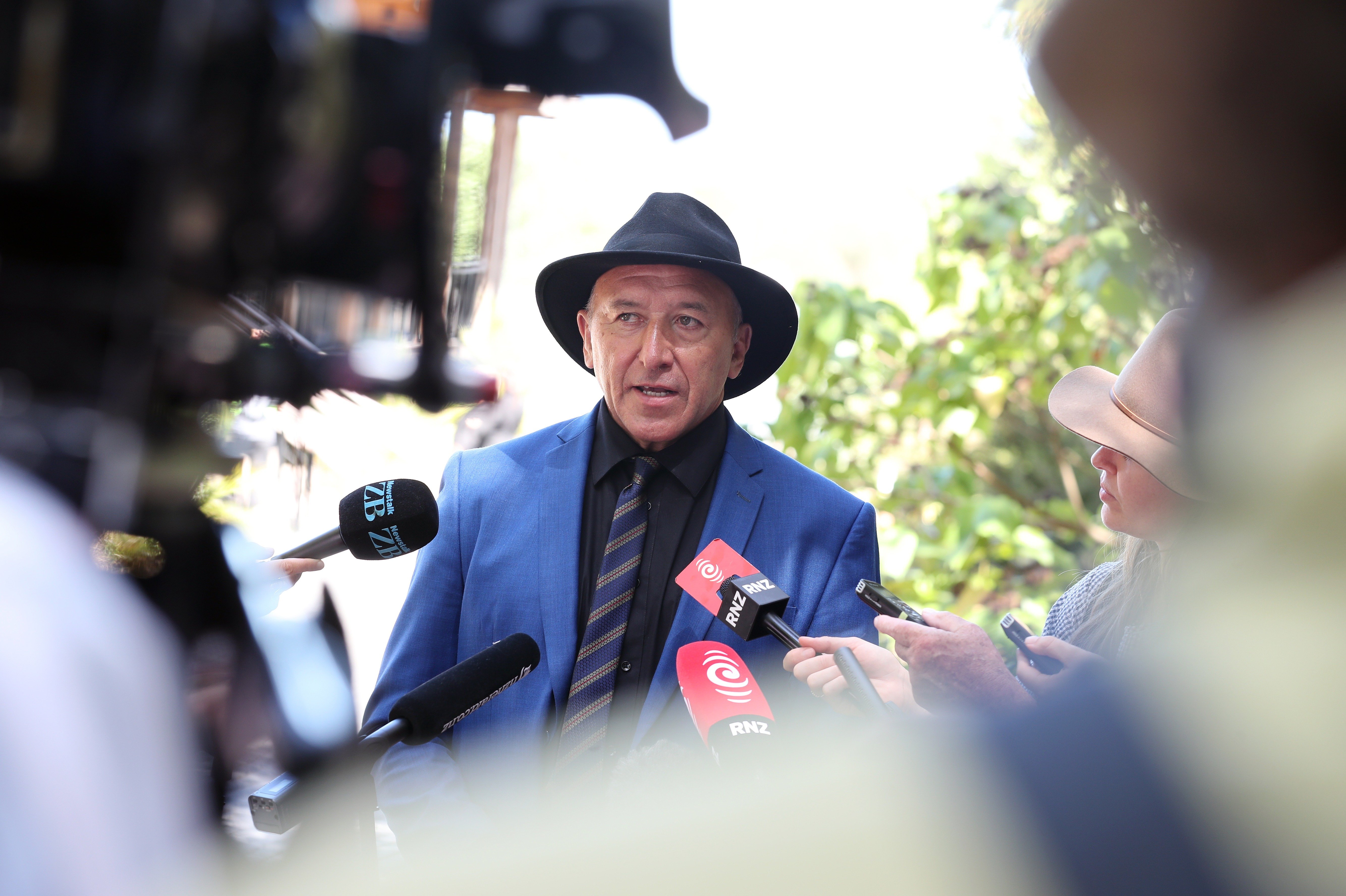
Tipene told the Herald it was “very unfortunate” to hear Jones’ take on the pōwhiri. He disagreed with the assessment it was a circus, arguing it followed tikanga [protocol].”
Tipene did acknowledge the microphone being moved was a slight distraction and accepted Jones’ comments did not reflect well on the trust’s relationship with the Government.
“Nobody, whoever they are, likes to be bought off and told, ‘Unless you do things according to how we want things, you won’t get funding’.”
He said he would be seeking an audience with Jones to discuss the matter.
National’s Justice and Treaty Negotiations Minister Paul Goldsmith said he did not share Jones’ position.
“As a Government, we don’t stop funding people because they disagree with us, that’s not how it works.
“Shane can explain his sentiments and I quite understand, it’s always an emotional experience up here and it’s a robust environment, but in terms of funding and things that I’m responsible for in justice, it’s not about the arguments, it’s about getting things done.”
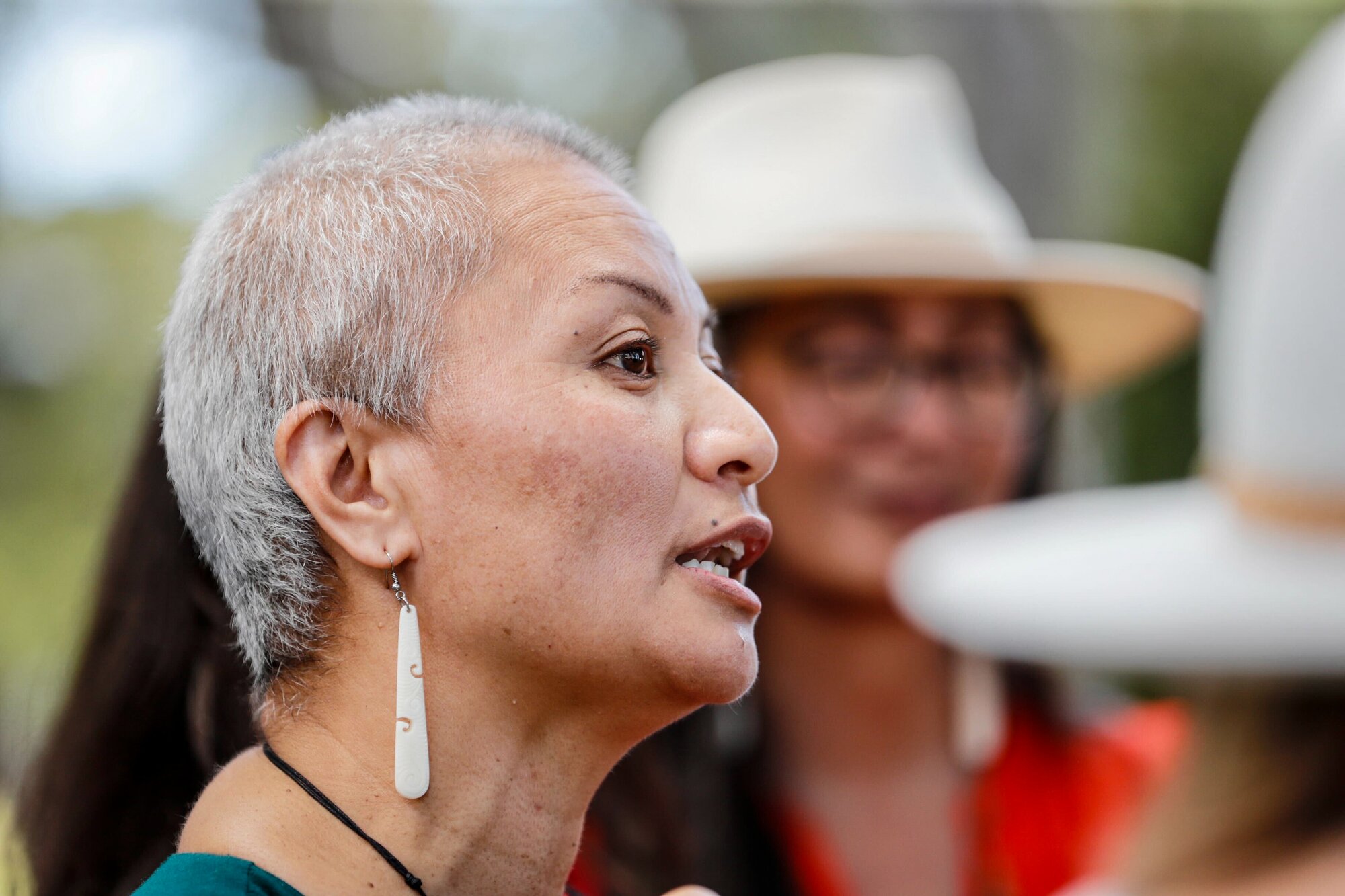
Both the Greens and Labour criticised Jones for his comments, the former deeming it an abuse of power while the latter calling them “utterly inappropriate”.
Labour leader Chris Hipkins later posted to social media, urging Luxon to reprimand Jones for his “intimidation” in the same way former National MP Alfred Ngaro was after he reportedly said charities would lose funding if they criticised the Government.
Today’s pōwhiri, which had a much smaller crowd than last year, was significantly shorter, with several changes including no speeches being made from the mahau (marae verandah), meaning the likes of Davidson, who is Ngāpuhi, was not given a chance to speak.
Tipene said today’s proceedings could be described as a “no frills pōwhiri”. He added the environment was “testy enough” so organisers decided to keep it brief.
Seymour, of area hapū Ngāti Rēhia, was deemed by the crowd to be the main antagonist of the pōwhiri after giving what was a noticeably more combative speech on the paepae compared to last year.
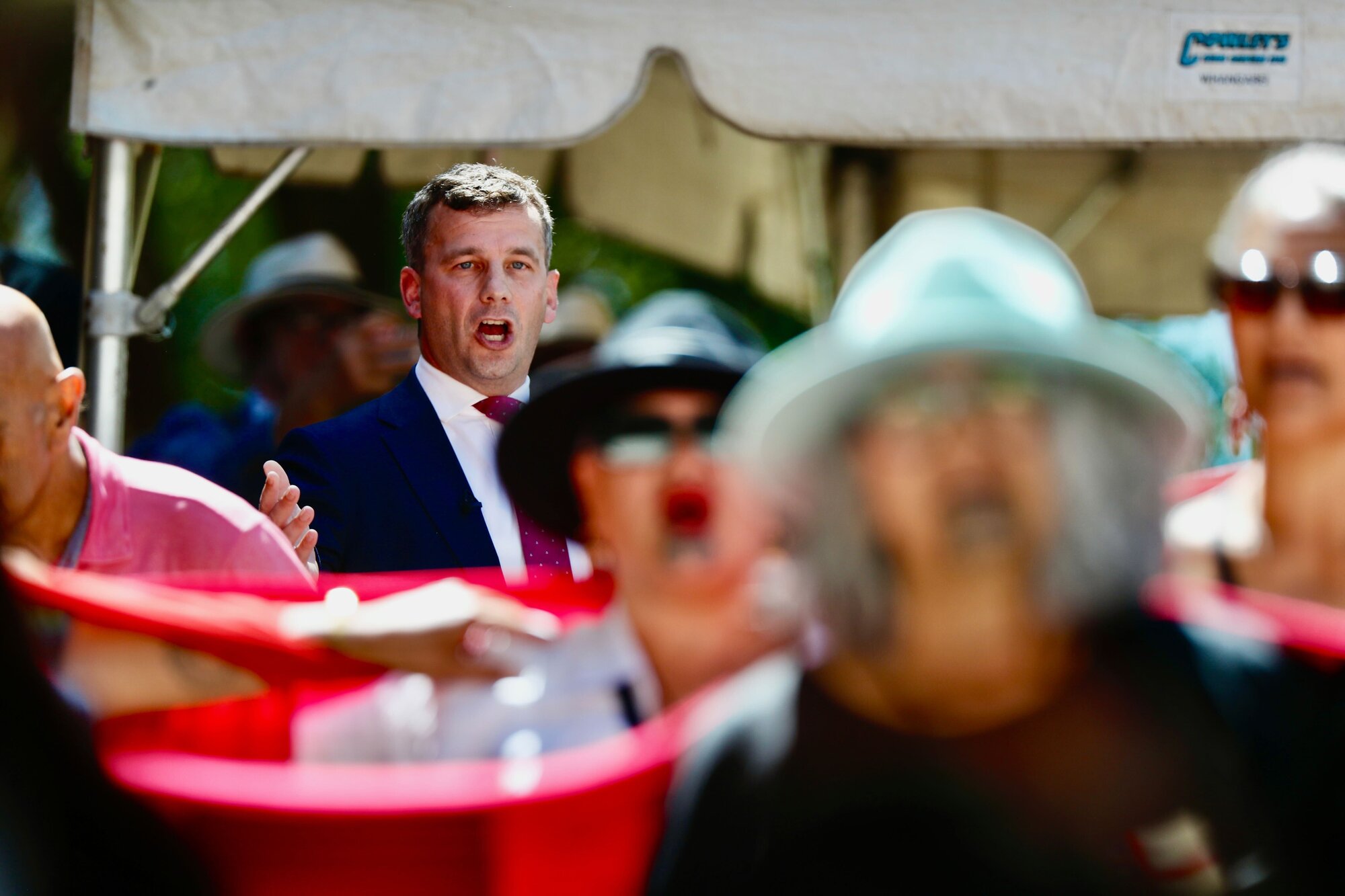
Much of it was a response to ongoing critics of his policies, namely the Treaty Principles Bill, claiming they had “poured poison in the ears of young people”.
“They’ve said that I want to take away their mana, their reo, and their culture ... the things they say are not true,” he said.
“Perhaps blaming me is a convenient distraction from other failures,” he said, citing the lower levels of Māori home ownership, school attendance, income and life expectancy.
Midway through Seymour’s speech, Edwards strode across the atea and took away the microphone and stand Seymour was speaking in front of, much to the delight of many watching.
Seymour continued speaking but could barely be heard. It wasn’t long before Shortland returned the microphone, only for Edwards to take it again. Shortland’s second intervention was enough to cease Edwards’ efforts to mute Seymour.
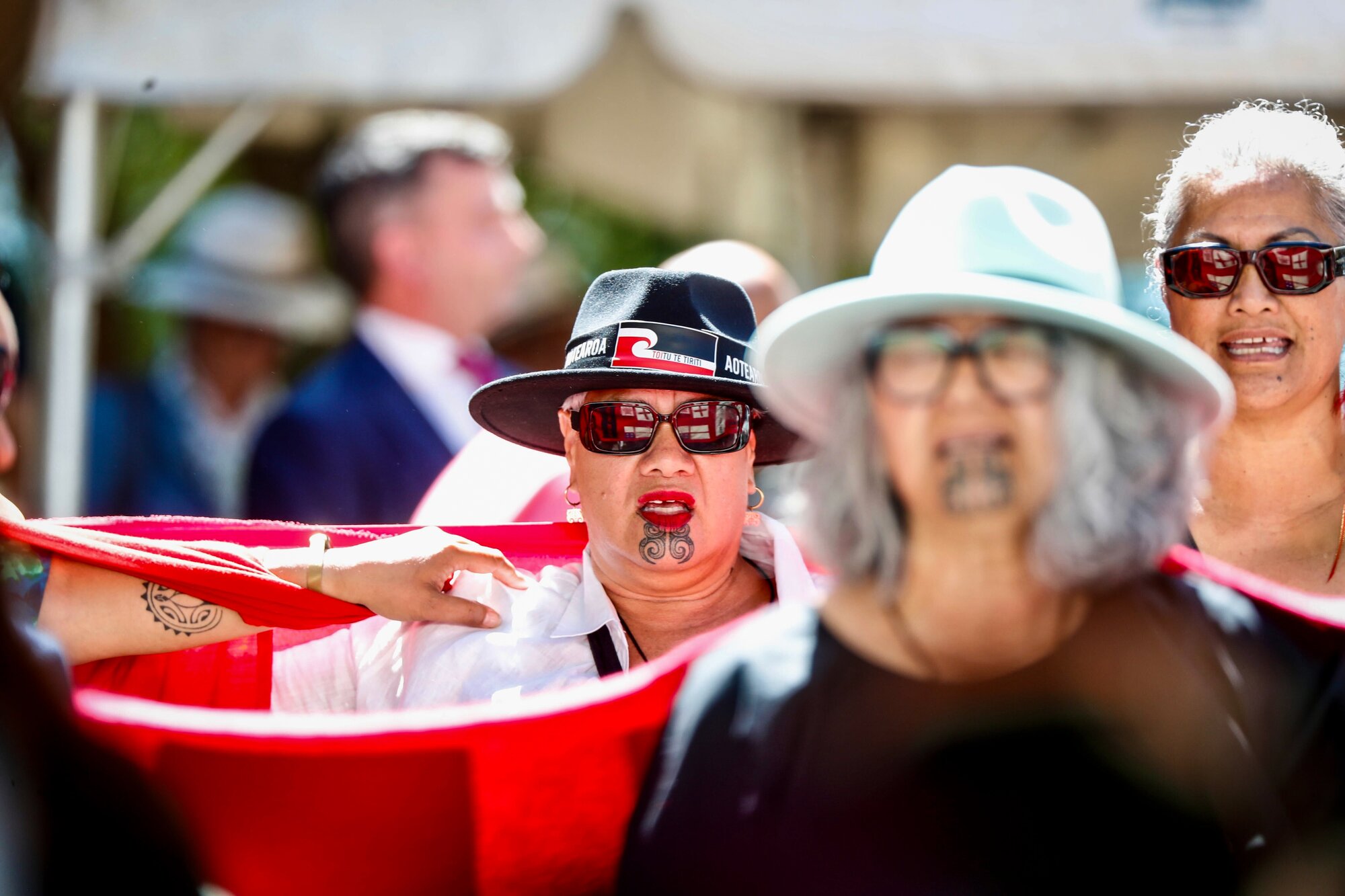
Speaking to the Herald, Edwards recalled Ngāti Rēhia advising their relative not to attend this year’s Waitangi celebrations in his defence of his actions.
“He was told not to speak. His presence caused a lot of angst and discomfort.
“On marae, speakers can be made to sit down in different ways.”
Shortland said he felt his return of the microphone took the “sting” out of the day, but was critical of Seymour’s choice of topic.
“Everything we have wanted to say about the (Treaty Principles) Bill has been said. Everything he has had to say has been said. We’re not going to hear anything new, so let’s try silence.”
Shortland met Seymour face-to-face in the greeting line where the pair shared a hongi. Seymour said to him: “Thank you for being gracious.”
Further along the line, words were also briefly exchanged between Edwards and Seymour. There was no hongi and the Act leader moved on.
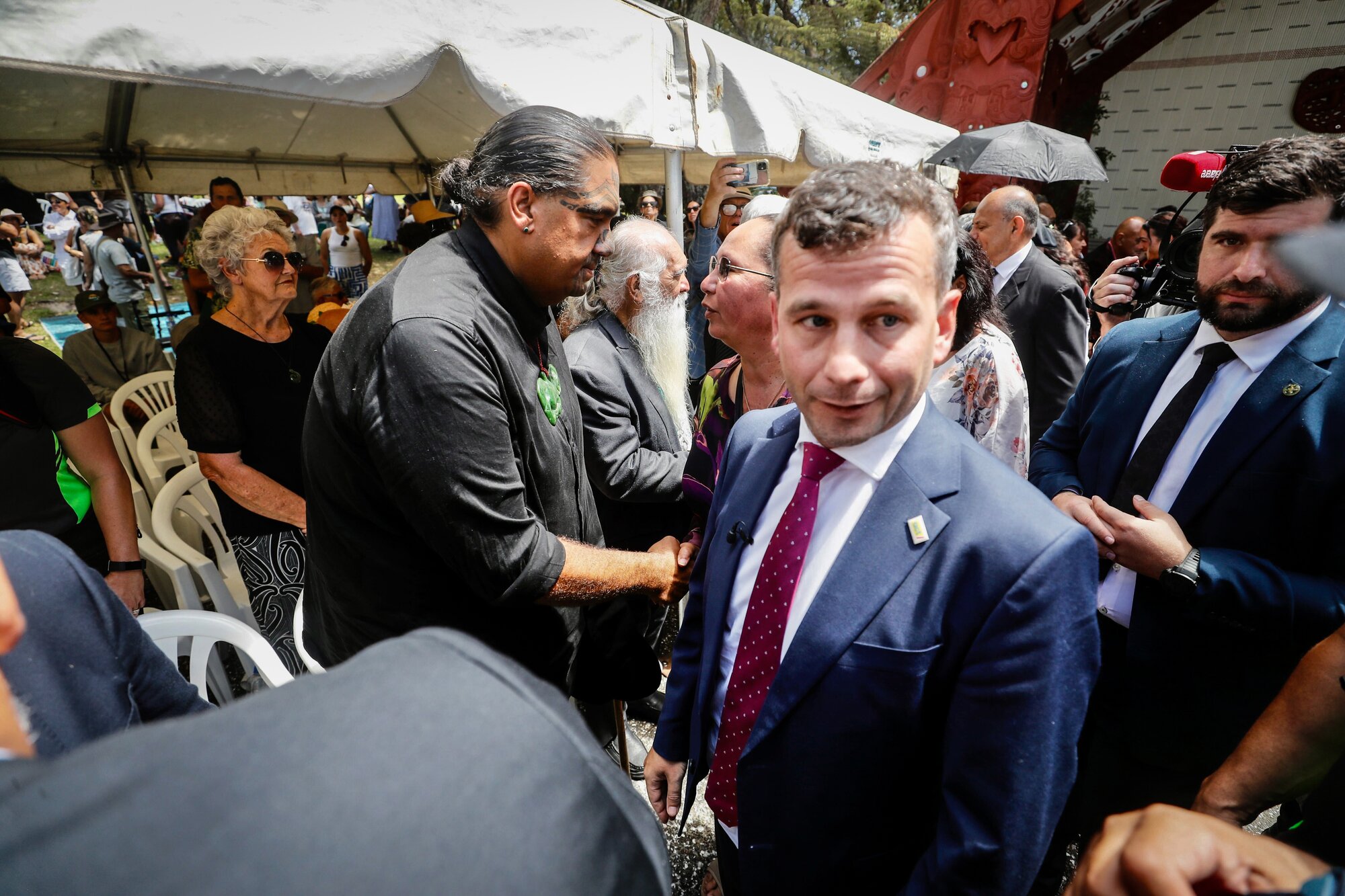
Tipene endorsed Shortland’s actions but said he felt relieved at the extent of today’s disruption.
“I really appreciate through all of the anger, the frustration, the disappointment with what’s going on now, with what is emanating out of the coalition Government the message is clear — we are keeping ourselves controlled, controlled anger.”
Speaking after the pōwhiri, Seymour described the withdrawal of his microphone as bringing “death to a democratic and free society” but he committed to returning to Waitangi.
“You can take away my microphone, but you can’t take away an idea and ultimately this country will have something very much like the Treaty Principles Bill because the idea of equal rights is what the Treaty promised and it’s also what allows all people to flourish.”
Goldsmith said Seymour having his microphone taken away was “disappointing”. Māori-Crown Relations Minister Tama Potaka said the resounding message he’d received from the pōwhiri had been an absolute commitment to Te Tiriti o Waitangi.
Hipkins described Seymour’s speech as “deliberately inflammatory”.
“He came here clearly to try to provoke a reaction, and he got a reaction. It’s not the sort of thing I think responsible political leaders do.”