Government announces roads where speed limit reductions will be reversed
The Government has announced the reversal of speed limit reductions on a large number of New Zealand roads, including many in the northern regions of the country.
The move will result in speed limits being increased on 38 sections of key routes, including parts of State Highway 1 in Northland, SH16 near Auckland and SH3 in Hamilton. Also on the list are changes to SH2 between Featherston and Masterton, and SH3 Whanganui.
Making the announcement in Wairarapa, where the speed limit increase will save drivers around three minutes on their journey, Transport Minister Chris Bishop said: “It all adds up - that is productivity and growth.”
A list of an additional 49 sections of roads is also being released for public consultation.
As the Herald revealed on Wednesday morning, 13 of the changes relate to roads in Northland, Auckland and Waikato.
They include specific sections of:
The speed limits on the sections of roads will be reversed to their previous limits by July 1. This will take place alongside planned maintenance and project work, beginning tonight.
For example, on a near-kilometre-long stretch of road on State Highway 1 Kamo Bypass, the limit will go from 60km/h to 80km/h.
A 1.43km long section of State Highway 16 in Waimauku, northwest of Auckland, will go from 60km/h to 70km/h. This is the part from 140m east of Wintour Rd to 95m east of Mabbett Lane.
On a section of State Highway 1C in Hamilton from west of Howell Ave to south of Riverlea Rd, the limit will jump from 50km/h to 60km/h.
“Where Labour was about slowing New Zealand down, the coalition Government is all about making it easier for people and freight to get from A to B as quickly and efficiently as possible, which will help drive economic growth and improved productivity,” Bishop said.
“Growth, growth, growth,” Prime Minister Christopher Luxon said in his opening remarks at a media gathering to announce the speed limit reversals.
Overnight, a number of speed limits would be returned to their previous, higher limit.
“It’s a great day, it’s a great day for New Zealand,” Bishop said.
Bishop said the 38 roads where the speed limits would increase were chosen because they were easy, long straight stretches of state highways.
He said the first section to have its limit reversed will be a section of State Highway 2 between Featherston and Masterton, “where the speed limit reduction in early 2023 under the previous government met with huge community hostility”. That section of road will retun to 100km/h from 80km/h.
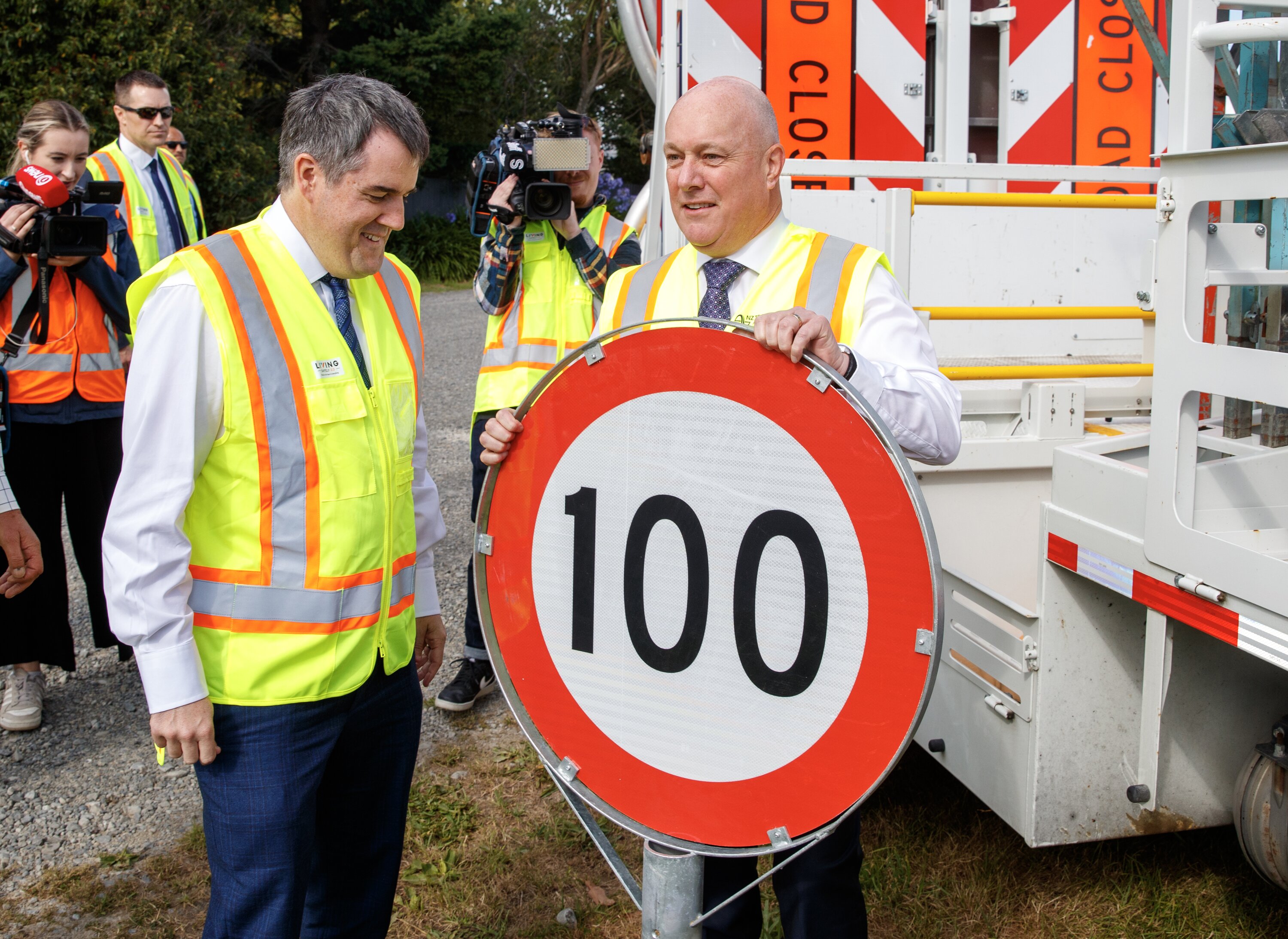
Former Labour associate transport minister Kieran McAnulty had wanted that speed limit reviewed, but Bishop said he had failed to get action. McAnulty has said NZTA previously told him it would not review it.
“I know how resolute NZTA were on it. I was associate transport minister and looked them in the eye and said, ‘I want you to review the speed limit,’ and they said no,” the Labour MP recently told the Wairarapa Times-Age.
Bishop has also released a further list of 49 sections of state highway for further public consultation “so local communities can have their say on keeping their current lower speed limit or returning to the previous higher speed”.
Public consultation on those sections begins tomorrow and will run for six weeks.
“In terms of local road changes, councils have until 1 May 2025 to advise NZTA of the specified roads subject to reversal under the new Rule.”
The new rule also requires variable speed limits outside schools during pick-up and drop-off times.
“We are prioritising the safety of Kiwi kids by introducing reduced speed limits outside schools during pick-up and drop-off times. We want to see these changes brought about quickly,” Bishop said.
“By 1 July 2026, local streets outside a school will be required to have a 30km/h variable speed limit. Rural roads that are outside schools will be required to have variable speed limits of 60km/h or less.
“Throughout the world, 50km/h is used as the right speed limit to keep urban roads flowing smoothly and safely. The evidence on this is clear – comparable countries with the lowest rates of road deaths and serious injuries, such as Norway, Denmark, and Japan, have speed limits of 50km/h on their urban roads, with exceptions for lower speed limits.“
Asked about the impact higher speed limits could have on the road toll, Bishop said the major cause of deaths on the road was drugs and alcohol.
“Thirty per cent of deaths on our roads can be attributed to drugs.”
“It is not to say speed isn’t important, it is important,” he said, adding that speed limits were being put up where it was safe to do so.
Asked if he would be open to reducing the speed limits again if there was an uptick in serious injuries or deaths on the given roads, Bishop said: “We have been clear this will not come at the [cost] of safety.”
Reversing speed limit reductions where it is safe to do so was a promise made to New Zealanders in the National-Act coalition agreement.
The parties argued, including during the 2023 election campaign, that speed limit reductions unnecessarily slowed New Zealanders down and that had flow-on effects for the economy.
The Government last year introduced a new rule requiring that speed limits lowered since January 2020 on some categories of road be reversed by July 1 this year. Public consultation on this found 65% of people supported reversing speed limits.
“Those in support of the draft rule felt it proposes a reasonable and common-sense approach to setting speed limits,” the Ministry of Transport said last year.
“Supporters of the reversal proposal often felt frustrated by reduced speed limits and believed they are slowing down the economy, and in some cases causing motorists to perform risky overtaking manoeuvres.”
Those in opposition were “mostly concerned about the safety impacts of increasing speed limits”. A group of health and road safety experts last year wrote to the Government asking they reconsider their plans. Labour has also raised concerns about the effects on safety.
In a statement after Wednesday’s announcement, Labour’s transport spokesman Tangi Utikere said the Government was making changes based on campaign promises, rather than evidence.
“We know this because the previous transport minister encouraged National Party supporters to submit on his own bill. He was not interested in the opposing views of safety campaigners.
“I would like to see the evidence that it is safe to raise speed limits on these roads, not the National Party opinion that it is.”
The Greens' transport spokeswoman, Julie Anne Genter, said it would cause “serious harm”.
“The laws of physics aren’t a matter of popular opinion. The faster the speed, the bigger the mess. The evidence is overwhelming: safe speeds save lives.
“And yet this Government is substantially hiking up the speed limit on a swathe of often undivided roads in regions such as Northland which has had historically higher rates of deaths on their roads compared to the rest of the country.”
Full list of speed increases
Northland
Auckland
Waikato
Bay of Plenty
Gisborne
Hawke’s Bay
Manawatū/Whanganui
Greater Wellington
Top of the South
Canterbury
Jamie Ensor is a political reporter in the NZ Herald press gallery team based at Parliament. He was previously a TV reporter and digital producer in the Newshub press gallery office.