Maritime Union of New Zealand holds rally at Parliament after Cook Strait mega ferries canned
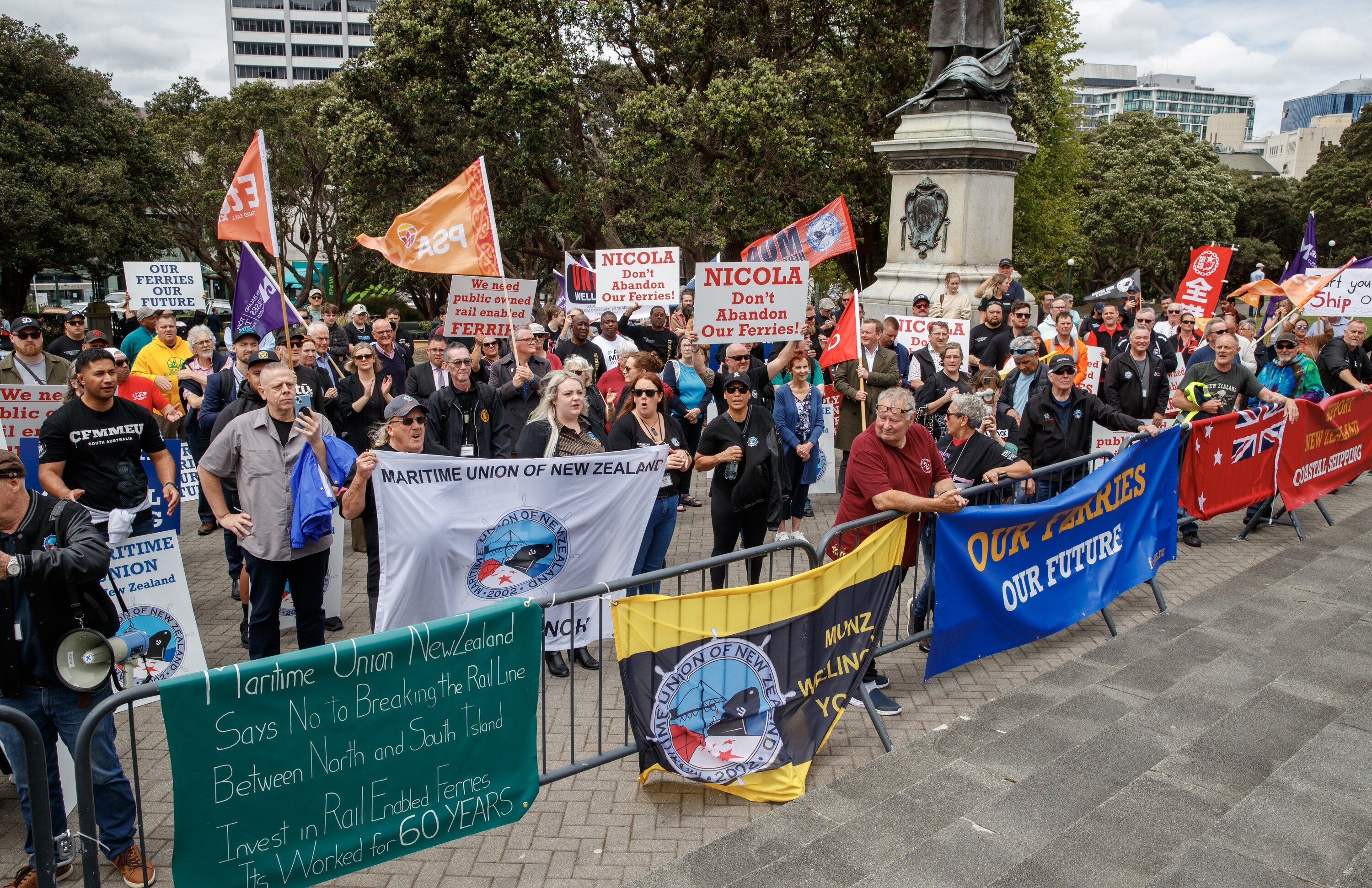
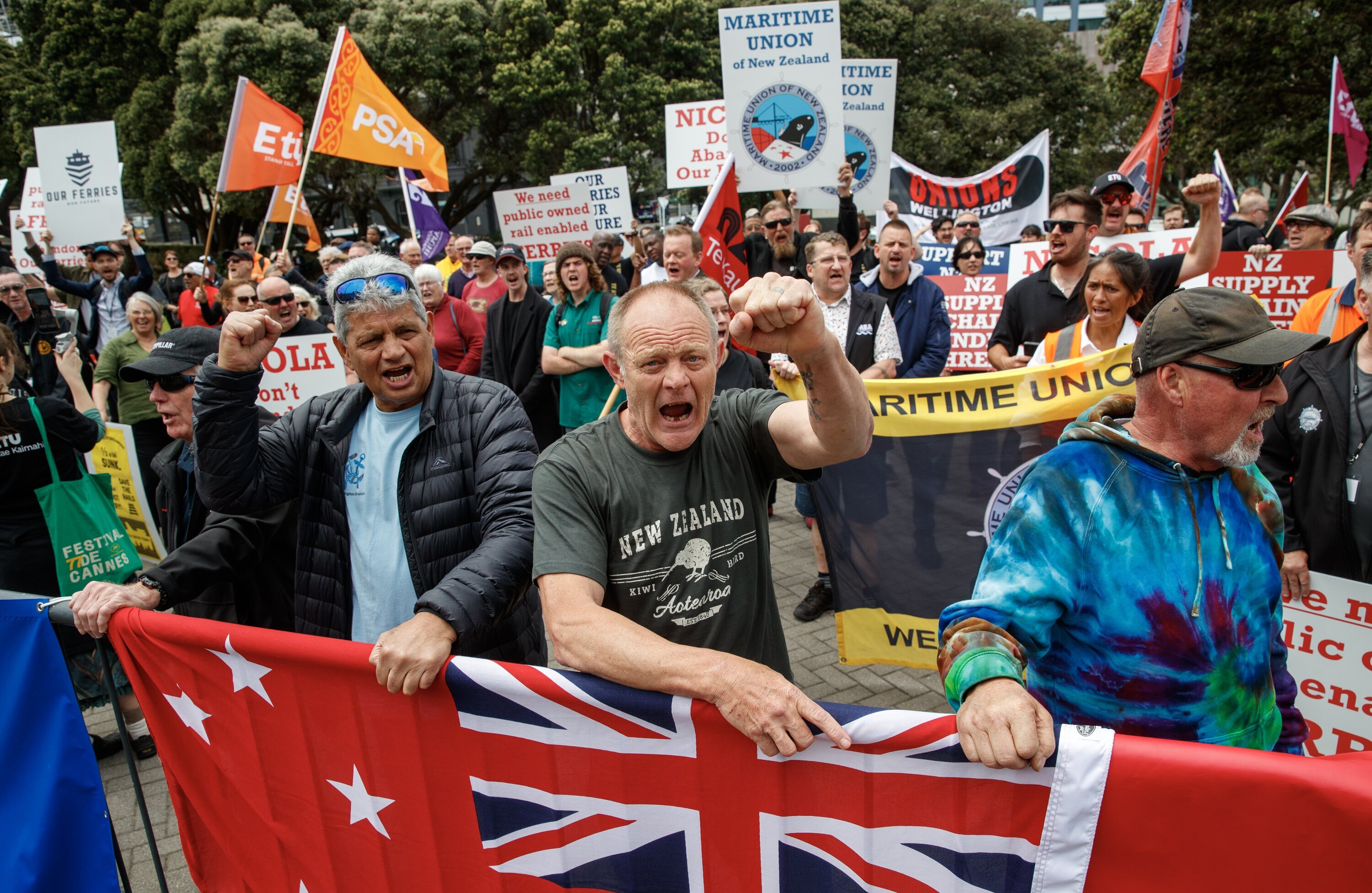
The Maritime Union of New Zealand is holding a rally in Wellington today, calling on the Government to invest in publicly owned and operated rail-capable ferries.
It comes as KiwiRail is still negotiating its exit from a contract to build two new mega ferries almost one year after the Government pulled the plug on the project.
A scheme to replace the current ageing Interislander fleet with two larger rail-enabled ships was left dead in the water in December after overall costs, including new terminals and wharf upgrades, ballooned to almost $3 billion and the new Government refused to fund the blowout.
The rally assembled in Midland Park at 12.30pm before marching down Lambton Quay and arriving at Parliament shortly before 1pm.
At least 100 people joined, including international delegates who are in Wellington to attend the Maritime Union of New Zealand national conference.
Their placards had a message for Finance Minister Nicola Willis: “Nicola, don’t abandon our ferries” and “sort your ship out”.
The Government is yet to reveal what will replace Interislander’s ageing and increasingly unreliable fleet after cancelling the mega ferries.
Willis and Prime Minister Christopher Luxon have said there will be a decision by the end of the year.
“We’re evaluating the ministerial advisory group’s advice and we’ll have more to say about it towards the end of the year,” Luxon said.
Willis has said ministers were testing proposals, asking questions and making sure decisions were based on good advice.
There is speculation the question of whether the ferries should be rail-enabled is behind the hold-up.
The Government has also been considering whether KiwiRail may be best placed to provide an inter-island service in the future.
A KiwiRail spokeswoman confirmed this week that negotiations to exit the $551 million fixed-price ship-build contract with Hyundai Mipo Dockyard (HMD), based in South Korea, were ongoing and all details were commercially sensitive.
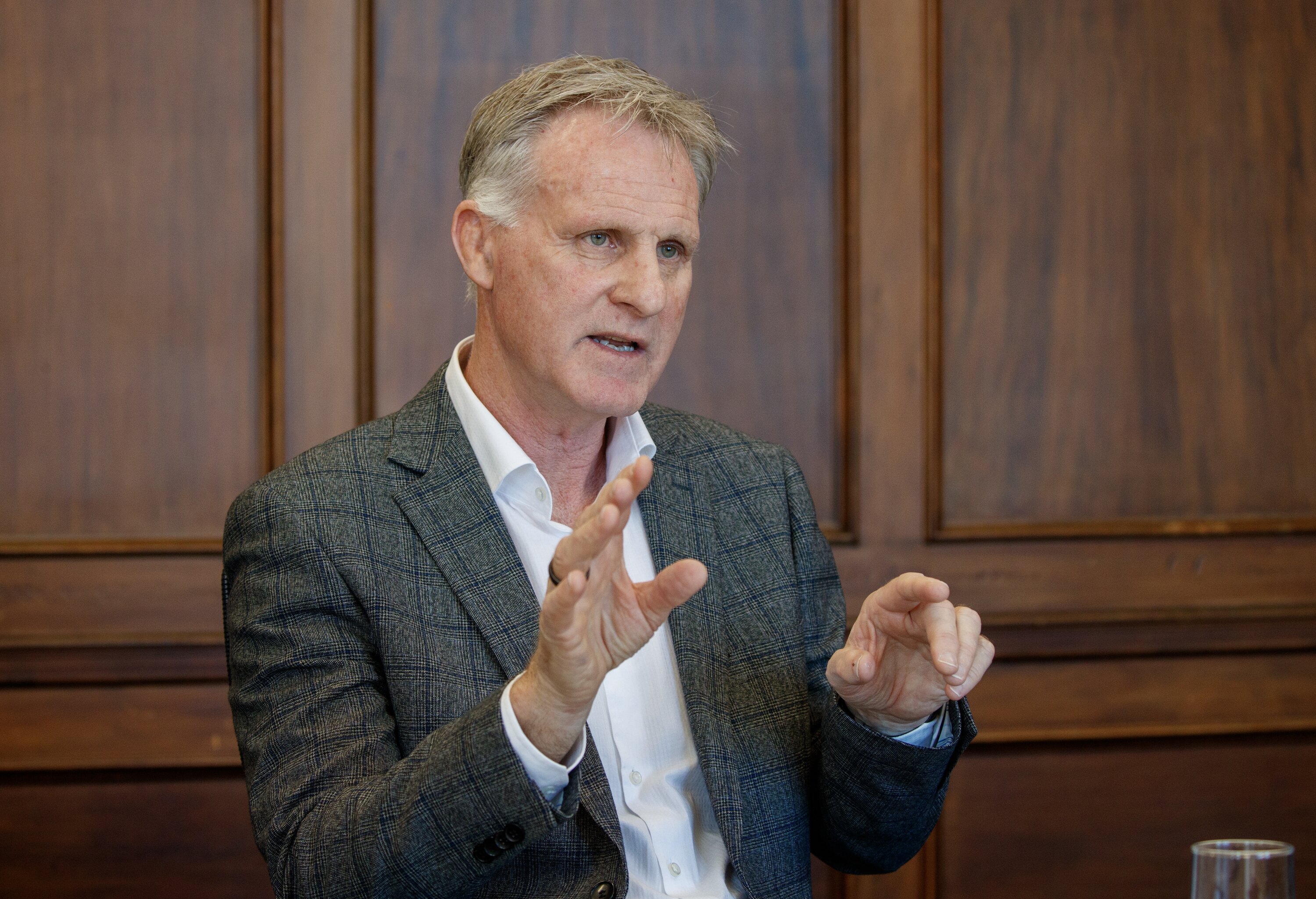
KiwiRail did not address questions as to why it was taking so long.
Minister for State Owned Enterprises Paul Goldsmith said it was a complex issue.
“They’re working their way through it as fast as they can.”
Asked whether there was any chance the Government was reconsidering exiting the contract, Goldsmith said no.
Willis told the Herald on Thursday the Government is “determined to deliver a good value-for-money solution for the Cook Strait”.
“We’re taking our time to make sure we get it right and we look forward to delivering safe, reliable ferry crossings that are compatible with rail, which we think has a really big future in New Zealand.”
KiwiRail took until February to formally announce it was repudiating the contract and the Herald has previously revealed it only did so after receiving a letter from Finance Minister Willis.
KiwiRail’s half-year report to the end of December said the wind-down of the mega ferry project was under way and expected to be “substantially completed” by the end of March this year.
In June, KiwiRail chief executive Peter Reidy told the Herald HMD had put a claim on the table.
“There’s a lot of complexity to it so, there are a number of elements of the claim. We’ve got international experts, maritime legal experts, just going through the claim with us line by line – assessing what’s reasonable, what’s fair.”
Asked what the new timeframe was for getting the contract wrapped up, Reidy said KiwiRail’s internal commitment was to have a “recommended range” finalised by the end of that month and to then sit down with ministers to discuss the cost.
KiwiRail’s 2024 annual report said the landside wind-down of the mega ferry project was substantially complete as of the end of June.
“The negotiations on exit of shipbuilding contract are still in progress,” the report said.
Maritime Union of New Zealand national secretary Carl Findlay said the time taken to exit the contract “seems really weird”.
He speculated it was because the deal was being resurrected or the exit costs were high.
The ship-build contract for the mega ferries was a great deal, Findlay said.
“There was no real rhyme or reason why they threw it out that I can see. They just panicked and threw the baby out with the bath water in my view.”
Labour Transport spokesman Tangi Utikere said cancelling the mega ferries was foolish and had already cost the taxpayer almost half a billion dollars.
“Nearly 12 months on from Nicola Willis saying that the deal would be off, we have no plan, no ferries and no way forward.
“Whatever happens we will likely end up paying more and waiting longer for a solution.”
Willis told the Herald: “As the previous Government so clearly proved, if you don’t get the details right on this stuff, it can cost billions.”
Georgina Campbell is a Wellington-based reporter who has a particular interest in local government, transport, and seismic issues. She joined the Herald in 2019 after working as a broadcast journalist.