David Seymour’s first outing as acting Prime Minister, Casey Costello faces Question Time scrutiny
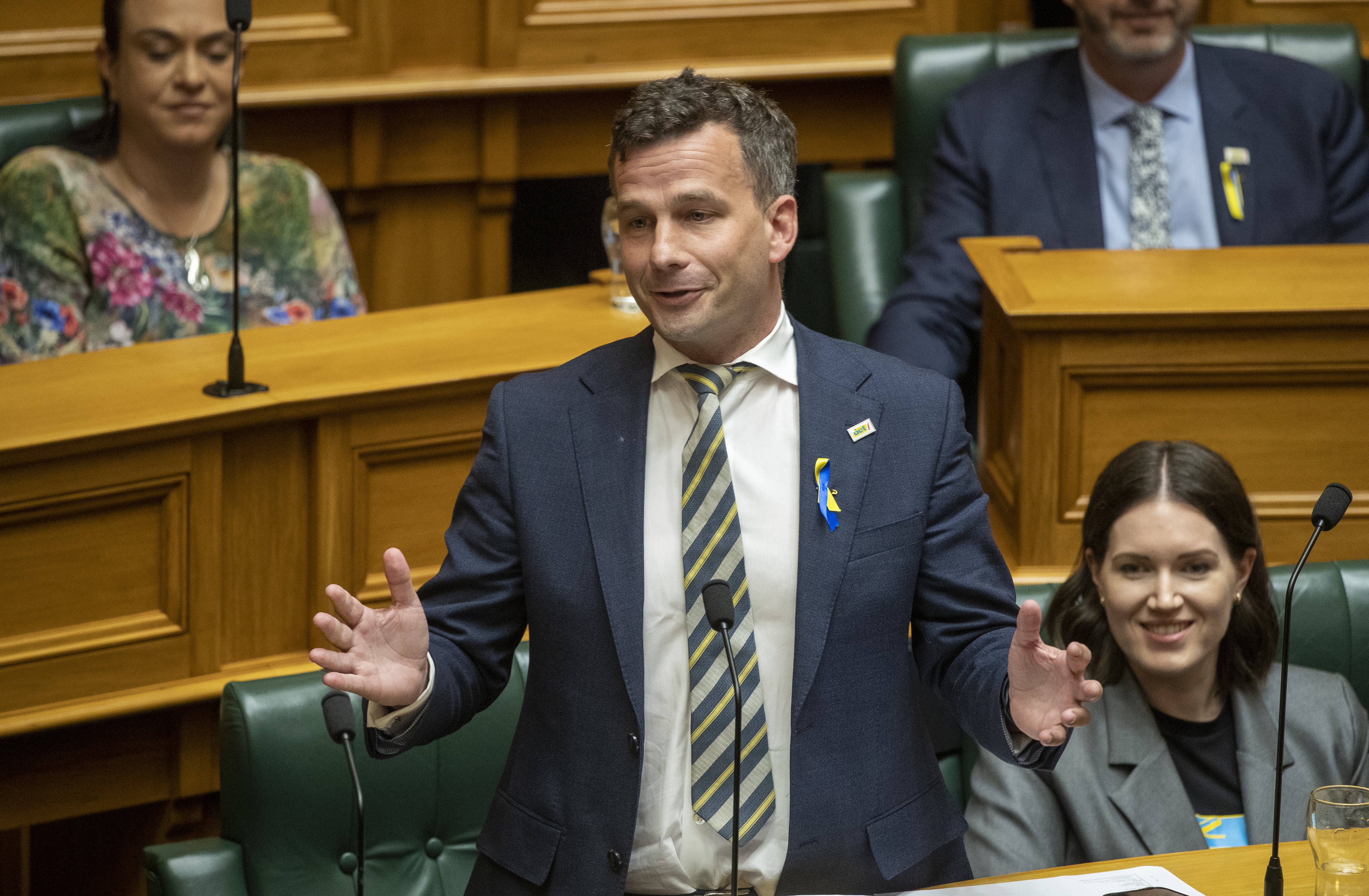
Act leader David Seymour has taken his first turn filling in as Prime Minister during Question Time today while deputy Prime Minister Winston Peters is in Australia.
The deputy usually fills in for the PM on a Thursday and Christopher Luxon is in Auckland today. Peters’ absence means the honours fall to Seymour for the first time.
During Question Time, Labour continued to pressure the Government on the actions of Associate Health Minister Casey Costello and the party policies she provided to officials to assist in developing smoking-related strategies.
Labour deputy leader Carmel Sepuloni asked Seymour to assure the House no members associated with the tobacco industry were involved in the development of the policy documents given to officials.
Mark Mitchell rules out lowering recruitment standards
Natasha Gordon
Police Minister Mark Mitchell has ruled out lowering recruitment standards in order to achieve the Government's aim of training 500 new police officers within two years.
He also confirmed those 500 would all be sworn officers and not include those who weren't able to work on the frontline - something the previous Government was criticised for when it said it would increase the workforce by 1800 officers.
Under questioning from Labour's police spokeswoman Ginny Andersen, Mitchell accepted how his briefings indicated workforce growth wouldn't be able to be achieved without other supporting measures. He then said other measures will be looked at to assist workforce growth.
Mitchell told the media earlier that the 500-officer target did not include attrition or officers leaving the workforce, which Mitchell's briefing said would increase in the coming years given the "large number" of officers over the age of 55.
Casey Costello claims her words and actions have been 'distorted by a media article'
Natasha Gordon
Associate Health Minister Casey Costello claims her words and actions have been "distorted by a media article" regarding the advice she requested from officials about strategies to lower smoking levels.
An RNZ report today claimed she had written to officials asking for advice on freezing excise tax increases on tobacco products. Costello told RNZ through a statement she had not written that advice.
Labour's health spokeswoman Dr Ayesha Verrall pressed her on why she had asked for that advice and why she had denied it to RNZ.
Costello said it was "unfortunate" her actions had been distorted by RNZ and again stated how she had sent various documents to officials, including previous party policy documents. She said she was unaware of who wrote the documents.
What can Melissa Lee do to improve rural broadband?
Natasha Gordon
Rural broadband is highlighted as a pain point in an MBIE bim for Innovation and Technology Minister Melissa Lee The briefing says the urban Ultrafast Broadband (UFB) network is “world class”, the bim says, but “Despite substantial government investment, rural New Zealanders experience connectivity services that are slower, less reliable, and more expensive than urban New Zealanders.”
It says that currently there is “no sustainable funding to address this urban-rural divide”.
What can Lee do to improve rural broadband? The Ministry’s recommended action is greyed out as “confidential”.
The bim also highlights “resilience concerns”, saying “the recent North Island severe weather events demonstrated the vulnerability of telecommunications networks to natural disasters.”
The major telcos have all touted partnerships with Elon Musk’s Starlink and other satellite broadband providers as a way to provide service to remote areas and cope with future events on a par with Cyclone Gabrielle.
But the bim says, “While the expansion of satellite broadband services has gone a large way to address coverage gaps, these services tend to be at least twice the price of urban fixed line fibre services. Prices for fixed wireless broadband are also significantly higher in rural areas than urban areas.”
Starlink currently pays a token amount for its six NZ ground stations. The bim suggests a “modernisation” of the regulatory framework that would include a review of fees (details of which are redacted).
The bim also notes Chorus’s suggestion that the UFB be extended so that some 40,000 rural households get fibre - which the firm has touted as a path to faster and more resilient broadband. The move would take UFB coverage from 87 per cent to 90 per cent of the population. MBIE’s thoughts on that play are redacted. The Ministry does say that any extension beyond 90 per cent would “require more government investment.”
MBIE also recommends that Lee continues the Memorandum of Understanding that gave a pan-iwi entity 20 per cent of the 5G spectrum allocated in 2022, and provided for 20 per cent of future spectrum allocations, at no cost. The arrangement - which sidelined but did not settle a Treaty claim on airwaves - is described as "pragmatic".
MBIE also says that a review of NZ Post’s Deed of Understanding is required by June 2024. It notes that frequency of delivery will be on the table, “against a backdrop of a rapid decline in mail volumes [and] in parallel, the rapid rise of e-commerce that has seen a dramatic expansion in demand for parcel services” but does not make any recommendation around the frequency of delivery
Opposition laughs as Chris Bishop muddles the meaning of 'mansplaining'
Vera Alves
Chris Bishop has muddled the meaning of mansplaining after being accused of doing just that when explaining the good aspects of colonisation.
Bishop, speaking on behalf on of the Treaty Negotiations Minister, fielded a question from Greens co-leader Marama Davidson who asked what good outcomes from colonisation he hoped to build on - a reference to a quote from the relevant minister Paul Goldsmith who said in an interview there were good outcomes of colonisation.
Bishop said he didn't view history in a "binary way" and went on to list what he saw as benefits of New Zealand being colonised, including bringing Westminster democracy, the establishment of law and order and promoting economic development.
Midway through his answer, Sepuloni called out: "mansplaining!"
Ministers usually didn't react to the Opposition's heckling in the House but Bishop clearly took issue with the comment, turning to Sepuloni, smacking his hand on the desk, opening his arms out and saying: "How can it be mansplaining to answer a question from a woman in Parliament?"
Much of the Opposition laughed.
Vera Alves
Labour is continuing to pressure the Government on the actions of Associate Health Minister Casey Costello and the party policies she provided to officials to assist in developing smoking-related strategies.
Labour deputy leader Carmel Sepuloni asked Act leader David Seymour, standing in for PM Christopher Luxon and DPM Winston Peters who were both away, to assure the House no members associated with the tobacco industry were involved in the development of the policy documents given to officials.
Seymour began by saying he had received assurances from all coalition partners that they had had no funding from the tobacco industry and added there had been "no undue influence" from anyone from the industry on Government policies.
Labour complained to the Speaker he had avoided the question, to which Seymour repeated how he was confident there was no undue influence.
The Opposition parties continued to argue for a better response to the question as National argued the party policies were not something that the Acting PM should have to answer for. The Speaker said he would reflect on the matter and make a decision next week.
Sepuloni tried to probe further, asking about whether Seymour was confident all conflicts of interest had been declared by ministers and when Luxon would dismiss Costello from her ministerial portfolios - something also called for by Labour's Dr Ayesha Verrall.
Seymour said he was confident conflicts had been declared and was assured Sepuloni would come to see the value Costello had as a minister.
Question time in Parliament
Vera Alves
Following the release of the Bims. Stay tuned for live updates.
‘Could happen tomorrow’: Government warned of chances of ‘catastrophic’ earthquake
Vera Alves
The Government is being warned of the country’s vulnerability to more frequent severe weather, and the chances of catastrophic earthquakes that could cripple the country in the near future - even tomorrow.
Read the full story below.
Traditional TV broadcasting faces uncertain future - briefing document to Media and Communications Minister Melissa Lee
Vera Alves
The document outlines the sector’s big shift to digital - TVNZ is investing heavily in a new streaming platform - but also details the impact that the likes of global tech giants such as Facebook, Google and Netflix have on the industry.
Read the full report by Shayne Currie below.
Scrapping Auckland Light Rail project will likely cost millions of dollars
Vera Alves
The disestablishment of the Ministry of Transport’s work on the Auckland Light Rail project will likely cost millions of dollars spent over six months and will involve the disposal of property, land and settling obligations.
The Auckland Light Rail (ALR) project was officially scrapped by the new Transport Minister Simeon Brown on January 14, 2024, who cited the project would have cost taxpayers $15 billion, with advice showing the cost could increase to $29.2b. The commitment to scrap ALR was part of the National government’s 100-day Action Plan.
The cabinet paper proactively released today by the Ministry of Transport (MOT) has revealed that “existing funding” to ALR Ltd will be “sufficient to fund” its disestablishment.
The cabinet paper lists that of the $153.4m operating expenditure in the ALR Ltd budget $33.6m is available. Only $302,000 of ARL Ltd’s $26m in capital injection appropriation is left available. And $98m of ALR Ltd’s $131m strategic land acquisition appropriation budget is left available.
The cabinet paper states that MOT expects an “additional amount of up to $33.6m” will be returned to its budget, but that “the amount returned will depend on the costs of disestablishing ALR Ltd.”
The $98m in remaining land acquisition budget will also be returned to the MOT central budget, the cabinet paper says.
This projection means the ALR disestablishment process could still possibly cost millions of dollars, based on the remaining budget of the project that is still unspent.“
The best way to stop work on the ALR project is to change the purpose of ALR Ltd from a focus on developing the project’s business case, to managing an orderly disestablishment,” the cabinet paper says.
“Officials expect that it could take up to six months to substantively complete the disestablishment process.”
Background in the cabinet paper on the ALR also details disagreements on the design of the infrastructure project.
"The project has faced challenges to progress. The ALR Sponsors were not unanimous on whether the tracks should be built above or below ground.
"The project recently missed a significant milestone of lodging the Notice of Requirement to protect the corridor, because the ALR Ltd Board did not think it was appropriate to make that decision at that time."
A recommendation of the cabinet paper is also to make changes to ALR Ltd’s board so it can “support the new purpose” of disestablishment.
This will will involve: “reducing its size to 2-3 directors (which may involve the need to remove or appoint new directors depending on the skills of existing directors and their willingness to continue on the Board).”
The Minister of Transport is invited in the paper to report back to Cabinet on the progress of disestablishing ALR Ltd “including the future of its land holding and disposition of its other assets and the settlement of obligations and liabilities” by the end of March 2024.
Christopher Luxon tells parents to ‘wake up’ and tackle low school attendance
Vera Alves
Prime Minister Christopher Luxon has said parents need to “wake up” and tackle low school attendance.
The comments follow a ministerial briefing which revealed “high levels of disassociation from school”.
World is ‘less prosperous, less secure and less free’
Vera Alves
The Ministry of Foreign Affairs and Trade (MFAT) has painted a depressing, if not scary, picture of the world, saying it has become “less prosperous, less secure and less free” since Covid-19 came along.
“New Zealand can no longer rely on the durability of continuing international cooperation and trade liberalisation, which have been the foundation of its foreign, trade and economic policies for decades,” MFAT said.
It believed New Zealand would be affected by three big global shifts: rules to power, economics to security and efficiency to resilience.
It said Russia’s invasion of Ukraine was “an assault” on the rules-based international system, which has “further exacerbated food and energy insecurity, and revived the threat of nuclear war”.
As for the Israel-Hamas conflict, MFAT expected it to spread further.
In a section on China, MFAT said the wider Indo-Pacific region “is now a theatre for increasing strategic competition”.
“All these issues reduce the international system’s capacity to tackle more existential challenges - notably climate change.”
Public Service Commission issues advice on public sector cuts
Vera Alves
The Public Service Commission has warned its minister Nicola Willis that steps such as a cap on public service numbers or a hiring freeze to try to cut spending are a blunt instrument, and warned careful management will be needed to cut public service spending without compromising services to the public.
In its briefing, it addresses the government’s push to trim spending in the public sector and cut back on contractor and consultant numbers.
“In general we do not recommend the use of input controls (i.e. ‘caps’ or ‘hiring freezes’) as an effective means of re-prioritising resources. These tend to be blunt instruments, which can lock in resource allocations not aligned to your priorities, set perverse incentives or create upward pressure on contractor and consultant spend, and give you less deliberate choice about which programmes you invest in.”
The PSC puts forward some ideas on how to achieve the cuts the government wants, suggesting the pool of existing public servants could be better organised instead.
“We can also provide advice on more specific options for improving workforce efficiency or reducing the pressures on consultant spend via more strategic workforce planning, deployable pools of mobile staff, or in-sourced consultancy models.”
It said New Zealand’s public service was very decentralised, and thought could be given to using public servants with specific skills – such as policy development - across more than one department.
It also proposed reducing poaching and competition for staff between government departments – which put upward pressure on salaries - by aligning terms and conditions across the public service.
It has also presented advice on National’s promise to cut the use of contractors and consultants in the public sector by $400 million a year – the government’s 100-day plan includes instructing public sector chief executives to start reducing spending on consultants and contractors.
Figures in the BIM showed spending on contractors and consultants had increased from about $600 million a year from 2018 – 2021, to over $900 by June 2022, dropping slightly by mid 2023. Spending as a proportion of the total public sector workforce spend had gone from between 10-12 per cent, to 14 per cent and then back down to 13 per cent in 2023.
Some government departments – including MBIE – have defended the use of consultants and consultants in their BIMs, saying they were for roles which the department did not have the in-house expertise to do.
It suggested that a more performance-based model be applied to government chief executives and departments.
“Setting clear priorities and driving efficiency will bring a strong focus to government activity, but chief executives and agencies will still need to deliver on a wide range of outcomes, and more could be done to mandate a performance-based approach at this level.”
It also pointed to the number of government departments and entities in New Zealand, compared to other countries of a comparable size. It said that indicated there was scope to reducing the number of agencies, potentially by merging or amalgamating, and offered more specific advice if the minister wanted it. However, it warned of some short term consequences:
“While such change can generate savings in the medium to long-term, our experience is that significant change can also be complex to manage and generate high transition costs or reduced productivity in the short term.”
The PSC also advised Willis that a number of chief executive appointments are needed in the first half of 2024, and "a large number” of collective agreements in the public service will expire in late 2024 and early 2025.
It also said that a number of Fair Pay agreements were underway or expected that would impact on the public sector.
Willis has responsibility for advising the PSC of her expectations for the qualities needed of appointments as government chief executives – and their remuneration.
Willis is expected to produce a statement with her expectations on pay increases for public servants.
Govt to continue to fund school lunches beyond the end of the year - Christopher Luxon
Vera Alves
Prime Minister Christopher Luxon is currently speaking to the media and has confirmed that the government will continue to fund school lunches beyond the end of the year.
'Significant pressure' on police funds
Vera Alves
Mitchell has been warned future events akin to Cyclone Gabrielle or the Auckland floods would put "significant pressure" on police funds, given police received no funding from Budget 2023 for cost pressures.
The briefing said the police executive had made decisions to reduce costs to fund the organisation's cost pressures, but any details were redacted.
'Funding additional cancer drugs within Budget 2024 will have some challenges'
Vera Alves
Health officials have highlighted some risks in some of the Government’s top priorities, including a third medical school at Waikato University.
“As with any large project, standing up a new medical school will involve some challenges and risks, even with a 2027 start date for first enrolments,” Health Minister Shane Reti has been told.
“These include the financial costs in capital and other set-up costs from both government and the University’s financial resources, and the significant work to set up operations including developing and staffing a programme and gaining medical council accreditation.”
National’s election promise to fund 10 new cancer drugs also faced some uncertainties, officials said.
“Funding additional cancer drugs within Budget 2024 will have some challenges given the existing legislative settings and decision-making framework for the public funding of medicines,” the minister’s briefing said.
“There are additional considerations to enable access to the cancer drugs such as from workforce and system capacity limitations.”
Govt to address overwhelming burden of mental health callouts on police
Vera Alves
The plan to address the overwhelming burden of mental health callouts on the police will be considered by Cabinet next month, Mitchell's briefing says.
The plan, developed by police and health agencies, charted a five-year transition to a multi-agency response for people in mental distress who call 111.
Mitchell had identified the need for a new workforce to take the pressure off police in his letter of expectations to Coster last year.
At the time, he accepted creating this workforce could take multiple terms of government.
The briefing said only 2-4 per cent of the thousands of mental health callouts resulted in a criminal offence.
"Mental health events have increased by 152 per cent and threatens/attempts suicide events by 92 per cent between 2013 and 2023."
Council balance sheets are deteriorating and urgent clarity is needed on three waters
Vera Alves
The Department of Internal Affairs (DIA) has told Local Government Minister Simeon Brown it is a challenging time for local government.
“The current structure and system are ageing, not performing well, and no longer meet the needs of the sector.”
Challenges include historical underinvestment and a short-term reactionary focus driven by crises and compliance, the department said.
Many councils are under financial stress and their upcoming 10-year budgets are expected to show deteriorating balance sheets, significant rates rises and constrained infrastructure investment.
The Government has not yet repealed Labour’s controversial Three Waters reform legislation but it has promised to do so within its first 100 days.
DIA said uncertainty around three waters is making it difficult for councils to put together their budgets and urgent changes to legislation are needed to support local government, the briefing said.
“Councils are currently preparing plans for adoption by 30 June 2024 under a set of transitional arrangements that were inserted by the water services entities legislation.
“This approach would need to be reconsidered as part of repeal of the legislation, to ensure councils have clarity about what is required as quickly as possible.”
Councils need the right tools, legislative and financial settings to develop their own plans for water services delivery using a financially sustainable model, the briefing said.
Councils will need the right tools and legislative and financial settings to develop their own plans for three waters, DIA said.
This could include changes to allow for a council-controlled organisation model that maintains council ownership and local accountability, with statutory limitations to ensure financial independence.
Emergency housing grants down but hardship assistance payments up
Vera Alves
A briefing document to incoming social development Minister Louise Upston has revealed the number of Emergency Housing Special Needs Grants during the September quarter last year dropped 5,298 or 17.0 per cent from the previous September.
"The value of these grants was $88.2 million, down 3.9 per cent from the September 2022 quarter."
However, the document said hardship assistance payments were up 8.7 per cent over the same period.
"There were 339,222 Special Needs Grants for food during the September 2023 quarter, up 31,020 or 10.1 percent from the September 2022 quarter. The value of these grants was $36.6 million, up 16.5 percent from the September 2022 quarter."
NEMA briefing warns of major earthquake that 'could happen tomorrow'
Vera Alves
A NEMA briefing warned recent research found a 25 per cent "probability of a major Hikurangi Subduction Zone ... earthquake event occurring in the next 50 years"
They warned that "indicative national impacts of a major Hikurangi earthquake and tsunami include tens of thousands of people dead, injured or displaced from their homes, and significant damage to the built environment (in excess of $144 billion)".
The paper warned a quake and tsunami caused by the Hikurangi subduction zone could happen "tomorrow".
"If not in our lifetime, then in that of the next generation. Crucially, it could happen tomorrow".
Ram raids at lowest level since October 2021
Vera Alves
Mitchell has been informed reporting of retail crime continues to grow alongside concerns of "increasing threats and violence". This was due to improvements in reporting tools, such as Auror which about 15,000 retailers were linked to and could report crime through.
The level of ram raids was at the lowest it had been since October, 2021.
Of the 1385 ram raids between January, 2022 and July 2023, enforcement action had been taken against 864 offenders and referred 368 offenders to Youth Aid.
Officials also said there was no evidence more recent ram raid offending was being driven by youth gang affiliation or membership, despite some offenders having gang associations.
Prison population steadily rising again - Corrections
Vera Alves
Figures provided in a briefing to new Corrections Minister Mark Mitchell show the prison population is steadily on the rise after reaching a record low under the last Labour Government.
The total prison population declined from more than 10,000 in 2020 to a little under 8000 at the end of 2021.
Since then, it has been generally on the increase, driven in part by a significant increase in the number of prisoners on remand awaiting trial or sentence amid court backlogs.
It now sits at about 9000, of whom 57 percent are sentenced prisoners and 43 percent are on remand.
Māori make up 52 percent of the prison population and 45 percent of the people Corrections manages in the community, the briefing said.
Eleven percent of inmates are under 25 and six percent are women.
More frequent power outages possible
Vera Alves
New Zealand’s electricity supply is likely to fall short on an increasing number of occasions, according to the Ministry of Business, Innovation and Employment (MBIE).
“Our most immediate challenge is to ensure sufficient electricity generation to meet peak demand during cold winter mornings and evenings,” MBIE said.
“These tight periods can last minutes or hours and are a particular challenge at times when our thermal generators are not already running to provide baseload electricity supply, when the wind drops, or when the weather is colder than forecast.”
The ministry explained the challenges arose from the country’s move away from fossil fuels towards more sustainable energy sources.
Electrifying the country means there’s more demand for electricity. However, we can’t control when the wind blows and sun shines, and quick-start thermal generation plants are coming to the end of their lives.
Judith Collins of “suspected foreign intelligence officers” who travelled to NZ
Vera Alves
Efforts by foreign states to drive “social change” has become an increasing feature of the threats facing New Zealand, says a briefing from the NZ Security Intelligence Service and Government Communications Security Bureau.
The two intelligence agencies produced a joint briefing for new minister Judith Collins which - typically - included large chunks of redacted material.
But it still painted a big picture of what our spies like to call the “threat environment”.
That strategic level competition among big powers “to advance competing visions” of the regional and global orders has again come to the fore. In doing so, it has made “the global and regional security environment more complex and unpredictable”.
That instability for a “small export nation which relies on stable international rules-based order” poses a greater threat to nations like New Zealand than it might to larger countries.
Technology developments had always been part of strategic competition but the agencies warned efforts to “drive social changes are becoming equally commonplace”.
“The race to gain an upper hand is also helping to fuel a hyper-active information environment in which disinformation can spread rapidly.”
Actions by foreign states weren’t simply digital with the agencies telling Collins of “suspected foreign intelligence officers” who travelled to New Zealand and had “assets” in place here they could use.
While migrant communities were most commonly targeted, the agencies said the NZSIS had detected suspected interference efforts against political, academic and media.
The agencies said that it had worked across government to raise awareness of foreign interference and espionage.
Foreign interference was listed third on the list of New Zealand’s national security intelligence priorities behind the more generic economic security and identification and protection of emerging “critical and sensitive” technology.
- David Fisher
Percentage of the working-age population on a main benefit has increased
Vera Alves
The percentage of the working-age population on a main benefit has increased to 11.3 per cent, a 0.2 per cent increase from September 2022, the Ministry revealed in a briefing to incoming Minister Louise Upston.
"At the end of September 2023, 362,094 people were receiving a main benefit. This was up 16,332 or 4.7 per cent when compared to September 2022."
Those receiving job seeker support had also risen, and the document said in September last year 181,509 people were receiving Jobseeker Support, 11,472 more than the year prior.
"The proportion of the working-age population receiving this benefit increased to 5.7 per cent, up 0.3 percentage points from September 2022."
The sole parent support benefit rose by 2.9 per cent, with 2103 more people receiving the support since September 2022.
Similarly, the supported living payment was up around the same per cent.
"At the end of September 2023, 101,364 people were receiving Supported Living Payment."
Govt wants to encourage more private and international investment into local media
Vera Alves
The ministry says it's considering options to encourage more private and international investment into local media content.
"Advocates for regulatory intervention (including sector organisations such as the Screen Production and Development Association) highlight that most of the global streamers that are popular with New Zealand audiences have almost no locally produced content in their catalogues.
"In October 2023, a manual scan showed Netflix had only six New Zealand titles in its catalogue, half of which are more than five years old. Disney had none. Neon, Sky’s New Zealand streaming platform, carried 54 home-grown titles, making up 4 per cent of its catalogue."By comparison in Australia in the 2021/22 financial year, streaming companies (Amazon Prime Video, Disney, Netflix and Stan) spent $335.1 million on acquiring, producing or investing in 718 Australian programmes.
"This kind of investment provides a significant boost to the Australian media production sector as well as assisting local content to reach Australian and global audiences.
"In New Zealand’s context, it could enable potential savings to Government by reducing reliance on content funding (which constitutes the significant majority of portfolio spend)."
Fair Digital News Bargaining Bill faces uncertain future
Vera Alves
The ministry cites the previous government's Fair Digital News Bargaining Bill as a "mechanism to encourage sustainable investment in local online news".
The bill - which would force the likes of Google and Meta (Facebook) to the table to negotiate with media companies, or otherwise pay for news - faces an uncertain future under the new coalition Government.
Sources have previously said that National has softened its view on the Bill that’s before the select committee, although it may well want changes.
It seems the minister does now want to reflect.
Through a spokesman, Lee told the Herald in December: “After considering the best way forward to address any concerns, changes and impacts on stakeholders who have already submitted, the minister has confirmed to the Leader of the House to recommend that the Fair Digital News Bargaining Bill remain re-instated for the purposes of select committee processes.
"This does not preclude the minister deciding to discharge the bill after considering the findings and any recommendations of the select committee in charge.”
Estimated $820m savings from new housing delivery system
Vera Alves
Housing Minister Chris Bishop's briefing from Kāinga Ora included a description of the benefits being derived from the new housing delivery system which allowed faster and more reliable planning and build times, reduced construction costs and improved performance through the build process.
Officials estimated the system would save about $820 million over four years.
However, it did acknowledge the aim of providing stable homes - and therefore reducing cost to Government - was challenged by a "small proportion" of people who struggled to live well or behaved in a disruptive manner.
The briefing said Kāinga Ora had developed a new customer operating model to better support people's needs and had used relocations and evictions through changes to the Residential Tenancy Act to mitigate the impact of the few on whole communities.
Media companies call for more work on copyright issues
Vera Alves
The document says artificial intelligence, copyright and intellectual property issues are creating "opportunities and challenges".
"Media companies are calling for more work to be done on intellectual property issues to ensure our copyright regime remains fit for purpose in the context of a rapidly changing technological environment. This environment is impacting the way we create, distribute and consume content."
Shane Reti warned about 'change fatigue' in health system
Vera Alves
Health Minister Shane Reti has been warned about “change fatigue” within the health system as the Government prepares to scrap the Māori Health Authority (MHA).
The disestablishment of the authority, also known as Te Aka Whai Ora, was promised by all three governing parties during the election campaign.
It is among the Government’s 100-day priorities, though officials said the timing of any law change would depend on the scope of the changes planned by ministers.
Most of the briefing is redacted, but officials did warn about the impact on health sector staff from years of upheaval, which would be increased by the abolition of the MHA.
“There is significant organisational change fatigue in the health system,” the briefing said.
“The next couple of years will be important for stabilising, consolidating, and refining the new operating roles and functions of key entities, including the changes resulting from the disestablishment of the MHA."
Pay gaps at senior levels at Ministry of Social Development
Vera Alves
The agency's staff turnover rate has dropped from a high of 18 per cent in late 2022 to 13.5 per cent in September 2023. It's gender pay gap has also reduced, from 15.1 per cent in June 2018 to 10 per cent in June last year.
Ethnic pay gaps remain in the agency, including a 4.5 per cent gap for Māori and 9.9 for Pacific people, the document said.
"There are generally no gender pay gaps within the same or similar roles or across most pay bends. However, there are some areas in senior levels where minor, but relevant, pay gaps between genders or ethnicities undertaking like-for-like work have been identified which we are working to address".
Two pages were redacted under the upcoming decisions external requirements headline, which the Minister is expected to be given advice on in the coming months.
"The first table outlines decisions for you that arise from existing requirements, including annual government processes and previous Cabinet decisions. The second table is a non-exhaustive list of selected priority topics on which we expect to provide you with advice for your consideration."
Current rules discourage bidding for rights to international events - TVNZ says
Vera Alves
The Media and Communications briefing document recommends meetings with major industry players including NZME, Stuff, Warner Bros. Discovery, Sky TV, Freeview, the News Publishers Association, and the Radio Broadcasters Association.
Most of these meetings have taken place.
The Ministry says it has preliminary work under way to modernise the regulatory system for media. A primary focus is the 30-year-old Broadcasting Act.
"Inconsistent regulation across platforms has wider impacts beyond market distortion.
"For example, TVNZ has advised that these rules discourage it from bidding for rights to international sporting events such as Rugby World Cups, which may be limiting audience access to events of national significance.
"New Zealand’s funding entities and broadcasters support modernisation of the Act."
New 600-bed prison facility expected November 2024 - Corrections
Vera Alves
The new 600 bed facility at Waikeria Prison near Te Awamutu is expected to be finished in November 2024, the briefing to new Corrections Minister Mark Mitchell said.
The facility includes a dedicated 96 bed mental health unit.
Number of people on electronic bail triples in six years - Corrections
Vera Alves
Since 2017, the number of people in the community on electronically monitored (EM) bail - an alternative to imprisonment while on remand awaiting sentence or trial - has increased from 495 in 2017 to 1743 in November last year, the briefing to the Corrections Minister said.
“The particularly rapid growth of EM bail is creating resourcing pressures, complexities in assessing and managing risk, and making it more difficult to retain staff.”
Broadcasters facing prospect of switching off TV and radio AM services
Vera Alves
The document outlines the sector's big shift to a digital-first focus, but also the impact that the likes of global tech giants such as Facebook, Google, and Netflix have on the industry.
"Digital products provide only a fraction of the revenue previously provided by traditional operating models," says the briefing document.
"At the same time, the expense of maintaining those traditional models means broadcasters are now facing the prospect of switching off TV and radio AM services and moving exclusively to online streaming.
"There are opportunities to support both sector innovation and greater audience choice. The media and content production sectors are aware of the need to find funding from sources other than Government and are strong supporters of creating a more modern and streamlined system that encourages more effective investment."
Vera Alves
Engagement between the Crown and Māori on the issue of spectrum has historically been characterised by disagreement on the nature and extent of Māori interests. In the past, this disagreement led to delays in spectrum allocation work programmes and particularly affected the pace at which spectrum for new mobile technologies was made available. This changed in February 2022 when the Crown and Māori entered into a memorandum of understanding (MoU) on radio spectrum, following a significant period of collaboration with Māori to design an approach to spectrum management that recognises Māori interests.
The MoU provides a pragmatic, mutually beneficial solution that should significantly reduce the likelihood of future legal or Waitangi Tribunal claims.
In particular, the MoU provides an ongoing allocation of 20 per cent of all future commercial spectrum allocations and seed funding to allow the Māori Spectrum Entity to establish itself.We would welcome an early conversation with you on the next steps on implementing the MOU, including the transfer of funding to the Māori Spectrum Entity to enable them to finalise a time-sensitive contract to purchase a complementary business to accelerate Māori participation in the telecommunications and technology sector.
Sobering picture of New Zealand media industry's financial challenges
Vera Alves
The briefing document paints a sobering picture of the New Zealand media industry's financial challenges, citing TVNZ's drop in profits from $59.2 million in 2020/21 to $1.7m in 2022/23 and a forecast loss of $15.6m this financial year.
It also outlines heavy losses for MediaWorks and Warner Bros. Discovery as well as NZME's drop in profit in 2022.
A line about another company has been redacted.
Analogue broadcasting infrastruture in the spotlight
Vera Alves
The future of traditional television broadcasting has been raised in the briefing document to Media and Communications Minister Melissa Lee.
"As the sector transitions online, companies will be required to consider the viability of ongoing investment in analogue broadcasting infrastructure," says the Ministry for Culture and Heritage briefing document.
"It is likely that the Freeview Chief Executives (from TVNZ, Warner Bros. Discovery, RNZ and Whakaata Māori) will raise the future of traditional TV broadcasting with you. TV broadcasters pay a fee to Kordia (a government-owned firm), and the costs are increasingly unsustainable as competition increases from global streaming companies.
"The ongoing transition away from legacy transmission infrastructure continues to require careful management. Analogue radio and TV broadcasting still contribute to New Zealand’s resilience during natural disasters and towards equity of access for geographically isolated New Zealanders."
Rising remand population causing concern - Corrections
Vera Alves
The briefing to new Corrections Minister Mark Mitchell said the increase in the number of people on remand, i.e. those in prison awaiting trial or sentence, is creating challenges for the department.
“After a period of relative stability from July 2020 to July 2022 there has been asteady increase in the remand population,” the briefing said.
“Based on projections, and without interventions, it is likely that the remand population will continue to grow faster than the sentenced population. The high number and proportion of people on remand is significant and has created challenges for Corrections across multipleareas.
”Of the approximately 9000 people in prison, 43 percent are on remand, the briefing said.
It said the length of time people spend on remand has also increased significantly
."This follows an increase in the time it takes to resolve serious charges in the courts. As most people on remand are managed as high security, these changes are creating challenges for Corrections, such as additional staffing and infrastructure requirements."
A challenging period for the health system
Vera Alves
In a briefing to Health Minister Shane Reti, he was told that the health system overall serves New Zealanders well and performed well by international standards.
However, there was much more work to do, including responding to workforce shortages, the ongoing impact of the Covid-19 pandemic and ageing populations - while also implementing major reforms.
Director-general of health Dr Diana Sarfati said the ministry’s priority was supporting the Government’s 100-day plan initiatives, including:
• setting new health targets - including for wait times, immunisation rates and cancer treatment
• introducing legislation to disestablish the Māori Health Authority
• developing a programme of work towards a third medical school at the University of Waikato, including cost-benefit analysis
• extending breast cancer screening
• improving hospital emergency department security
The ministry said it was also eager to explore some of the sector's medium-term challenges.
It identified several key challenges:
• our population is growing, ageing, and diversifying, and our life expectancy has increased faster than our health expectancy (the time we spend in good health), so more people are spending longer dealing with chronic health challenges
• some New Zealanders experience avoidable health outcomes, particularly for Māori, Pacific peoples, disabled people, women, and those in lower-income households
• our ability to rapidly grow our workforce is limited in the short-term, so we need to balance our short- and medium-term investments to make improvements
• maintaining the quality of healthcare services in the face of rising costs and increasing need is a challenge, particularly following the global COVID-19 pandemic’s impact on health and economic conditions.
Officials also warned that this would be “a challenging period for the health system”, saying that wider economic uncertainty meant Government would need to carefully prioritise investment to ensure it targeted interventions to achieve the best outcomes.
Application of consumer protection law could be narrowed
Vera Alves
The Ministry of Business, Innovation and Employment (MBIE) concedes “issues persist with the scope and workability” of the of the controversial law aimed at protecting vulnerable borrowers from predatory lending.
It suggests the Credit Contracts and Consumer Finance Act (CCCFA) could be applied more narrowly to “certain types of lenders, products and/or consumers”.
The law is currently applied to the likes of banks, which are risk averse with their lending, as well as pay day lenders, which service vulnerable borrowers, typically unable to get bank finance.The CCCFA has been tweaked a few times in recent years. Commerce and Consumer Affairs Minister Andrew Bayly has committed to reviewing it again.
MBIE says a 2022 investigation it did found “the prescriptive one-size-fits-all approach to assessing affordability of loans and the associated liability regime unduly restricts access to credit and imposes unnecessary or disproportionate inquiries on borrowers and compliance costs on lenders”.
Corrections facing staff pressures
Vera Alves
The briefing acknowledged Corrections well publicised staffing woes. The Herald earlier reported Mt Eden Corrections Facility, the country’s busiest prison, is more than 60 officers short.
“Like many organisations, we have faced pressures recruiting and retaining staff,” the briefing said.
“We ramped up our efforts to recruit more frontline staff and have seen a strong increase in the number of job applications for corrections officers as a result, with more than 11,810 applications received since 1 October 2022. We have also recruited 826 people into corrections officer roles, with many more in the recruitment pipeline.”
According to the briefing, there was an average of about 9000 people in prison in 2022/2023, while the department managed about 27,000 more people in the community, such as those on electronically monitored sentences or other community based sentences, or on bail.
1102 schools at risk of flooding: Ministry of Education
Vera Alves
The ministry’s briefing noted the fact our education system is devolved - meaning each school or education provider able to make significant decisions.
“The downside is that, without some central support for and accountability in areas where it matters (e.g., the quality of teaching and learning, the strength of connections to family and whānau), this can lead to high levels of variability of teaching practice and outcomes for learners and inefficiencies in resource use (e.g., good teaching practice being built multiple times in multiple classrooms but not adopted more broadly.
“In our view, this is because we do not have the right balance between enough standardisation from the centre (in terms of supporting what is taught and how it is taught), local autonomy and innovation in local contexts, and accountability for outcomes.”
Teachers were dealing with more complex issues and problems among their students, the ministry noted.
“We need to take the education workforces with us; selecting a small number of areas for change and sticking to them is likely to be more effective and sustainable.”
The ministry wants to work with ministers on areas it believes need attention, including:
- “Reforming the curriculum (being clear about what learning cannot be left to chance, more direction over pedagogy pre-service and in-service, and assessment), and lifting teaching effectiveness through , both in-service and pre-service education.”
- Early intervention for children who are at risk of not attending, or poor learning.
- “Creating inclusive environments for learners for whom the system doesn’t work well, while still offering genuine alternatives to school settings for learners who would benefit from that.”
- Raising engagement and achievement for Māori: “To do this, greater agency and authority for Māori over education provision will be required.”
- Shoring up the education system by fixing immediate problems like how to attract and retain quality teachers, digital infrastructure and “looking at adaptive pathways for the 1102 schools at risk of flooding across the country”.
Fewer university/tertiary courses could be available to students
Vera Alves
The Ministry of Education briefing notes that financial pressure on tertiary providers will continue this year, “which will likely increase risks to the breadth of study options available to learners.”
Unemployment figures and demand for housing assistance will likely grow
Vera Alves
The Ministry of Social Development has warned the incoming Minister that unemployment figures and demand for housing assistance will likely grow as the rising cost of living hits Kiwi households.
Its Briefing to the Incoming Ministers document said the working-age benefit numbers were forecast to rise from 351,700 in June last year to around 382,900 in January 2025.
"Demand for support from the Ministry is increasing, in part because of shortage of affordable housing and rising living costs, which affect other aspects of clients’ lives. We are seeing increasing complexity in clients’ needs, including mental health distress."
Concerns about high net migration numbers post-Covid
Vera Alves
The MBIE briefing notes to the Immigration Minister express concerns about the high net migration numbers New Zealand is experiencing post-Covid.
The provisional net migration gain of 118,800 for the year to September 2023 is the highest on record for an annual period.
"It is still unclear how much of this is catch-up, and what direction it may go in. Unless absorptive capacity keeps pace with population growth, then we will have increasing difficulty to take in more migrants and provide high-quality services to the locals. There can be tension where increased migration puts pressure on the absorptive capacity, but can provide the workforce needed to alleviate the pressure on absorptive capacity."
Increase in the number of prison inmates with extremist views - Corrections
Vera Alves
The Department of Corrections briefing to Mark Mitchell, the new Corrections Minister, says the prison service has identified an increase in the number of inmates with extremist views.
“In recent years, there has been an increase in the number of people we manage who are identified as potentially holding extremist views or displaying risk factors and indicators specific to radicalisation or violent extremism,” the briefing says.
“We are also one of the government agencies dealing with the emergence of new, more sophisticated gangs and domestic and transnational organised crime groups.”
The briefing discusses the Prisoners of Extreme Risk Unit (PERU) in Auckland Prison at Paremoremo, a special prison within a prison set up following the Christchurch terror attacks.
Alongside Brenton Tarrant, the unit has housed other inmates deemed capable of influencing other prisoners, such as high-ranking gang members and an international drug trafficker.
One page of the briefing is titled “key upcoming decisions” and is redacted in its entirety.
'More needs to be done': Andrew Coster tells Police Minister Mark Mitchell
Vera Alves
Police Commissioner Andrew Coster has told Police Minister Mark Mitchell in his briefing that "more needs to be done" to curb blatant offending and the concerning rise in the visibility of gangs, ram raids, aggravated robberies and the "cohort of persistent young offenders".
Coster stated the well-known fact police were attending more family harm and mental health-related callouts than ever before, which was straining a workforce facing recruitment pressures - something that was also making it difficult to staff areas including the East Coast and in the Far North.
Mitchell's briefing outlined how global factors - technological advancement, transnational crime, geopolitical influence - combined with local factors - cost of living pressures, declined mental wellbeing, depravation, increased willingness to use firearms - to shape the policing environment.
While the briefing advised New Zealand society was still safe to live in, officials noted how feelings of safety "are often incongruent" with the reality of crime statistics.
"Like other public institutions, establishing and maintaining public trust and confidence in Police is getting harder."
National's law and order election campaign strategy centred around the claim New Zealanders no longer felt safe under the Labour Government. Mitchell has also staked his job on making Kiwis feel safer.
Concerns raised over collective bargaining
Vera Alves
The Ministry of Business, Innovation and Employment (MBIE) says there may be value in doing more work to ensure the collective bargaining system has “appropriate incentives for bargaining parties”.
The advice follows the Coalition Government committing to getting rid of Fair Pay Agreements, established by the previous government.
“Several recent bargaining processes have been lengthy and significantly impacted actors beyond the bargaining parties, particularly in the public sector,” MBIE said.
“A number of concerns have been raised with MBIE.”
Covid fuels ‘high levels of dissociation from school’
Vera Alves
The Ministry of Education briefing notes that “a feature of the post-Covid environment, here and overseas, is high levels of disassociation from school and early learning, challenging behaviour and a marked increase in anxiety as well as more severe mental health trauma for young people.”
“Out of school factors contribute to this, as does the capacity of the education workforce to deal with this. Covid also led to a step-change in the use of distance learning technology, which can provide a basis for innovation in the future, but teachers have to adjust their pedagogies to teach in those media, compounding capacity issues.
“There are some big system shifts required, within schools and beyond, if the schooling system is able to respond to the significant social and economic shifts in a post-pandemic world.”
An education system that fails too many
Vera Alves
Critical priorities listed by the Ministry of Education included the fact that “the education system does not deliver excellent and equitable outcomes for all”.
“New Zealand has long-standing excellence and equity challenges to deliver education success for Māori, Pacific peoples, deaf people and those with disabilities and those from low socio-economic backgrounds.“
PISA 2018 scores reveal that New Zealand has some of the largest gaps in achievement compared to other countries and that this variation is greater for students within a school than between schools, pointing to in-class factors, such as the quality of teaching, as an important contributor to achievement.
Some evidence suggests that our system is less effective than those in other countries at providing the “lift” for those from low socio-economic backgrounds.
”An “Equity Index” for schools replaced decile funding from the beginning of last year, and was introduced by the last National-led Government, with an increase of funding of $75m a year.
However, the briefing states that “by international standards, New Zealand’s equity funding remains low.”
The ministry is current evaluating the equity impact of programmes including free school lunches, counsellors in schools and the Equity Index.
“On its own, the redistribution of resources is unlikely to increase learner presence, participation and progress. International and domestic research shows that teachers need to have the capability to understand and respond to the identity, language and culture of every student to attract, retain and teach learners. Quality of teaching is the most important factor, after family, in influencing educational outcomes.”
'We need money,' military leaders tell Minister of Defence Judith Collins
Vera Alves
It was well-forecast that agencies needed to make budget cuts but military leaders have told the new Minister of Defence Judith Collins it needs money.
Collins was told there was short-term and medium to long-term investment needed - first to stabilise NZDF and then to grow it. That means better pay and conditions for those who serve, and an upgrade of NZDF’s run down real estate portfolio.
That’s against a back-drop - Collins was told - of increasing strategic competition in the region and an expectation of increasingly serious climate events.
Despite those looming and serious issue, the briefing to Collins said “the most significant issue facing Defence right now is high levels of attrition and lower retention”.
High levels of attrition had slowed but were expected to continue for some time, she was told.
The consequence, the briefing said, was the impact on NZDF’s ability to do the jobs government wanted it to do. Not only were experienced staff needed for those jobs, they were also required to introduce new equipment - such as the P8 Poseidon surveillance aircraft - and to train the next generation of service personnel.
In terms of scale, the Minister was told 30 per cent of uniformed personnel had left in 20 months to February 2023. In terms of numbers, the briefing said NZDF was 1300 uniformed personnel short. Its current numbers - based on an OIA release to the Herald - was around 8200 people in uniform.
There were a range of efforts to fix the problem, including increasing pay to bring 91 per cent of staff within 5 per cent of the market median and to review outdated benefits to compensate for military service, such as extended time at sea.
A snapshot of services showed attrition had impacted each: the Navy had three ships tied up; Army had “limited capacity” to respond to disaster or security events at scale and “very limited capacity” to deal with multiple events; Air force “has a number of capacity shortfalls”.
- David Fisher
Ministry of Education's Bim highlights cost pressures
Vera Alves
Other cost pressures include the need to keep pace with cost inflation, and changes in tertiary and early childhood student numbers.
The previous Labour Government in August 2023 asked the Ministry of Education to find almost $70m in permanent baseline savings each year, from 2024/25.
However, the briefing states that an inability to make savings in areas like school property and capital and frontline education workers means the real saving requirement is not 2 per cent of departmental funding, “but closer to 15-17.5 per cent of the Ministry’s core expenditure, which is not likely to be possible without significant impact on our ability to deliver to our core role.”
“We will brief you further on options for meeting savings requirements, noting that, as the incoming Government, you also have policy priorities in relation to public service expenditure.”
Ministry of Education's Bim highlights need for funding for school lunches, other initiatives
Vera Alves
The Ministry of Education has released its Briefing to the Incoming Ministers, covering early childhood education, primary and secondary, and tertiary.
“There are some significant pressures in the education fiscal environment that the Government will need to act quickly to manage,” the briefing warned.
“The current fiscal position in education is extremely tight, and there are multiple pressures on both the existing votes and on Budget 2024.
”The main areas of pressure include “time-limited funding and fiscal cliffs”, the briefing stated.
New funding will need to be found for the following programmes, or they will stop:
- School lunches funding ends at the end of the 2024 academic year. It costs $330m a year.
- Funding for the Apprenticeship Boost Initiative finishes at the end of this academic year. To continue it will need about $90m annually.
- A 4% increase in tertiary education subsidy rates for degree provision will end in 2026. To keep going, it will need $70m annually.
Bill English on the 'twists and turns' of the Treaty relationship
Vera Alves
Former Prime Minister Sir Bill English says that despite the current anxiety over Treaty of Waitangi issues, New Zealand has a good track record in managing and reducing such tensions.
But, as Audrey Young writes in the piece below, the former PM believes the Crown needs to find its footing and give greater clarity about the limits of partnership with Māori.
Aukus on the agenda, as Winston Peters and Judith Collins try to charm Australia
Vera Alves
There's quite a bit going on in New Zealand politics today, in fact. Across the Tasman, Winston Peters and Judith Collins will be trying to charm Australia during their visit to Melbourne.
Thomas Coughlan has written about what's on the agenda for this trip in the piece below.
The potential contenders to be Greens co-leader and why they might be right for the role
Vera Alves
In other political news, Herald reporter Derek Cheng looks at the contenders to replace James Shaw as Green Party co-leader.
You can read Derek Cheng's full piece below.
Vera Alves
NZ Herald journalists are compiling the highlights of the briefings, due to be released late morning on government department websites.
Stay tuned for updates on what these briefings include and what that means for New Zealanders in the coming months.
What is a Bim?
Vera Alves
The Briefings to the Incoming Ministers (Bims) are produced by public servants after each change of government or change of minister and usually set out trouble spots and challenges looming in each portfolio area, some preliminary advice on government policy as well as a basic introduction to how the government department operates and the ministers’ responsibilities.
Briefings for new Government ministers to be released today
Vera Alves
Kia ora, everyone. The National-Act-NZ First coalition Government is set to release a vast tranche of the early briefings new ministers got from government department officials today.
Seymour began by saying he had received assurances from all coalition partners that they had had no funding from the tobacco industry and added there had been “no undue influence” from anyone from the industry on Government policies.
Labour complained to the Speaker he had avoided the question, to which Seymour repeated how he was confident there was no undue influence.
The Opposition parties continued to argue for a better response to the question as National argued the party policies were not something that the Acting PM should have to answer for. The Speaker said he would reflect on the matter and make a decision next week.
Sepuloni tried to probe further, asking about whether Seymour was confident all conflicts of interest had been declared by ministers and when Luxon would dismiss Costello from her ministerial portfolios - something also called for by Labour’s Dr Ayesha Verrall.
Seymour said he was confident conflicts had been declared and was assured Sepuloni would come to see the value Costello had as a minister.
During Question Time, Associate Health Minister Casey Costello claimed her words and actions have been “distorted by a media article” regarding the advice she requested from officials about strategies to lower smoking levels.
An RNZ report today claimed she had written to officials asking advice on freezing excise tax increases on tobacco products. Costello told RNZ through a statement she had not written for that advice.
Labour’s health spokeswoman Dr Ayesha Verrall pressed her on why she had asked for that advice and why she had denied it to RNZ.
Costello said it was “unfortunate” her actions had been distorted by RNZ and again stated how she had sent various documents to officials, including previous party policy documents. She said she was unaware of who wrote the documents.
It comes as the Government announced the minimum wage increase for the year would be 2 per cent, a much smaller increase than in recent years. Workplace Relations Minister Brooke van Velden announced it would increase by 2 per cent to $23.15 an hour from April 1, 2024.
Van Velden said New Zealand’s minimum wage was higher than in many OECD countries and increases under Labour had far outstripped the consumers price index (CPI).
“Between June 2016 and June 2023, overall, the minimum wage increased at nearly twice the rate of inflation, with a 48.8 per cent increase in the minimum wage and a 25.1 per cent increase in CPI. This Government’s approach sets the balance right.”
Other highlights of question time are likely to be NZ First’s Associate Health Minister Casey Costello again facing questions about whether she sought advice from officials on freezing the excise on tobacco products, after an RNZ story claiming her own notes from a meeting showed she had done so. Costello has denied being the one who wrote the notes.
Police Minister Mark Mitchell is also set to be interrogated again on this week’s backtrack over whether a coalition agreement promise to recruit and train 500 more police than normal would be done over two years or three years.
Mitchell has said he got it wrong when he said three years rather than two years - but has pointed to the difficulties police had raised about delivering on it in the two-year timeframe.
The police briefing to the incoming minister, released this morning, canvassed the difficulties in attrition and recruitment.