Philip Polkinghorne murder trial live updates: Defence calls Pauline Hanna’s sister as first witness
WARNING: DISTRESSING CONTENT
Pauline Hanna’s sister has taken the stand at Philip Polkinghorne’s high-profile murder trial today, claiming her sister tried to end her life in the early 1990s.
Ron Mansfield KC opened the defence’s case this morning, saying the Remuera eye surgeon would have to have committed “the perfect murder” to kill his wife and stage the scene to look like a suicide.
The first witness to be called for the defence is Hanna’s sister Tracey, who revealed to the court that Pauline had told her and their mother about trying to kill herself in the 1990s.
STORY CONTINUES AFTER BLOG
Trial to resume Monday
Helen Van Berkel
And that's it from the Herald as well. Thanks for reading, we'll be back 10am Monday for the next defence witness.
The jury has heard that it will be an expert witness.
'Still some way to go'
Helen Van Berkel
Justice Lang says we'll call it a day.
"Today's been quick," says the judge, but it's not necessarily going to be like that next week.
The trial looks like it is going to creep into the week of September 9, says Justice Lang.
"Keep an open mind, as I've said, because we still have some way to go.
"Have a good weekend and we'll see you on Monday."
Daniels saw no drug use
Helen Van Berkel
Daniels would have a couple of beers with Polkinghorne and Hanna, but they never had dinner with each other.
Daniels said he never heard yelling or screaming or arguments.
"They seemed fine."
Prosecutor Brian Dickey has some questions in cross-examination.
"Were you aware he was using drugs?"
"No."
"So that would come as a surprise to you?"
"Definitely."
Dickey refers to the evidence of Stephen MacIntyre, another Rings Beach bach owner, who said he noticed Polkinghorne acting erratically and like he may have been on drugs in the years before his wife's death.
Daniels said he never saw anything like that.
Dickey asks about Christmas 2019 when, the trial heard earlier, Polkinghorne went missing and wasn't contactable. It later emerged police found he had travelled to Sydney, but he had told his wife he was going on a personal development course.
Daniels doesn't seem to remember.
Polkinghorne 'quite eccentric'
Helen Van Berkel
Would Daniels chat to Polkinghorne?
Yeah, we'd have a chat when we'd put out set lines, says Daniels. He explains they would use electric Kontiki lines with about 25 hooks.
He counts himself among Polkinghorne's "fishing buddies" and says he's taught him a thing or two over the years.
"He can be quite eccentric," says Daniels.
"I'm not the sharpest tool in the shed," he adds, recalling that Polkinghorne would crack a joke and "it'd take me a couple of minutes to figure it out then I'd crack up laughing".
Daniels tells Mansfield he never saw Polkinghorne under the influence of drugs and had never seen him lose his temper.
He'd noticed Polkinghorne had lost weight but thought it could have been just a health kick.
"[I] don't take much notice of that sort of thing when it comes to blokes," Daniels adds.
Helen Van Berkel
Would he have been surprised not to see him there at Christmas? asks Dickey.
"I know he's a busy man with his eye stuff and all that sort of stuff. He could have been back in Auckland for all I know."
"Thank you," says Dickey.
"You're welcome," says Daniels.
He's free to go.
That is all the defence has for the day, Mansfield says.
"We've got a number of witnesses lined up for Monday."
Neighbourly chats at Rings Beach
Helen Van Berkel
The neighbours would say hello when they saw each other on the beach, Daniels says.
They'd see each other four, five six times a year, he says.
Daniels says he'd normally go to Rings Beach on weekends and long weekends.
He says the bach owners got to know each other "reasonably wellish".
"You seem like somebody who likes to have a yarn or a chat?" Mansfield notes.
"Yep."
Another Rings Beach neighbour to speak
Helen Van Berkel
The jury filters back into court, watched intently by the about 70 people in the public gallery.
Ron Mansfield KC calls David Martin Daniels.
He lives in Greenhithe, Auckland, and is a mechanic. Daniels' wife and sisters have a bach at Rings Beach, Coromandel, bought around the same time Polkinghorne and Hanna bought theirs. They are neighbours in the small beachside settlement.
Did Daniels get to know Polkinghorne and Hanna? Mansfield asks.
"Yep," says Daniels.
"Did you have a few things in common?" asks Mansfield.
"Yeah, we're accident prone," he says.
Final defence witness of the day about to start
Helen Van Berkel
Court is about to resume and the public are filtering back into the gallery to watch the evidence of the sixth and final defence witness of the day.
Court takes a break
Helen Van Berkel
Dickey mentions Hanna's friend, Margaret White, who earlier told the court Hanna was working well and committed to the South Auckland community.
Reid agrees, but says it was an enormous role, and again says that Hanna expressed that she was struggling in January 2021.
"I don't find a disconnect there necessarily."
Stuart asks if Reid was someone Hanna could confide in.
"Yes, and I believe she knew that," Reid said.
That ends the evidence of Anglican priest Gillian Reid, the fifth defence witness.
Ron Mansfield KC says the next witness is 10 minutes or so away, so the court takes a break.
Overworked, stressed and unhappy
Helen Van Berkel
Prosecutor Brian Dickey cross-examines Reid.
She confirms that at the January 2021 meeting, Hanna felt overworked, stressed and not happy.
Dickey refers to an earlier witness, Hanna's boss Sarah Prentice, who said Hanna was proud of her work and was performing at a high level right before she died.
Reid says she can only comment on what she was like in January, and things may have improved over the next few months.
Dickey then refers to Alison Ring, a friend of Polkinghorne, who said Hanna had told her she was coping well, felt she was helping the community and enjoyed the challenge.
Reid repeats that in January 2021, Hanna had expressed she was struggling. What she said in the relaxed environment of Rings Beach may not be the same as what she said in Auckland to friends or colleagues there, says Reid.
Helen Van Berkel
Did Hanna ever talk about her relationship with Polkinghorne? asks Stuart.
Only that time in January, Reid says. Hanna said he was intending to retire and that she was helping him with his retirement letter. That was the only time, the witness says.
Hanna's stress was showing
Helen Van Berkel
"She felt she wasn't achieving the standards that she had set for herself," Reid says.
Hanna's stress was showing at that meeting in early January.
"She did not look well in January. She'd lost a lot of weight.
"This was a woman who was very stressed and struggling to cope with what was going on around her."
Reid says others noticed the change in Hanna's appearance.
She was frequently changing her clothes in Rings Beach, three times a day. Reid says that indicated, in her view, that Hanna was struggling with her self-esteem.
"That's what women do."
Hannah Stuart moves on to Polkinghorne.
"Philip, to us, was quiet socially," says Reid.
He was happiest when he was out fishing.
He would socialise with "the fishing guys".
Anglican priest gives evidence
Helen Van Berkel
The defence calls Gillian Reid, an Anglican priest, who appears via video link.
She has a beach house at Rings Beach, Coromandel, like Polkinghorne, and has known the couple for more than 30 years, since they bought their bach before they were married.
Pauline Hanna was a friendly neighbour, says Reid.
"It's a small community."
The houses were about 500m apart.
Reid says in the early years, when they were all holidaymakers, they'd see each other two or three times a year.
Reid said she and Hanna would mainly talk about work.
"We both had similar corporate work environment experiences over those years," says Reid.
Reid says she moved to the beach permanently 10 years ago, when she became an ordained priest. After that, she saw more of Polkinghorne and Hanna.
Reid says Hanna would sometimes make an effort to see her. The initiative would come from her, says Reid.
Hanna talked about her several roles in the health sectors, including her final role in the Covid response.
Helen Van Berkel
The defence calls optometrist Zhen Xuen Lim, who also goes by Jade, and works at Bailey Nelson.
Lim worked at Auckland Eye with Polkinghorne. She said her father would drop her at Polkinghorne's Remuera home and they would travel to Papatoetoe, where Polkinghorne ran an eye clinic two days per week.
Lim agrees she had a professional working relationship with Polkinghorne and generally had no issues with him.
"It was quite easy working with him.
"He was quite funny, a dry sense of humor," Lim says.
On one occasion, Polkinghorne had paid for a patient's cataract surgery after the person had gone into overdraft after an earlier operation.
He was committed to his patients and would see them at short notice at the weekend, Lim says.
He was professional, Lim says, and the pair had friendly chats.
Mansfield asks about a text exchange she had with Philip in September 2020.
Lim says it was about a contact lens that was stuck in his eye. By chance, Polkinghorne then saw her friend about the issue, an optometrist working in Hastings.
Mansfield has no further questions and there is no cross-examination from the Crown.
Optometrist next on the stand
Helen Van Berkel
The defence calls Irene Lien, a registered optometrist who in 2020 worked in Specsavers Hastings.
She tells Hannah Stuart, a barrister assisting Ron Mansfield KC, that Polkinghorne came into the clinic around September 2020 wanting to have a retained contact lens in his eye removed.
She checked his eyes and couldn't identify any lens "and I reassured him as such".
Lien says sometimes people scratched their eye, when they removed lenses.
The trial earlier heard from John Riordan, Pauline's friend, that Polkinghorne had left a party early because he had a stuck contact lens. Hanna told the trial he doubted that explanation, given Polkinghorne was an eye doctor.
Polkinghorne's first wife takes the stand
Helen Van Berkel
The defence has called its second witness: Polkinghorne's first wife and the mother of his three sons, who sought and has been granted interim name suppression.
She and Polkinghorne were at the University of Otago in the 1970s but did not meet until a mutual friend later invited them to a party, telling her Polkinghorne wanted to meet her.
They started dating and later married.
They spent some time in Nelson where he was a house surgeon, travelled abroad, moved to Dunedin for his four years ophthalmology training then went to London for Polkinghorne's post-graduate training at an eye hospital.
In 1991 they separated.
Was that because the couple grew apart while in London and she felt isolated? Mansfield asks.
"Philip had an affair. It broke up the marriage," the witness says.
They separated and shared custody of the children.
Mansfield asks if Polkinghorne ever threatened or used violence during the marriage?
He did not, the witness says.
The Crown has no questions and re-examination. The witness is free to go.
The jury's four questions
Helen Van Berkel
Justice Lang is addressing four questions from the jury.
The first is why Madison Ashton appeared on the witness list for the prosecution but has not appeared.
Justice Lang says the Crown did not call her but gave no reason why so he was unable to tell the jury.
Question two is whether the panic buttons Mansfield said were in the master and guest bedrooms of Polkinghorne and Hanna's Upload Rd home in Remuera were real.
Justice Lang says there has been no evidence on that.
Question three is what was the approximate time of death and again Justice Lang says, no evidence has been offered on that.
The fourth relates to the results of any "rape kit" done on Hanna's body. Justice Lang tells the jury he assumes they're referring to the results of a medical exam and says the jury members have already heard the results of the analysis of samples taken from Hanna.
Afternoon session gets under way
Helen Van Berkel
Court is about to resume and the public are filtering into the gallery, which is once again packed to capacity. Philip Polkinghorne's sons and his sister Ruth, along with Pauline Hanna's sister Tracey and brother Bruce and his wife Shelley, are all in the front row.
Court adjourns for lunch
Vera Alves
Court will resume at 2.15pm for a new defence witness.
Who will it be? The jury haven’t been told.
Pauline Hanna's sister finishes giving evidence
Vera Alves
No further cross-examination from Crown prosecutor Brian Dickey.
Defence lawyer Ron Mansfield has some questions in reply, asking if Pauline Hanna had contacted her around Christmas 2019 to say she had contacted a mental health crisis team following suicidal thoughts.
Tracey says no as Justice Lang interjects.
The Judge says he's not sure that came out in cross-examination.
"So ask that one question," says Justice Lang.
"Well I think I did."
As Dickey seems to object, the Judge allows the question, and it's asked and answered in the same way.
Tracey Hanna is told she's free to go and says "Thank God".
She then thanks the jury before leaving.
Prosecution casts doubt on suicide claim by Hanna's sister
Vera Alves
Crown prosecutor Brian Dickey reads texts between Polkinghorne and Tracey Hanna after Pauline Hanna's death.
"I'm so toxic about the NZ Police," Polkinghorne wrote, saying he wasn't sure he could treat another police officer as a patient.
"They've treated you appallingly ... whatever happened to innocent until proven guilty," Tracey Hanna replied.
She went on to say she was considering a formal complaint.
Dickey says that it was after this she decided to produce this "little nugget" of uncertain date and uncertain place for the police.
She says the location the attempt revealed was the kitchen of the family home in the Hawke's Bay, during a dispute between Pauline and he mother.
"It's the truth," says Tracey.
"You are the only source of that truth?"
"I didn't know that. My mother isn't alive otherwise she would be able to testify as well."
Asked about relations between the siblings when her mother was going into care, Tracey said they were largely aligned and it wasn't always strained.
When was it strained? asked Dickey.
It was hard to get Pauline to agree to help print some family photos, says Tracey as an example.
Dickey refers to a text message saying "it went as well as it could" in relation to the funeral.
"Rose's loyalty to Pauline is beyond critical analysis," Tracey wrote.
Rose Hanna is Pauline's niece, who gave evidence for the prosecution.
Tracey said this was after it emerged in the media Philip was a person of interest in the death.
Vera Alves
Crown prosecutor Brian Dickey reads a statement Tracey made after her sister's death.
"Whatever happened to innocent until proven guilty?" she reportedly said.
Cross-examination grows heated
Vera Alves
The cross-examination of Pauline Hanna's sister Tracey, already tense, grows more heated.
"You'd already taken a view about what had happened," says Crown prosecutor Brian Dickey.
"So had the police!"
Dickey asks if she was "adding a little nugget" to help Polkinghorne's case.
"I disagree," says Tracey.
Dickey says she's provided detail of dinners in London in 1997 and trips away, but we have very little detail about what supposedly occurred between 1990 and 1992 "of an event which is far more dramatic". Do you find that dramatic?
"I've been led by the questions, I'm just answering the questions," says Tracey.
Dickey says there's "scant detail" about the suicide attempt.
"That's because I could only remember the argument and her saying it, to kind of punctuate the pain she was in," says Tracey.
Was it the most dramatic event in your relationship with your sister.
"Until she actually killed herself," Tracey says.
Tracey says she feels "really awful" about her response, then takes aim at prosecutor Brian Dickey.
"And you're making me feel very inadequate right now."
Vera Alves
Tracey says the memory in 2021 was triggered because she remembered Hanna had claimed she'd tried to kill herself after her father's death. Her mother had died in early 2021, and she made the association, 32 years later, Tracey says.
"I'd forgotten about it actually, which is terrible."
The memory came back before she made her statement but after she was told of Pauline's death by Polkinghorne, Tracey tells prosecutor Brian Dickey.
Tracey Hanna was "critical" of police investigation
Vera Alves
Dickey asks if in her exchanges with Polkinghorne a week or two after the death of her sister, whether she was critical of the police investigation.
"I was critical about the next of kin point yes."
Were you critical about their focus on Polkinghorne?
"I might have been, yes," says Tracey.
She says it was a very intense time.
"I'm not lying": Tracey Hanna questioned about sister's suicide attempt
Vera Alves
Why didn't you tell your brother? asks Crown prosecutor Brian Dickey.
He wasn't there, says Tracey.
She didn't convey it to her older brother.
Tracey says her response was "totally inadequate".
"And when did you first kind of write this down?"
"Write it down, do you mean on the statement?"
"Well anywhere?"
"I don't think I've ever written it down."
Brian Dickey asks if she knows Pheasant Riordan, Pauline's close friend, who was also a bridesmaid for her.
She does.
Dickey suggests she was closer to Pauline than Tracey.
The witness, now tearful again, says she wants him to define what he means by close.
"Ms Riordan had never heard of the suggestion that Pauline had attempted suicide either."
Tracey says she couldn't see marks on her wrist when she held them up in the kitchen.
She didn't tell her what hospital she went to after the suicide attempt.
"She didn't offer much other than she tried to kill herself, I wasn't going to sit there questioning her."
"Why not?"
"Because she was upset, she was having an emotional meltdown... I was completely inadequate and I regret that deeply."
Dickey says that if she had provided any of that sort of detail, they would be able to check if the suicide attempt claim was true.
"I'm not lying. That's what Pauline Hanna told me," says Tracey.
"Take all the offence you like": Tense cross-examination as Crown prosecutor quizzes Tracey Hanna
Vera Alves
"Are you suggesting I'm lying about this?" asks Tracey.
"Just try answer the questions," says Dickey.
"I take offence."
"Well take all the offence you like but just try answer the questions."
Crown cross-examines Pauline Hanna's sister
Vera Alves
Prosecutor Brian Dickey is on his feet to cross-examine the defence witness.
When was the last time you saw Pauline? asks Dickey.
April 2019, says Tracey.
And the time before that?
2018, in Auckland and Hawke's Bay and maybe in London. She can't remember.
On to the 1992 suicide attempt revelation.
It might have been earlier than that, says Tracey, between May 1990 and February 1992.
"Can you just be a little more specific?" asks Dickey.
"No I can't, I'm sorry."
"When did Pauline get to Auckland?"
"I don't know," says Tracey.
Well this must have been the outstanding event of this period of time, your sister disclosing she'd attempted suicide. So let's try to remember when it happened, says Dickey.
"I've tried a lot."
"Well keep trying," says Dickey.
It was after her father's death, when her mother was grieving.
"How many people did you tell about it?" asks Dickey.
"No one," says Tracey.
She says she was about 20 or 21. And her sister would have been "about 32 I guess".
"Well let's not guess it please," says Dickey.
"I don't know."
How many years older was Pauline than you?
Eleven.
Bruce is nine years older than her.
To recap, Bruce Hanna earlier told the court he had never heard of Hanna previously attempting suicide in the early 1990s, as alleged by the defence and its first witness Tracey Hanna.
Vera Alves
Defence lawyer Ron Mansfield has a question about her smart dress and care for her appearance.
That was something Pauline had also took pride in, Tracey confirms.
Tracey was aware of her taking anti-depressants.
In the mid 2010s, she remembers her saying "Oh I just keep taking the pills" in relation to the anti-depressants, Tracey remembers.
On to her drinking.
Polkinghorne would maybe drink a bit less than Hanna, Tracey says.
There were "quite public displays of wealth" so Tracey said she didn't question their financial status.
That ends Mansfield's questions.
"Thanks for coming along and helping us."
Actually one more.
Did you have an opportunity to make a statement to the police after Hanna's death?
Yes, says Tracey, she did. And she confirms it covers much of what was just discussed between Mansfield and the witness, she confirms.
Pauline Hanna left family group chat in 2020, sister says
Vera Alves
Was there a family group chat around this time? asks Mansfield.
Yes, says Tracey, there was a group chat with Bruce, Shelley and Rose Hanna, Pauline and Tracey.
Pauline didn't contribute a lot, but would be following it.
She exited the group chat before her death, Tracey says. She can't remember when.
She thinks she left the group chat in 2020.
Tracey Hanna says Pauline worked eight weeks without a break
Vera Alves
Tracey said Pauline was proud of her work, committed to her community and worked long hours.
"She used this unusual expression, I don't know if it's particular to New Zealand, that 'things would turn to custard,'" Tracey remembers.
She said things had "gone to custard" at work a couple of times, Tracey said.
Tracey confirms she was copied into an email on May 9, 2020, from Hanna to a number of other family members. Anyone who's been following this trial closely will have heard a lot about this email.
Mansfield reads it again. Pauline Hanna says there is a risk she will be linked in the media to an issue around Covid procurement.
The email was initially sent to Polkinghorne's son Ben and his wife Bridget.
It says she didn't have a day off in eight weeks.
"Awful isn't it," says Tracey.
The past eight weeks had been exhilarating but also difficult. She wanted to put it in the words but said she didn't have the talent.
Did the email cause you concern? asks Mansfield.
Yes, says Tracey, especially that she'd worked eight weeks without a break.
It goes on to say she has "experienced the best and worst of human behaviour".
She said she has been "personally criticised and bullied" which had been "incredibly brutal".
The email says the auditor general had already launched three inquiries. She says there is a chance she could be linked to issues in the media, and wanted her family to know she had done everything transparently and with integrity.
"...and I will defend that to the end, I have nothing to hide," the email said.
Did you have any concerns? asks Mansfield.
Throughout Covid, says Tracey, people like her sister were under a lot of pressure. Countries did not appear prepared and it felt like she was a little bit in the firing line, which she says felt unfair.
"I know she would have been making huge efforts."
Tracey Hanna could not attend Pauline's funeral due to Covid restrictions
Vera Alves
Back to questions about her mother Fay going into a rest home, then dying in 2021.
Tracey confirms there was frequent communication between he siblings about her decline.
How was she coping?
"Oh, she was very sad," says Tracey.
Was she close and protective of her mum in this difficult period?
"Yes, very."
Tracey said she believes her brother Bruce phoned her to inform her of her mother's passing. This was in February 2021, the trial heard earlier.
How was she affected?
"She was upset, naturally."
Tracey wasn't able to get back for the funeral due to a lockdown in the UK. But she recorded a tribute to her mother, and her boys recorded a piano recital and a poem.
She didn't see Pauline again before she died.
Tracey said she was not able to return for Pauline's funeral, due to Covid restrictions, but she again recorded a tribute.
She didn't talk about her relationship in the leadup to her death, Tracey says.
Tracey says she didn't talk to Pauline about Bruce's revelation about her affair.
"I suppose I felt it was none of my business," says Tracey.
Pauline would never talk to her about her sexual relationships, says Tracey.
Bruce Hanna told Tracey Hanna about Polkinghorne's affair
Vera Alves
In 2018, Tracey visited Pauline and Polkinghorne, staying at their Remuera home.
"I saw nothing unusual .. I thought they seemed happy and welcoming," she says.
She qualifies that, saying Polkinghorne might not have been excited exactly,
Did you ever see Philip trying to control Pauline? asks Mansfield.
No, says Tracey.
Did he try and control her spending?
No, says Tracey.
"And if he'd try he clearly didn't succeed very well."
He used to tease her sometimes but it was very sweet, says Tracey.
Did he appear proud of her?
"I guess so. He's not really demonstrative in that way."
"He often seemed quite... just happy in her company."
Would Pauline act differently just around you versus when she was around Philip?
I don't think so, says Tracey.
At one holiday in Port Douglas, when Philip wasn't there, she appeared to be drinking a bit more than she would around him.
In 2019, was there talk about Philip having an affair?
Yes, Tracey says, Bruce told him of it in April 2019. She was there to visit her mother.
"He just told me that Philip was having an affair with a woman in Australia."
Did he say what the woman did? asks Mansfield.
"No."
Tracey says she didn't know of Bruce having a problem with Polkinghorne.
"I don't think that's relevant", judge interjects during Mansfield's questioning
Vera Alves
Defence lawyer Ron Mansfield asks if her uncle Roger died in 2009.
He did.
He lived in Bognor Regis in the UK, never married and had been successful in business, Mansfield says.
Bruce Hanna came over for the funeral, the trial hears.
He helped with the funeral and winding up the business.
The estate was divided between her mother and aunt.
Did Bruce show any interest in the estate? asks Mansfield.
Justice Lang interjects."I don't think that's relevant," says the Judge.
Tracey Hanna recounts holidays with Pauline and Polkinghorne
Vera Alves
Tracey and her husband would see Polkinghorne and Hanna every couple of years.
They'd regularly visit London.
They took holidays together, including a canal holiday in Wales, and one on the Greek Island of Santorini.
How did they appear to get on in the close quarters of a canal boat? asks Mansfield.
"Really well."
And what about the Greek Island holiday?
Polkinghorne was excited at the time to have become a professor as well, and was a bit embarrassed, but celebrated nonetheless, Tracey says.
There is now not a single seat free in court. All 75 seats of the public gallery appear to be full.
Between the Wales and Santorini holidays, Tracey repeatedly visited New Zealand.
Hanna came over to Tracey's wedding in 2005, and did a reading "very beautifully", her sister remembers.
In 2007, Hanna and Polkinghorne hosted a midwinter Christmas at their Remuera home, Mansfield says.
Tracey agrees but can't remember if they stayed at the Upland Rd property.
"It always just seemed like a normal husband and wife relationship to me."
Court resumes with Pauline's sister Tracey still giving evidence
Vera Alves
The jury has indicated they have some questions already. Justice Lang has told them he doesn't want to interrupt the flow of this evidence and will address them later.
Tracey is remembering meeting Polkinghorne for the first time in the 1990s at a restaurant in Soho, before he married Hanna.
Polkinghorne was charming, generous, friendly and great company.
"I was really happy for my sister," says Tracey.
She returned to their wedding at the Hawke's Bay, at the family farm at Longlands. Tracey was her bridesmaid.
Tracey says she knew Polkinghorne had three sons from a previous marriage. They are in court today.
She knows Ben the best because he lives in London.
"She was very proud to become a mother to them, she was very excited about family life."
Tracey said Pauline didn't want her own children because she was focused on her career.
When she married Polkinghorne, Pauline was in a senior administrative role with a DHB and Polkinghorne was a specialist.
When Polkinghorne would visit, they would always have a fancy dinner in a London restaurant, Tracey remembers. One was at Mirabelle.
How did she appear towards her husband? Mansfield asks.
"Very typical couple behaviour. Happy couple behaviour," says Tracey.
A quick recap while the trial adjourns for a morning break
Vera Alves
Defence lawyer Ron Mansfield during his cross-examination of Crown witnesses repeatedly mentioned a 1992 suicide attempt, but none of the people called by the prosecution had heard anything about it, including her brother Bruce Hanna.
Tracey Hanna has provided the first direct evidence from the witness box of the attempt. She remembered going into the kitchen, where Pauline and their mother were having a dispute, both shouting and crying.
"Then she turned her anger onto me, and I can't remember, there was toing an froing and all of a sudden she [pause] she said that she'd tried to kill herself."
Vera Alves
Justice Lang has called the morning adjournment. Proceedings will resume in 15 minutes with more evidence from the first defence witness, Tracey Hanna, Pauline's sister.
Pauline "not coping at all with mum's dementia development" in 2019
Vera Alves
When Tracey last saw Pauline in 2019 at Ring's Beach in the Coromandel, where Polkinghorne had a bach, she said she was "not coping at all with mum's dementia development".
Pauline worried how frequently she would be able to visit her mother.
"So it was quite intense," Tracey says.
When their mother moved into care, Pauline seemed really happy, says Tracey.
"It was probably the right time retrospectively," says Tracey.
Everyone was happy with the home she went into.
Hanna family rift revealed as sister gives evidence for defence
Vera Alves
Not long after revealing to her sister and mother she had attempted suicide, Pauline made a comment about taking pills indicating she was being medicated for depression, Tracey says.
"So I kind of thought, she's safe."
How long after the suicide attempt disclosure was that? asks Mansfield.
Tracey says it's possibly around 1994, definitely before Pauline Hanna got married. In 1994 she would have been 24. Pauline would have been about 35, Tracey says.
What was your relationship as sisters like (when the alleged 1992 suicide attempt disclosure was made)? asks Mansfield.
"She was still quite parental," says Tracey.
"I looked up to her and I was slightly terrified sometimes."
What happened to the farm after your father died, called Longlands, asks Mansfield.
It was called Longlands, Tracey says, sounding strained.
"But then my brother rebranded it Hanna Berry Farm," says Tracey.
Bruce eventually decided to build a property in the sheep paddock beside the house, into which they moved.
He was managing the berry farm for their mother. At some stage the farm was transferred to him as well, says Tracey, around the mid to late 1990s.
Was there any arrangement made? asks Mansfield.
Yes, my mother had said it would secure her to live in her home, which she wanted. She made it clear to me she wanted to live out her days on that property, Tracey says. It seemed important to her.
Did you and Pauline have any issue with Bruce being there and taking up that role? asks Mansfield.
"I felt relieved that mum could stay where she wanted to be.
"In terms of transferring it to my brother Pauline and I both felt it was an unfair distribution of family legacy."
But she went along with it for her mother.
Her mother Fay eventually came to suffer from dementia, Tracey said.
There was discussion about 2019 about placing her into a rest home for "respite care".
Did any issue arise when she became ill? asks Mansfield.
Yes, says Tracey.
When she became difficult to manage carers were brought into the property. Then that became unsustainable.
Tracey said she'd advertised for someone to live full time at the property.
But Bruce didn't like that idea, says Tracey, and wanted his mother to go into a care home.
"I didn't like it, I wanted her to be on her property as she had wanted."
"I went along with it by the way because my sister decided to go along with it by the way."
What was Pauline's position? asks Mansfield.
"Pauline wanted mum to be on the property as well."
But her position also changed, because the care arrangements weren't working. So she also came to support the rest home move.
"We live in a democracy so majority rules," says Tracey.
"With any adult siblings there's going to be disagreements about parental care. I thought broadly speaking we kind of worked okay together."
Was there any issue between Pauline and her brother over the care home arrangement? asks Mansfield.
I don't know, says Tracey.
The day after her mother moved into care, Pauline phoned Tracey to say she and her brother had "had a huge argument".
Pauline Hanna told mother and sister of suicide attempt, sister and first defence witness claims
Vera Alves
Pauline had phoned her sister Tracey excited to share the news in 1997 that she was marrying Philip.
Tracey says her father died in 1990.
He'd had a stroke and didn't really recover, the court hears.
He'd caught pneumonia in Egypt at some point during WW2, which caught up with up him at the end of his life, Tracey says.
He smoked and drank, Tracey says.
Was that an issue? asks Mansfield.
She doesn't think her mother loved it, she says.
She was at home with the rest of the family when her father died.
Pauline would return to the family farm in her university holidays.
Were you close? asks Mansfield.
Yes, fairly, says Tracey.
Mansfield asks about an incident in the family.
There was an argument between Pauline and their mother Fay in the kitchen.
It escalated, Pauline was having an emotional crisis. She was shouting and crying and her mother, unusually, was also crying, Tracey says.
She went into the kitchen and intervened asking why she was upsetting their mother.
"Then she turned her anger onto me, and I can't remember, there was toing an froing and all of a sudden she [pause] she said that she'd tried to kill herself."
She flashed her arms up at us, as if to say she'd tried to harm herself, says Tracey.
Did she say she'd tried to harm herself in that way? asks Mansfield.
No, says Tracey, she just signalled it.
What did you do? asks Mansfield.
"Just the world stopped. I can't remember, I can't remember what was sent after that."
"Of course I should have followed up and looked after her," says Tracey, before saying she was an immature, unworldly 21 year old.
In the 80s and 90s we didn't talk about suicide in New Zealand, says Tracey.
Did you ever follow up? asks Mansfield.
"I didn't and I deeply regret it," says Tracey. "It was never mentioned again."
"She was an inspiration to me": Pauline Hanna's sister gives evidence
Vera Alves
Pauline Hanna's sister Tracey says she normally lives in London.
She lives there with her husband and children.
Mansfield is leading her evidence.
Tracey is the youngest sister, 11 years the junior of Pauline.
They were brought up near Havelock North in the Hawke's Bay, on a small farm.
From her age of 10 the farm was mainly boysenberries.
Her father owned a garage in Havelock North and focussed on developing the farm when he retired.
To recap - Bruce Hanna, another sibling, gave evidence for the prosecution.
Tracey left home at Auckland aged 18 to work for an insurance company as a secretary.
Pauline first left home when Tracey was about 6.
She went to Victoria University initially, then she withdrew from university and went to a secretarial course in Wellington, before moving home.
When Tracey was about 11, Pauline went travelling overseas.
She worked as a secretary after moving home to the Hawke's Bay then went overseas.
Upon her return to NZ she went back to university.
"She was kind of a motherly figure to me when I was younger,' says Tracey of Pauline, adding that she was occasionally a bit controlling.
But she speaks highly of her late sister.
"She was an inspiration to me," says Tracey.
Tracey says that when she left the Hawke's Bay to move to Auckland Pauline was there too. "She helped me get my flat."
They saw quite a lot of each other.
That was after Pauline had returned from overseas.
Pauline was studying economics at Auckland University before undertaking an MBA.
Tracey thinks the MBA was in Auckland but doesn't appear sure. (The trial heard earlier it was in Otago).
Mansfield says "we've already heard from Bruce, what was he doing when you left home?"
He was in Dunedin, says Tracey, or at least in the South Island.
After their father died, Bruce returned full time to the Hawke's Bay.
He used to return over summers help with the harvest.
Pauline and Tracey were in Auckland at the same time for two years.
After that, Tracey moved home because her father was sick.
He died and Tracey stayed on the property for a while saving to do a short stint in Australia travelling, and then onwards to the UK.
She was about 20 by this point, she says.
Tracey went to the UK in 1992, the court hears.
She visited New Zealand frequently but never returned full time.
She met her partner in the UK and is an account director for a branding, design and corporate communications company.
Did you remain in contact with Pauline? asks Mansfield.
Yes, after Pauline met Philip in the mid 1990s they would frequently visit the UK, says Tracey.
"We'd kind of see each other every year or two."
There were phone calls on Christmas and Easter.
"We weren't in daily contact but we were a fairly close family, at that time."
First defence witness revealed to be Pauline Hanna's sister
Vera Alves
Defence lawyer Ron Mansfield concludes by asking the jury to focus on the question as to whether there was a culpable homicide.
His opening address has finished.
Are you in a position to begin calling evidence, asks Justice Lang.
"I certainly am sir, thank you," says Mansfield.
Ron Mansfield has called Tracey Hanna as the first witness.
Polkinghorne will not testify in court, defence says
Vera Alves
Note: An earlier version of this post had the words "on earth" instead of "under oath". This was a typo by the reporter in court and has since been corrected.
Philip Polkinghorne will not give evidence in court, his lawyer, Ron Mansfield, says.
The reason is simple, he says.
He sat down with police on April 5, 2021, and very openly provided them with what he could tell them of what happened that morning.
And although it's not under oath, it couldn't be more reliable, because it was then and there.
It's well before the police investigation had been completed and disclosed to the defence.
"It was right then and there in the moment he was asked to describe what he could recall even though he was in shock and struggling to remember anything."
After his first statement at the home, he endured a long police interview at the station.
They filmed him from about 1pm to after 5pm at the station.
"Every little movement he made was recorded and captured," says Mansfield.
"Police knew what they were doing, but he was none the wiser," says Mansfield.
That was until a call from his lawyer friend Tony Bouchier, who said the scene examination at his Remuera home suggested he was a suspect.
Polkinghorne is watching the jury and his lawyer intently with his arms folded during Mansfield's opening address.
He thought the interview was a one on one conversation with a police officer in a relaxed sitting.
He never thought it would be "broadcast to the nation," says Mansfield.
Instead he thought it was just for their coronial inquiry into the suicide, the lawyer says.
He was just trying to help police understand, as he was trying to, why his wife committed suicide.
You could not get a better glimpse than the interview into what he saw and experienced that morning.
What you would get now would simply be a more rehearsed version now well equipped with what the police investigation was," says Mansfield.
The much better evidence is to what happened is from the interview, where he was open and honest.
"Nothing is to be gained by him giving evidence," says Mansfield.
Defence talks jury through its case and who they will hear from
Vera Alves
Defence lawyer Ron Mansfield says he won't be focussing on drugs or the relationships the couple had outside of their relationship.
That's because they don't assist you, he tells the jury, in your first fundamental question: did a fatal assault occur?
There are a great deal of myths around suicide, he says.
One is that people who have something to live don't' commit suicide.
Another is that people who are successful or who are Type A personalities or who present well don't kill themselves.
"Suicide is sadly unpredictable," he says.
It's often the case, says Mansfield, that people with no real connection to mental health commit suicide, leaving people bewildered and shocked.
You might have taken a lot from the evidence about how Pauline presented, says Mansfield to the jury.
But in this trial we've needed to look behind that appearance or how she presented to the public.
"The sad reality is that Pauline can reasonably be seen as a real risk for taking her own life by suicide."
"And we know that because we know a great deal more about Pauline than most," beyond her outward appearance, says Mansfield.
We've heard about her experiences with her doctor and the drugs she was prescribed.
She revealed to others she wasn't happy and wasn't coping, Mansfield says.
A detective had said she had a perfect sleep and woke up at the same time. But it was only when the defence produced her emails into the early hours.
"Pauline sadly was despite all outward appearances and only known to a few, a high risk for suicide."
"Dr Polkinghorne may have a lived a life that many of you will think was selfish," says Mansfield to the jury.
"Some will think that not only was he selfish, but he was a silly old fool."
Many people in the community go through a phase like that, says Mansfield.
"But you know more than that. 68 at the time close to retirement, married 24 years, a doctor for 42, an ophthalmologist for 35."
Mansfield said they'd call a number of witnesses to assist the jury with understanding the mechanisms of suicide by the means suggested.
"We're going to hear further evidence regarding Pauline and whether she was at risk," in relation to the drugs she was taking.
And we'll hear from two overseas pathologists, he says. One is a distinguished Australian pathologist, who had confirmed Hanna died by neck compression consistent with suicide.
His evidence has been reviewed, after suggestions by Dr Sage, by a very senior pathologist from the UK, says Mansfield, with an OBE.
He will confirm the pathologist "is dead on the money".
"That the evidence confirms that death was by way of neck compression entirely consistent with suicide by hanging."
"They're not advocates, folks," says Mansfield, they're proper experts.
You'll also hear evidence from an electrical expert who will help us understand when the washer and dryer were most likely on, and whether the toaster was pushed down, says Mansfield.
That evidence of the washer, dryer and kettle, will corroborate what you already know is the position of Dr Polkinghorne, he says.
An engineer would give evidence relating to how the mechanism described by Polkinghorne could result in death by hanging, by applying sufficient pressure.
A psychologist and psychiatrist would give evidence for the defence on suicide factors.
Mansfield said they'd then call a suicide expert from the mental health sector, to put to bed what he says are the myths the Crown rely on regarding who will commit suicide.
The KC tells the jury they'll be a wee bit inundated by expert evidence. But it's very important evidence, he says.
But it shows the pathology and other evidence shows Hanna's death was by way of suicide.
If you remain concerned about the drug use or the sex, then that just added to the burden Hanna was carrying, it didn't form motive for murder, says Mansfield.
Mansfield says his client would have to have committed "the perfect murder"
Vera Alves
Defence lawyer Ron Mansfield is questioning if police ever had an open mind. They spent many days combing through the property to find evidence of the homicide the thought must have been committed.
"Not one skerrick of evidence was obtained from that scene that is consistent with there being a fatal assault?"
The supposedly dishevelled bedroom. That was just the bed having been stripped, Mansfield suggests.
There was washing in the washing machine and washing in the dryer consistent with bedding, Mansfield says.
Everything in the room including the pillow slips not in the pillows indicated the bed was in a state of undress, someone stripping the bed before doing the washing, he says.
"So there's nothing in that."
The ottoman was on its side because it needed to be tipped over for someone to reach the high cupboard, the KC says.
There were soft toys up in that cupboard, and they had a grandchild coming to stay.
"So there's nothing in that bedroom indicative of a fatal assault, a struggle. There's no blood, there's no bodily fluid, there's no urine, there's no damage. There's just a stripped back bed in a state of undress," and the ottoman on its side.
"There is nothing in that room indicative of a fault assault."
And if there was, asks Mansfield, where is the evidence of the movement of the body, on the Crown theory that she was moved downstairs to stage a suicide?
Justice Lang interjects saying this level of detail is more appropriate for a closing address. Mansfield assures the Judge he won't go through every single aspect of the case.
What is important, says Mansfield, is for the jury to understand that when he spoke to the police twice on April 5, first at the scene and then during his voluntary interview at the police station, he gave a full explanation both times.
Nothing was identified in the scene consistent with a fatal assault or the movement of a body, says Mansfield.
But the police knew that after this very long investigation at the scene, other than evidence of an incomplete hanging there was no evidence at all of any forensic value of a fatal assault occurring.
And then we have the further months and months and months of investigation trying to find this motive, he says.
To recap - it took 16 months for Polkinghorne to be charged with murder.
You have heard from two pathologists called by the Crown. Dr Kilak Kesha, who said Polkinghorne died from neck compression, entirely consistent with a partial suspension hanging, says Mansfield.
The other pathologist Dr Sage confirmed that finding, he says.
But the Crown case says it's possible to die from neck compression.
"I suppose, folks, that's the perfect murder, no evidence at the scene, no evidence on the body, that would have to be the perfect murder.
"Can I suggest it's not, it's a phantom."
The fundamental question is has there been a death by way of an unlawful assault, or did she take her life by way of hanging?
Mansfield says police were "intoxicated" with Polkinghorne's drug use and affairs
Vera Alves
No wonder he was stressed, says defence lawyer Ron Mansfield continuing to open the case for the defence, given the fact two partners had left Auckland Eye in acrimonious circumstances to set up shop next door, and receiving payouts bigger than Polkinghorne's retirement payout. But it wasn't about the money, says Mansfield. He'd worked his entire life to build the practice. And he struggled to let it go.
"This family this unit were doing very well. Conservatively $10.5m they would have if they sold up just their real assets."
He had a great reputation and worked hard, despite some not liking his quirky sense of humour, says Mansfield.
Mansfield urges the jury to give some thought to what they know of Polkinghorne, when they hear he's accused of killing his wife, rather than be "intoxicated, as the police were" with the evidence of drug use and other relationships.
"What started this?" asks Mansfield.
Two things, he says.
When Polkinghorne found his wife dead, by suicide, he contacted the emergency services, says Mansfield.
You've heard the harrowing call, he says.
He knew the emergency services would attend, including the police to investigate on behalf of the coroner.
Of course, emergency services turn up, they report the obvious, that "it was by way of suicide an hanging".
Police attend, "and they come in with the concept that this is a complete hanging".
They believe what they're attending is a complete hanging. No one can blame them, Mansfield says, suggesting the classic picture of a hanging is a full suspension hanging.
Not the partial suspension hanging he says Hanna used to kill herself.
It's not something that's in the media, because of reporting restrictions and rules, he says.
"That's why when we get this unusual act by a relatively junior officer" this tension check, "suddenly everything looks suspicious".
"He doesn't record it, doesn't have anyone else record it, but that sets off the next train of investigation. Because he's thinking 'that wouldn't hold anybody," says Mansfield.
They jumped to the conclusion it was suspicious because when they tugged on it, the rope came loose, says Mansfield.
Polkinghorne had explained in the interview why that was, because he had loosened the rope.
Police then did not stop and think, Mansfield says. They called in photographers, ESR staff and pathologist.
"It's like a junket that just gets bigger and bigger and the more time and the more money spent on it there was a need, you might think, to get a result."
Defence opens its case
Vera Alves
Defence lawyer Ron Mansfield begins his opening address.
"You don't need a motive if a crime hasn't been committed and you don't need a motive if there has been no murder," says Mansfield.
"This trial is really as focused as that. Your issue for you to determine is whether there has been a culpable homicide.
"And that's really murder 101."
During the course of the trial, Mansfield says, we've spent a lot of time looking at evidence that does not focus on that fundamental issue, but instead looked at potential motives "for a crime that has not actually been established".
You might have thought when the police found meth and evidence of extramarital sexual relationships, "that they became intoxicated by the thought of establishing a murder".
Even though when they stood back there was no evidence at all of a culpable homicide.
As they spent more and more time and money on their investigation, their focus became to prove a crime that hadn't happens, says Mansfield.
When there's drug use by a professional "in one of the more comfortable suburbs of Auckland," it's easy to get distracted, the KC says.
He's also said that it's easy to get distracted by the fact Hanna and Polkinghorne were having liaisons outside their union.
Mansfield said the drug use had only been established on a social or recreational level.
And the extramarital activities risked becoming a dangerous distraction for you, the jury, Mansfield says.
"Do we judge people by how they live their relationship, how they choose to conduct themselves in the relationship what either of the two put up with or tolerate, if that is what is occurring? Or do we let people live their union their relationship as they so please?"
There are many people in Auckland who use meth, says Mansfield.
And many of you would have been shocked Polkinghorne was consuming meth, albeit on a recreational basis, not to a point where he was disabled to the point where he was unable to control his emotions, as suggested by the Crown, Mansfield says.
The loss of weight was attributed by witnesses to a change in diet and a focus on health and fitness, not his meth use, says Mansfield.
"Both Pauline and him were conscious of their outward appearance."
But it doesn't suggest what the Crown wants to say, that he was "consumed by a P diet," says Mansfield.
There's no evidence of any great meth addiction or habit as mooted by the Crown, he says.
Now to the evidence of him falling asleep at a long board meeting.
Mansfield says that meeting discussed matters he was already aware of. And he was 68, you couldn't blame anyone for dozing off, says Mansfield.
"We need to be careful that we don't get intoxicated by that evidence, of people falling asleep or getting tired when they're old," says Mansfield.
He says the defence has been trying to give the evidence context so the trial does not runaway with the Crown's implications.
Crown closes its case
Vera Alves
There is barely a seat to spare in the public gallery. More than 70 people are in court in addition to media and lawyers.
Justice Lang has addressed the jury, saying he had a message from Mansfield early in the morning telling him he needed further time to prepare before he opens.
"Our first priority was to stop you before you got to court."
The witness who was in the witness stand on Wednesday will not return.
"The Crown closes its case," says prosecutor Brian Dickey.
Vera Alves
Bruce Hanna and his wife Shelley are once again in court. They are seated in the front row. Further down the front row are Polkinghorne's sister Ruth and his sons.
Court is about to resume.
Former police commissioner Mike Bush attending the trial today
Vera Alves
Among the public gallery for today's hearing is former police commissioner Mike Bush, who is now a director of a consultancy and works as an investigator for private clients.
Bush told the Herald he had no involvement in the case on either side and was just there to watch proceedings.
Polkinghorne and family arrive in court
Vera Alves
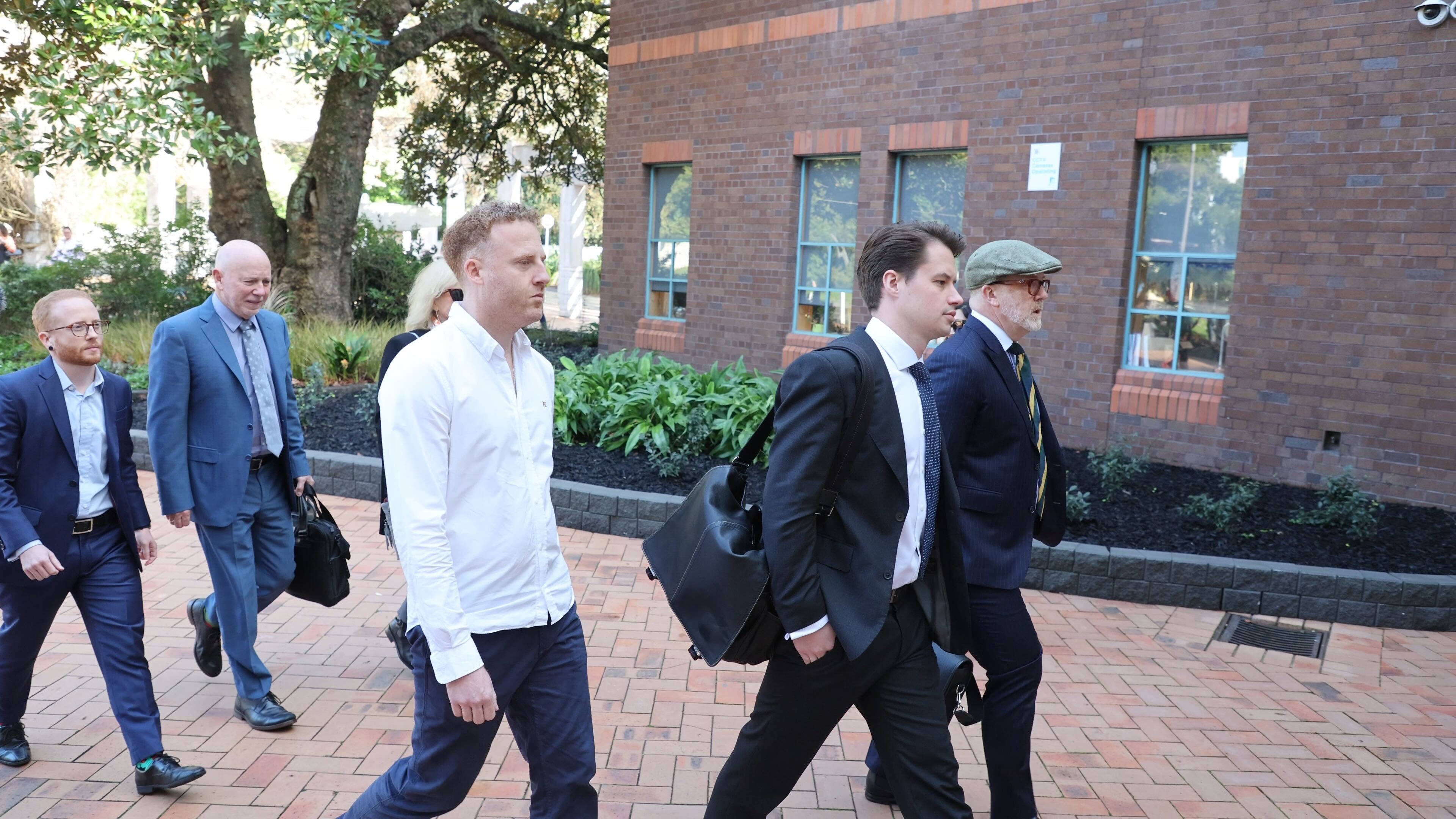
Philip Polkinghorne, his defence team, and his family arriving at Auckland High Court this morning.
Polkinghorne today arrived with his sons, Ben and Taine Polkinghorne, as well as his sister Ruth, pictured here holding his arm.
His other son, John, is also inside the court.
Photos / Michael Craig
Polkinghornes and Hannas in court today as defence opens its case
Vera Alves
Polkinghorne's three sons Taine, Ben and John are at court to see their father's lawyer, Ron Mansfield KC, open the defence's case.
Also here for the first time is Tracey Hanna, Pauline's sister, who has lived in the UK for many years.
His sister Ruth was also in the contingent who strode silently into the Auckland High Court this morning.
None of them gave evidence for the prosecution. They all declined to speak to media on their way into court.
Bruce Hanna, Pauline's brother who gave evidence, is once again at court.
There is a huge contingent of people waiting to get into the public gallery of courtroom 11.
Proceedings will begin at 10am. It's expected the defence will open their case. But as we've learned in this trial, anything could happen, and the Crown have yet to formally close their case. So we could see a few more questions of their last witness.
Defence to open their case today
Vera Alves
At 10am the defence is expected to open their case.
Polkinghorne's sons arrive in court for the first time
Vera Alves
Philip Polkinghorne has arrived at court with two sons, Taine and Ben, who have made their first appearance of the five week trial.
His other son, John Polkinghorne, is also at court.
Also with the contingent of Polkinghorne's was his sister Ruth, making her first appearance as well.
None of them spoke to media as they strode towards court, remaining silent.
They arrived with Rob Mansfield KC and his junior Harrison Smith.
Pauline Hanna's sister attends trial for the first time
Vera Alves
Tracey Hanna, Pauline Hanna’s sister, has arrived at the Auckland High Court for the first time, 23 days after the trial started.
Defence lawyer Ron Mansfield and Polkinghorne have yet to arrive.
The trial is set to start at 10am when the defence are expected to open.
Tracey has lived in the UK for many years, the trial has heard.
Polkinghorne trial day 23: defence case set to begin
Vera Alves
Welcome to the fifth day of the fifth week of the murder trial of Philip Polkinghorne, the Remuera eye surgeon accused of killing his wife Pauline Hanna and staging the scene to look like a suicide. He maintains she killed herself.
After a couple of false starts it appears the Crown will close its case this morning and the defence will open. After defence lawyer Ron Mansfield’s opening address, he will begin calling witnesses to support their contention Hanna killed herself by hanging, following years of intermittent depression and suicidal thoughts, and amid huge work stress.
Yesterday morning, the court emailed us shortly before 9am to say the trial would not sit on Thursday but would resume as usual at 10am tomorrow.
Later on Thursday morning, Justice Graham Lang issued a minute saying he had received a memo from Polkinghorne’s lawyer advising he needed to conduct further inquiries to be in a position to open the defence case.
The judge said he then had a telephone conference with the lawyers and was satisfied it was appropriate to afford the defence further time.
The shape of the defence case has begun to form via the extensive cross examination by Mansfield of Crown witness. It’s clear he’ll call several expert witnesses for the defence, including IT and electricity specialists, and the defence’s own pathologist, who concluded Hanna died after hanging herself, Mansfield said earlier in cross examination.
But as is usual he has yet to signal to the jury whether he will put his client in the witness box. And it’s not clear who he’ll call as lay witnesses.
The trial is set down for six weeks. But trials can and do run over time.
Stay tuned. Court will resume at 10am.
What the jury heard on Wednesday
To recap what we heard on Wednesday, by the time proceedings finished early that afternoon.
Mansfield had been cross-examining police digital forensic analyst Jun Lee, a surprise last-minute police witness.
The jury heard he had taken the cross examination as far as he could without seeking further advice.
The Crown case was set to conclude on Wednesday.
Lee was the last of about 60 Crown witnesses and was a surprise addition to the prosecution’s lineup.
He was called in at the 11th hour to address an assertion in cross examination by Mansfield that Hanna’s phone had been used to draft two unsent messages about 4am on the day of her death, to her husband and the daughter of a family friend.
Lee said the logs the defence IT expert used to come to this conclusion were from an automatic lookup process that occurs in the background without the phone being used, as part of its security processes.
He said that if the phone had actually been used to draft a message, there would be logs showing it had been picked up and unlocked. Those logs were missing, he said.
As a result, Lee said it was a straightforward analysis to confirm the phone as not used again by Hanna after 10.47pm.
Justice Lang told the jury on Wednesday that after the initial cross examination that the trial was finishing early for the day for Mansfield to consult his defence IT expert on further questions.
There has been one notable omission from witnesses called by the Crown - Australian escort Madison Ashton, with whom the ophthalmologist developed a years-long relationship.
She was mentioned many times in evidence, and texts she exchanged with Polkinghorne in the days after his wife’s death ranging from loving to testy were repeatedly read to the jury.
Ashton’s name was among those read out to potential jurors at the start of the trial.
The nine women and three men who will decide this case have not been told why she was a no-show.
Earlier on Wednesday, Detective Senior Sergeant Chris Allan, the officer in charge of the case, said police obtained a warrant shortly after Hanna’s death on April 5 to intercept Polkinghorne’s calls.
Among those calls was one on April 8 to pathologist Rexson Tse, two days after Kilak Kesha conducted the autopsy for the police. Just as the recording was about to be played to the jury, Auckland Crown Solicitor Alysha McClintock raised a legal issue, and it was not played.
Before that, Mansfield said the Polkinghorne home had panic buttons in both the master and guest bedrooms upstairs, where Hanna and Polkinghorne slept respectively on the night of April 4.
But it appears police made no note of that beyond recording the written statement of an Auckland Eye worker who stayed at the home, who mentioned the button.
The prosecution alleged Polkinghorne lied in the letter to his wife where he said he was spending a few days over Christmas 2019 at a retreat course in Auckland called "moving on and up", during which he told Hanna he wouldn't be able to reply to her messages. Police secured records from Customs showing he flew to Sydney while she was at what was meant to be their family Christmas at their Ring's Beach bach. At the time, Ashton was based out of Sydney.
Another new piece of evidence to emerge from Allan’s time in the witness box was that meth cost about $350 per gram in Auckland in 2019 meaning the 37g found in Polkinghorne's home would have been worth roughly $13,000, not taking account any wholesale discounts
🎧 LISTEN | Accused: The Polkinghorne Trial
Vera Alves
STORY CONTINUES
Polkinghorne arrived at court this morning accompanied by family members, including two of his sons, for the first time during his trial.
His sister Ruth was holding his arm as the contingent made their way into the courthouse to hear the defence open its case.
Jurors in the High Court at Auckland have now sat through nearly five straight weeks of testimony, with the Crown having called its final witness.
Jun Lee, a digital forensic analyst and civilian police employee, was called at the last minute on Wednesday to rebut a revelation by the defence that Hanna’s phone had logged two interactions around 4am on the morning of her death. Polkinghorne’s 111 call reporting her death was about four hours later.
Jurors were left with the impression that the 4.04 and 4.05am logs were indications that Hanna’s iPhone had been used at that time to draft two messages – one to her husband and another to the teen daughter of a friend. If that was the case, the iMessage texts were deleted before they were sent and their contents are unknown, Mansfield suggested on Tuesday as Detective Andrew Reeves sat in the witness box for a third day.
The defence implied the messages could have been aborted goodbye notes as she contemplated suicide. If jurors decide the evidence is sufficient to conclude that Hanna was on the phone at 4am, it will significantly reduce the timeframe for when she died.
When asked about the logs on Tuesday, Reeves suggested there might be alternative explanations. Polkinghorne knew his wife’s pin code, he pointed out. But Reeves said most questions about the log entries would be best directed at an IT expert.
Lee, the expert, was adamant the defence was flat wrong in its interpretation of the data.
“It just runs in the background,” he said. “I have checked. There was no user interaction of the phone at all.”
Lee explained that iPhones frequently run checks of other iPhone users on a person’s contact list – verifying their authenticity in an effort to protect against phishing scams. Doing so will create a log. But if someone was to use iMessaging, even if to draft a note that was deleted before it was sent, there would be “heaps of logs” to make it evident.
Hanna’s phone, he said, had no logs indicating that it had been turned on or even picked up around that time.
Mansfield asked if such logs are sometimes omitted when extracting data from a phone for analysis. Lee insisted that wasn’t the case.
“It’s fairly straightforward,” the witness said. “We deal with this every single day.”
The trial ended early on Wednesday so Mansfield could consult with his own tech expert in Australia. He sought extra time yesterday for his preparations, which meant the trial didn’t go ahead.
Mansfield briefly addressed the jury with an opening statement at the start of the trial but he will have an opportunity today to give a more fulsome outline of the defence case before the first of Polkinghorne’s witnesses are called.
Craig Kapitan is an Auckland-based journalist covering courts and justice. He joined the Herald in 2021 and has reported on courts since 2002 in three newsrooms in the US and New Zealand.
The Herald will be covering the case in a daily podcast, Accused: The Polkinghorne Trial. You can follow the podcast at iHeartRadio, Apple Podcasts, Spotify, through The Front Page feed, or wherever you get your podcasts.