Philip Polkinghorne murder trial live update: Defence pathologist weighs in on Pauline Hanna’s suspicious death
WARNING: DISTRESSING CONTENT
The mechanics of a partial hanging - the defence Dr Philip Polkinghorne contends his wife used to kill herself - would have been relatively easy for her to achieve, an overseas expert has told jurors in the eye surgeon’s trial for murder.
But much of the evidence so far from retired pathologist Stephen Cordner cannot be reported - by court order - to anyone outside the High Court at Auckland courtroom, where the sixth week of the high-profile trial continues.
“Some of what I’m going to be talking about is pretty grim stuff, so I apologise for that,” he warned jurors as he began his evidence, which took all morning and is expected to continue well into the afternoon.
Polkinghorne, now 71, is accused of having strangled his wife of 24 years inside their Remuera home before staging the scene on April 5, 2021, to look like a suicide by hanging. Two pathologists called by the Crown earlier in the trial have said both strangulation and hanging were possible reasons for her death due to neck compression.
STORY CONTINUES AFTER THE LIVE BLOG
James Wheeler
Defence lawyer Ron Mansfield is finishing up for the day.
Mansfield asks defence pathologist Stephen Cordner if there is no indicative injury, internally or externally, to support the idea Pauline Hanna died by manual (hands) or ligature (belt, rope or similar) strangulation as part of a homicide?
“There is no evidence of a forensic pathology kind to positively support a conclusion that this deceased has been homicidally, manually or ligaturely killed,” Cordner told the court.
That's it for today. Court will resume 10am Friday, with more evidence from the defence pathologist.
The trial is not sitting tomorrow because jurors have other commitments. Mansfield is also in the Court of Appeal tomorrow.
James Wheeler
The defence line of questioning now moves on to manual strangulations.
Ron Mansfield asks defence pathologist Stephen Cordner if we'd expect to see clear internal and external injuries?
Yes, says Cordner.
Mansfield: And we might also see other defensive injuries to the victim?
Cordner: Yes.
Mansfield: And no such injuries in this case?
That's right, says the defence pathologist.
Defence lawyer: “And the injuries aren't there, are they?”
James Wheeler
Defence pathologist Stephen Cordner tells the court he would expect to see serious injuries inside the neck or other injuries consistent with assault in a ligature strangulation.
“And the injuries aren't there, are they?” asks defence lawyer Ron Mansfield.
“No, they're not,” says Cordner.
Mansfield is on to manual strangulations.
Cordner says they can be achieved just by hands around the neck, or by a choke hold, called a carotid hold by one of the pathologists called by the Crown, Dr Martin Sage.
That is a hold from behind where the assailant applies enough force to compress both the veins and the carotid artery.
(Carotid arteries are the two blood vessels on either side of the neck taking blood to the brain.)
“It's said SAS-style people are taught this sort of thing as an effective way of overwhelming people,” says Cordner.
Such a hold would require a disparity in strength and size, says Cordner.
That sort of hold could result in blood, skin or DNA under the victim's fingernails, Cordner agrees.
He says you'd expect to see visible bruising on the neck as well.
Mansfield says Cordner has talked about trained professionals like in the police or Army using this hold, but is it commonly used by laypeople successfully in a domestic setting?
Justice Graham Lang interjects, and asks if the witness has come across this in his experience.
"No," says Cordner.
"And that's really my point," says Mansfield.
Cordner qualifies that to say he has been involved with occasional deaths when police apprehend someone and it's unclear precisely how the suspect was apprehended.
"I really wouldn't regard myself as an expert in what the SAS do or more highly trained parts of the police force," says Cordner.
Even with training, Cordner says he'd expect in most cases a carotid hold to cause injury.
Defence pathologist says leather belt would have caused neck abrasions if it was used to strangle Hanna
James Wheeler
Defence lawyer Ron Mansfield asks the witness, Stephen Cordner, how many years he's been a pathologist for.
Cordner says 43 years, but he's been retired for five.
Mansfield: Have you ever had yourself a case of a homicidal ligature or manual strangulation resulting in no internal or external injuries?
“Obviously the answer's no,” Cordner says.
The trial heard earlier Hanna did not have any obvious injuries to her neck.
“It doesn't seem to appear in the literature and I haven't had such a case,” the defence pathologist says.
Mansfield is back to the lack of neck injuries.
Cordner said that if the belt was used as a ligature in a strangulation, it would have moved on the neck, causing abrasions, which were not seen on Hanna's neck.
“We find it easy to underestimate the dynamism of these sorts of events,” he says.
The permutations and combinations of two individuals, one trying to kill the other... “vigorous doesn't do it justice”. It would be “chaotic and hard-fought,” he says.
There would not need to be much movement of the leather woven belt to cause some abrasion, says Cordner.
Defence pathologist: 'We're not in the ballpark of assaultive injuries'
James Wheeler
Defence lawyer Ron Mansfield says we know Pauline Hanna was wearing rings, including some with a stone embedded. During a fight, might skin, blood or DNA become lodged in the ring?
Yes, says defence pathology witness Stephen Cordner.
Further, there might be bruising from the ring apparent if she had been in a fight? asks Mansfield.
The witness agrees.
Neither of the above was identified in the post-mortem examinations, Cordner agrees.
Cordner says he wouldn't want people to think we are sort of close to the mainstream of the sort of injuries that accompany homicidal strangulations.
The number and severity and pattern of injuries to Hanna does not allow the conclusion those injuries were the result of an assault, he says.
We've got minor abrasions and other non-specific injuries, the defence pathologist Cordner clarifies.
"It's about five injuries, and in five of the 27 suicides that I looked at from the institute, there were a small number of non-specific injuries in those cases."
"I really want to be clear we're not in the ballpark of assaultive injuries... where any forensic pathologist could conclude assault," Cordner says.
Cordner says again that 70% of cases of homicidal strangulations showed extensive assaultive injuries. In the other 30%, there were obvious reasons why there were not injuries, such as the victims being young or unwell, he said earlier.
Expert confirms no DNA from Polkinghorne found under Hanna's nails
James Wheeler
Defence lawyer Ron Mansfield asks pathology witness Stephen Cordner about nail clippings taken from Pauline Hanna.
Cordner explains that's a standard process as part of any autopsy examination in these sort of circumstances.
If the victim has managed to scratch an assailant, there might be skin of the assailant under the fingernails, there might also be blood beneath the nails and therefore DNA, he says.
And you're aware there was nothing by way of Philip Polkinghorne's blood, skin or DNA found? Mansfield asks.
"That's my understanding, yes," says Cordner.
Cordner confirms he's aware Hanna wore artificial acrylic nails.
Mansfield says all her nails were present, or in place, with none dislodged, when her body was examined.
Cordner agrees. But to be fair, one was missing from her large toe, and it was later found in the washing machine with some bedding and gym gear, says Mansfield.
If there was a struggle or a fight... is it helpful or unhelpful as far as you're concerned that all of her acrylic nails were in place, the defence lawyer asks.
Cordner says it's common sense that shows there has not been any great disturbance.
In one study, an author studied 20 assailants in ligature or manual strangulation, and 12 of them had injuries, such as scratches to the face or neck as victims fought back, Cordner says.
The trial heard earlier Polkinghorne had a small fresh abrasion on his forehead when police arrived, but no other injuries.
Cordner says he did not see any form of clear defensive injury suggesting she had been embroiled in a struggle. Not did Dr Kesha or Dr Sage – the pathologists who appeared for the Crown, he adds.
Pauline Hanna's injuries consistent with death by hanging - defence pathologist
James Wheeler
Court has resumed.
Defence lawyer Ron Mansfield KC is questioning pathology witness Stephen Cordner on the cluster of bruises on Pauline Hanna's right arm, seen during the autopsy and photographed.
Cordner says what's interesting about the photograph, compared to the one at the scene, is the one at the scene shows lividity in that area of the arm, but the autopsy version does not.
Does their appearance help us, asks Mansfield, with the level of force that might be applied?
Cordner says that if Hanna was grabbed, the question is why there is no corresponding thumb mark on the other side of the arm, or a grab mark on the other arm either.
Mansfield is on to questions about a single bruise on the right side of her head, near the temple region.
Cordner says it could be accidental, but it could also be blunt force trauma resulting from a punch or other blow.
Mansfield confirms this means it's also a "non-specific injury" that doesn't help narrow down the cause of death.
Cordner tells the court the level of force to cause the bruise to the right temple was not the result of somebody wielding a weapon and did not cause the skin to break.
It's a modest bruise. Mansfield clarifies it's 5cm x 2cm.
There seems to have been a bit of biting of the tongue, Cordner says.
There was hemorrhaging at the base of the tongue as well, attributed to a congestion resulting from the blocking of veins.
Mansfield asks if the injuries he's just traversed are consistent with an incomplete hanging.
Cordner agrees.
"There's nothing incompatible in my view with the presence of those injuries and a conclusion of an incomplete hanging."
Scene photo challenges grip mark theory
James Wheeler
Defence lawyer Ron Mansfield asks pathologist Stephen Cordner, even if it had occurred in life, whether the injury is non-specific and does not help prove if it's a manual or ligature strangulation or a partial hanging?
Cordner raises the point that if it was a forceful or violent grip, why was there no mark all the way around the arm? He also says she had a level of alcohol in her blood when she died, and someone could have gripped her to steady her.
“I don't think that constellation of bruises on its own constitutes or justifies a thought that it is assaultive in nature.”
Mansfield has produced the scene photo as an exhibit. It apparently shows no bruising on Pauline Hanna's arm after her death.
To recap – the Crown has suggested they showed bruises in the shape of a grip mark on her arm.
We are taking the afternoon break. Court will resume shortly.
Defence produces surprise photo, as expert says arm bruises could have happened after death
James Wheeler
Defence lawyer Ron Mansfield says there was also an abrasion on Pauline Hanna's back.
Defence witness, pathologist Stephen Cordner, says it was not bleeding and there's no bruising, so it's in the same category – superficial – as the nose injury.
“So another non-specific injury that takes us nowhere?” asks Mansfield.
“That's right,” says Cordner.
Mansfield is now referring to the cluster of four contusions – bruises – on her right arm.
“The thing that immediately comes to mind is it looks like a grip,” says Cordner.
He says doctors cannot tell the difference between a bruise that happened 10 minutes ago or a day ago. But they do eventually go yellow, about 18 hours at least after the bruise was inflicted.
“So we don't know when those bruises got there.”
However, there is a photo of the scene showing there are no bruises on her right arm, says Cordner.
Mansfield is producing the surprise photo for the judge.
This is the first the trial has heard of a police photo taken after death that does not show the bruises on her right arm.
Cordner says this is the only photo of the back of the right arm at the scene, and he can't see any of the bruising observed in the same area during the autopsy.
The prosecution is checking something with Mansfield.
His questions resume. He asks how bruising of that kind might occur after death.
Cordner says one reason could be that there was already bruising, but it hadn't appeared yet, because the bleeding from the small injured area under the skin emerged superficially. That's a phenomenon that can continue to occur after death, he explains.
It also does raise the possibility that the bruising could be caused by the movement of the body after death, he says.
"I think it could happen after death, I don't know that it happened after death."
More defence questioning over Pauline Hanna autopsy findings
James Wheeler
Defence witness, pathologist Stephen Cordner, as an aside is talking about the phrase “consistent with”, explaining it links two things on the level of them being possible.
Martin Sage, a Crown pathology witness, earlier told the trial he did not like the phrase. Cordner doesn't either.
What should he say instead? asks defence lawyer Ron Mansfield.
“You're the master of the words,” says Cordner.
Justice Graham Lang says “a possible explanation” might be better.
To illustrate this point, the petechiae (blood spotting) and facial congestion are consistent with partial-suspension hanging.
But they also can be consistent with death by homicidal strangulation.
Mansfield then refers to an injury on Pauline Hanna's upper-right eyelid.
Cordner says both injuries showed tiny ecchymosis (another word for bruise).
This is another manifestation of the petechiaeal haemorrhages which the jury heard earlier were caused by blood being unable to return from the head, because the veins in the neck are blocked.
There were also a couple of abrasions on the nose, Cordner says.
They do not show evidence of bleeding, he says.
And the pathologist did not describe any bruising or a bleeding nose. So in a medical sense, they are trivial injuries, he says.
But if it's the case there is no bruising, those injuries could have been caused after death.
"Bruising is the hallmark of a vital sort of injury, or bleeding is [also] a vital sign."
The injuries on the nose could have been caused after death, Cordner agrees.
Pathologist questioned on Pauline Hanna autopsy findings
James Wheeler
Defence lawyer Ron Mansfield asks pathologist Stephen Cordner about the protruded, dried tongue evident in Pauline Hanna's autopsy.
Cordner says the tongue was even dry at the scene.
“That is a very common thing to see in hanging,” says Cordner.
But it can also be seen from other forms of neck compression, he adds, qualifying that the state of the tongue does not prove she died by hanging.
Judge seeks clarity on pathologist's lividity evidence
James Wheeler
Justice Graham Lang asks defence witness pathologist Stephen Cordner to clarify a point on the lividity.
Cordner says lividity is the settling of blood due to gravity soon after death, becoming fixed six to 12 hours or even later.
So if you're moving the body around in that period, the lividity moves. After 12-24 hours, the lividity won't move.
Defence lawyer Ron Mansfield asks, if Pauline Hanna died while seated, whether the lividity would commence after her death and there would be a settling of blood consistent with a seated position? (e.g. with redness developing in her lower legs).
Cordner says, to clarify, it is a sign that is compatible with her sitting in the chair after death.
Then when she's moved and laid down on the ground, some of the lividity, but not all, would move.
Not much had moved by the time emergency services arrived, says Cordner.
But when she's placed in a body bag and taken to the mortuary for an autopsy, there would be further movement, the witness agrees.
He again agrees the lividity pattern evident in the photos is consistent with her being seated, then placed onto the ground, as Philip Polkinghorne claimed happened.
Defence pathologist says lividity of body consistent with Polkinghorne's version of events
James Wheeler
Defence lawyer Ron Mansfield asks pathologist Stephen Cordner if there is anything on the lividity markings that helps show Pauline Hanna was seated before being placed on to the floor?
The characteristic appearance of lividity in a fully suspended body, the blood goes down into the legs and possibly fills up to the lower abdomen.
“The lividity looks like a pair of trousers on the deceased,” says Cordner, and the hands and forearms could also look dusky and dark.
The dusky colour on the back of the thighs is different to the pale colour on the front, he says. The same thing is evident on the hands, not present on the right arm which may have been on the front of the lap, the witness says.
Cordner says he doesn't want to be sitting there “like I'm speaking from Mt Olympus”, and says there's no hard and fast rules.
However, the lividity pattern is consistent with Hanna being seated for some period after death, he says.
He says the lividity in the lower legs is not apparent at the time of the autopsy.
“So I reckon the lividity was still mobile at the point where she's laid on the ground.”
And that's an indicator that death possibly occurred in the relatively small number of hours before she was found, he says.
Pathologist explains how lividity reveals body's position after death
James Wheeler
The questioning of the defence to pathologist Stephen Cordner moves on to lividity now.
Cordner explains that after death, blood settles within the body, consistent with gravity. If you're lying on the floor, the blood settles closest to the floor, apart from the parts of the body compressed against the floor, which will appear white.
But all the bits in between, the hollow of the back, back of the knees and neck, they'll be darker red, because that's where the blood has settled to.
The front of the body will be pale because the blood has settled towards the floor, by the back.
“How long does it take to settle and set?” asks defence lawyer Ron Mansfield.
Cordner says in very ill people, lividity can actually begin before death.
But normally it starts in the first few hours after death but remains mobile for a number of hours after that, possibly three to six hours before it fixes.
If you move the body in the first few hours after death, the lividity that has started might move.
A body on its back moved to a different position shortly after death, such as being rolled on to its front, might reverse lividity. But it mightn't all move, he says.
Can lividity be helpful to show someone's position before they were found in another position? asks Mansfield.
The defence lawyer explains that in this case, Philip Polkinghorne says he found his wife in a chair but was then told by emergency services (who understood it was a complete hanging) to cut her down, and he then placed her on the floor.
Condition of Pauline Hanna's body consistent with hanging, not homicidal strangulation, says defence pathologist
James Wheeler
Asked if the mark could have been left after Pauline Hanna's death, as part of a staged suicide as alleged by the Crown, defence witness pathologist Stephen Cordner tells the court you would have to imagine what it is like to manipulate a dead body to simulate a hanging by perhaps sitting the dead individual in a chair and setting it up to create this sort of thing.
“It's quite mind-boggling to imagine that, because that looseness and the floppiness makes the body very hard to manage,” he says.
Forensic pathologists say it takes two people to easily and successfully manoeuvre a dead body, Cordner says.
His point is that he finds it hard to see how someone could have manipulated Hanna's body after death to leave a mark such as was found on her neck.
Lack of abrasions on Pauline Hanna's neck suggests belt not used to strangle her – pathologist
James Wheeler
Defence lawyer Ron Mansfield asks pathologist Stephen Cordner that if the mark is left during life and is part of the ligature that has resulted in the blocking of veins or arteries, and it disappears, what is the period of time where that might occur?
In other words, you can see the mark here when they are called to the scene. Given we know it disappears by the time of autopsy, does it help with time of death, asks Mansfield.
"No I don't think it really does help with that time of death," says Cordner.
But there are some internal markers allowing some pretty general comments about that, the defence witness says.
For example, there's a discussion to be had in this case about post-mortem lividity (redness from blood pooling) and its impact on time of death.
Cordner says he gets the impression the body was not stiff when it was first observed, which also allows general remarks on time of death.
Cordner quotes some research from 1984, referenced in his report.
"It must be emphasised that pressure marks originally evident on the neck may disappear several hours later following removal of the ligature," says the quote from the research, read by Cordner.
The research refers to the suicide of a young boy where belt marks are seen on the neck after death but which had disappeared several hours later.
A rope would almost always leave an abrasion.
But in this case, we just have an impression, which didn't cause any abrasion or bruising.
The fact there's no abrasion shows the contact between the belt and skin is static, there hasn't been any relative movement.
If the thought was it might have been used as a ligature, then that's absolutely out, because there would have been differential movement between the ligature and the skin, says Cordner.
"There's none of that."
If it had been used as a ligature in a homicide, you would have expected to see abrasions on the neck? Mansfield asks.
"And everything else that goes inside the neck also, plus other injuries outside of the neck from the victim trying to remove the belt," Cordner says.
Disappearing mark on neck used by Crown as evidence of homicide of "no significance" – defence pathologist
James Wheeler
Pathologists in general don't have any problem concluding a death occurred via suicide by hanging, even when there's no mark on the neck, says defence witness Stephen Cordner.
He confirms again there can be no impression left on the neck during a suicide by partial hanging.
To recap – police photographs captured a mark on one side of Pauline Hanna's neck on April 5, which had all but disappeared by the time of her autopsy the following day.
A partial hanging using the woven belt could cause death and not leave any mark, agrees Cordner.
Defence lawyer Ron Mansfield moves on to the fact the mark on the left side of the neck was no longer present the day after Hanna's death, when her autopsy was conducted.
We can't tell the difference between a mark resulting from hanging and someone who's died and then is suspended after death within a couple of hours, says Cordner.
“For me, the disappearing mark has got no significance,” he says.
There's also no literature about this, says Cordner.
Partial belt mark does not prove Pauline Hanna was murdered – defence pathologist
James Wheeler
Defence lawyer Ron Mansfield refers to a mark on the right side of Pauline Hanna's neck that was photographed at the scene with a pattern consistent with the leather plaited belt.
Mansfield: A mark can be caused as part of death, contributing to the incomplete hanging, or it can be caused or left after death, correct?
Yes, says the witness, pathologist Stephen Cordner.
He agrees the mark could have been made pre or post-mortem.
“This is I think a complete point of agreement with the two pathologists that have already given evidence, which is that the petechiaeal haemorrhaging we've already talked about, which are above the neck, really are an indicator that we think this deceased has died from compression of the neck. The question still remains if the compression of the neck was caused by one thing or the other,” says Cordner.
He agrees the mark on the right side of her neck photographed by police could have been caused by a suicide by hanging.
None of these marks resulted in bruising to the skin of the neck, so the marks could have occurred after death.
It's also possible a lineal abrasion on the left side of the neck, for all he knows, could be associated with the way the body was handled after death by investigators.
Does the absence of the belt impression all the way around the neck rule out an incomplete hanging? asks Mansfield.
No, says Cordner. "I'm not lying awake at night worrying about that."
The lack of the belt mark going all the way around the neck does not at all exclude suicide by hanging, says Cordner.
Defence pathologist says lack of drag marks on Pauline Hanna's body go against homicide theory
James Wheeler
Defence lawyer Ron Mansfield KC asks the witness, pathologist Stephen Cordner, whether, when we're looking at the scene where a body's found, can we draw some assistance from indicators at the scene as to whether it's a hanging versus a homicide by strangulation?
Cordner says the literature does show typical indicators.
The witness agrees the lack of drag marks on the floor or body are factors suggesting a homicide did not take place.
“There might be abrasions on exposed skin that have dragged across carpet or rough surfaces. You can get carpet burn.”
To recap, Hanna had no drag-mark injuries.
Mansfield asks if there might also be bruising showing how they might be held or carried.
“Yes, moreso if they're alive at that point,” Cordner says.
A body with clothes on backwards, or lacking clothes, injuries that cannot be attributed to a suicidal hanging and hemorrhages to the anterior and lateral parts of the tongue were all also factors more commonly seen in a homicide versus a suicide, he agrees.
James Wheeler
“Women and, particularly as they age, the structures of the neck, they calcify. So the larynx, the cartilages calcify and even ossify, turn into bone, and this makes them more brittle and more susceptible to injury,” says defence witness and pathologist Stephen Cordner.
That makes fractures more likely in both strangulation homicides and suicides by hanging, bearing in mind fractures are more likely in strangulation homicides compared to suicide hangings.
Cordner says Hanna was of the age when skin bruises became easier to cause, and the skin becomes thinner and easier to break.
To recap, the jury heard Hanna had bruise marks on her arm in the shape of fingers, like she had been grabbed, but the defence contends this could just have been someone stabilising her, like her personal trainer with whom she had an appointment two days before she died.
Defence lawyer Ron Mansfield KC is moving now to what we know of the death of Hanna.
James Wheeler
Professor Stephen Cordner is back in the witness box, with Ron Mansfield KC continuing to lead his evidence for the defence.
Mansfield is on to questions about the “venue” for suicide by hanging.
What do the studies show? asks Mansfield.
Domestic is most common, i.e. at home, and usually inside, Cordner says.
In England, 65% of suicides by hangings happened in the deceased's usual place of residence, the witness says.
Mansfield asks about cases showing a lack of internal injuries in an autopsy of a hanging victim.
The type of knot and whether it's a partial- or full-suspension hanging were factors, says Cordner.
James Wheeler
The public are filtering back into the gallery.
Earlier they were told by Justice Graham Lang to keep quiet when they came into court, when he is down and the jury is ready.
Justice Lang is back. And here's the jury.
Judge clarifies suppression orders on defence pathologist evidence
James Wheeler
Justice Graham Lang has released a minute clarifying the scope of the suppression orders covering the evidence of the defence's pathologist, Professor Stephen Cordner.
This followed discussions between the defence, prosecution and reporters in court about how the defence case can be fairly and accurately reported within the bounds of the suppression order already imposed.
It has been agreed that the media can report that, according to the defence's case, it would have been “relatively easy” for Pauline Hanna to achieve a partial hanging in terms of its mechanics, the minute says.
“However, the media cannot report anything more general that addresses the issue of the mechanics or methods by which it is possible to achieve suicide by partial hanging.”
Trial adjourns for lunch
Vera Alves
Justice Lang has called the lunch adjournment. It's a slightly shorter lunch break, we'll resume at 2pm.
Vera Alves
Asked about what people use to hang themselves, Professor Stephen Cordner says people generally use whatever is to hand, and the decision is very much subsidiary to the decision to attempt to take their own life.
Cordner says there are about 11 suicides per 100,000 of population in Australia, compared to 10 in New Zealand.
In Australia, 50% of suicides are hangings, he says.
In New Zealand in 2022, there were 565 suspected suicides, about double the road toll.
Kiwi health authorities don't break it down by method, which is understandable, but they do say hanging is becoming more common, Cordner says.
Suicide is 10 times as common as homicide, says Cordner.
Mansfield says it's important the trial has an understanding of the sad fact suicide by hanging is common.
The consumption of alcohol, is that a feature of suicide by hanging? asks Mansfield.
Cordner says the answer is yes. In about a third of cases of hanging, according to a very large study in Queensland, there was prior consumption of alcohol.
To recap, toxicological analysis found alcohol in Hanna's blood. Notes are found in just a third of suicides.
"A lot of people in the community would think suicide and a suicide note go together," but it's not the case in more than half of cases, says Cordner. Police did not find a note, but Polkinghorne claimed to a friend after he was charged that he'd found a note, his friend Alison Ring told the court earlier.
About a half of suicide cases had experienced conflict at work or home before their death, the witness says.
"There's no hard and fast sort of rules really," says Cordner.
Vera Alves
Cordner's evidence has now moved back into suppressed territory and general statistics about suicides.
Vera Alves
The forensic pathologist, Professor Stephen Cordner, is now on to homicidal manual strangulations (with hands) or ligature strangulations.
The circumstances of these are those of an assault and there's a likelihood the assault will be over an extended period, because the victim will probably resist and fight back.
The resistance might result in injuries as they try to remove the ligature, causing scratches of their own on the neck, Cordner says.
They might injure the assailant as they push away and scratch the attacker's face, hands or neck, Cordner says.
The generally accepted view, he says, is that homicidal manual or ligature strangulation is very often the end point of a more sustained assault, he says.
"The assailant has to overcome the victim before the victim is in a position to be successfully strangled."
There's a general acceptance that if you are strangled, you're likely to have been the victim of a more sustained assault.
In cases where there is not a more sustained assault, there's a very good reason for that, he says.
Cordner says 70% of all victims of manual or ligature strangulation were the victim of a much more sustained assault, possibly including fractures to the skull.
The good reason the other 30% of strangulation victims who may not have been injured included that the victim might have had a natural disease, such as heart disease, "so [were] relatively easily overwhelmed", Cordner says.
The age of the victim was also a factor in the extent of defensive injuries, says Cordner, referencing the case of an 11-year-old who was drugged beforehand.
Forensic pathologist describes injuries associated with different types of hanging
Vera Alves
Defence lawyer Ron Mansfield asks forensic pathologist Stephen Cordner about the sort of injuries you might expect to see from a death by compression of the neck veins.
Cordner says this stops blood circulating out of the brain, so it builds up in the head and if that's sustained, the little veins "pop" so there are showers of tiny blood spots or haemorrhage in the skin, face and other tissues.
These Petechiae, the tiny spots of bleeding under the skin, are more concentrated around the loose skin around the eyes and ears, because small blood vessels there pop more easily.
Petechiae are seen in 60% of partial hangings, and about 30% of full suspension hangings, he says. During the Crown case, the trial heard pathologist Dr Kilak Kesha recorded Petechiae in areas of Hanna's face.
The lack of blood flow also causes "congestion" of blood above the ligature, or reddening, which can show whether or not someone was alive when the ligature was applied.
Mansfield moves on to possible injuries to the tongue.
Cordner says the tongue is very vascular (full of veins), particularly the base, so it's prone to haemorrhaging from congestion rather than trauma.
Mansfield asks how he approaches the question of whether a death is from a partial or incomplete hanging, or whether it's a homicide.
Because the person wants to die, there are none of the injuries associated with a more sustained assault, the jury hears. But occasionally there are other self-inflicted injuries, Cordner says.
Cordner continues to describe the differences between the types of hanging and the injuries he expects to see in each of them.
Vera Alves
Forensic pathologist Stephen Cordner says while we've been talking about veins, arteries, the airway and the Vagus nerve, there are a number of other structures in the neck which can show evidence of an assault, or the lack thereof.
They are the skin's subcutaneous fat, muscles, cartilage and connective tissue, as well as the blood vessels and the airway, which can be injured.
"They’re the markers of what has happened to the neck," says the pathologist.
The tongue, sitting on the hyoid bone, can also be injured during an assault.
The back of the neck has the thick, tough skin found on the back generally, but it can also be injured by manual or homicidal ligature strangulation. It can also be injured in some hangings, Cordner says.
On either side of a vertebrae in the back is another artery feeding the brain, he says. But relying on that vertebral artery alone is not enough to keep the brain conscious, he says.
The evidence is back into suppressed territory.
Vera Alves
To provide some context on what the jury is seeing and hearing without breaching the suppression order, Cordner is traversing detailed medical evidence and referring to a diagram that has also been suppressed by the judge.
Vera Alves
The defence pathologist, Professor Stephen Cordner, is continuing to give evidence. It's about the general mechanics of suicide and much of it remains covered by the suppression order imposed by Justice Lang.
Trial resumes after morning adjournment
Vera Alves
The jury and the public are back. The families were quiet and respectful but the dozens of other members of the public, many with no connection to the case, were chattering away loudly, earning a rebuke from Justice Graham Lang.
"When you come in and I'm here and court is ready to go, can you please be quiet so we're ready to go when the jury is back?"
Trial adjourns for morning break
Vera Alves
Court will be taking a longer break until 12pm, when it will resume with more evidence from the defence pathologist Professor Cordner.
Judge suppresses details of forensic pathologist's evidence
Vera Alves
Defence lawyer Ron Mansfield produces documents for the witness and the jury relating to the neck, and different injuries associated with a suicide by hanging or a strangulation.
I can't remember if we produced this or not, says Mansfield.
"Yes," says a juror, holding up the document in question. They are paying attention as usual.
The booklet shows a diagram of neck structures affected by strangulation.
He refers to a diagram of the anatomy of the neck. In this trial we've learned already, says Mansfield, that in relation to death by hanging, it is either full suspension (like an execution) or a partial hanging, that results from occlusion (or blocking) of the veins in the neck.
Cordner says most people in the community think, when they hear of a domestic hanging in the community, that the person has died in a "judicial hanging".
"We've got to get that out of our minds as we think of this death, because the way people die is quite different," says Cordner.
The witness goes into further details of what happens in the different types of death by hanging.
“This is a very complicated part of the body functionally,” Cordner says of the strap muscles in the neck.
Some of the evidence currently being given by Cordner has been suppressed by Justice Graham Lang.
"We've seen a lot of quite distressing things in this case," Justice Lang says.
The judge explains to the jury he has the power to suppress the publication of evidence where it has the power to cause harm in the community.
He has also suppressed the diagram just shown to the court of the neck.
"I really need to make a blanket order suppressing from publication anything in relation to the mechanics of suicide," Justice Lang says.
The judge earlier suppressed much of the evidence of mechanical engineer Andrew McGregor, who gave evidence yesterday. McGregor conducted simulations which he said showed enough force could be generated to cause death by the arrangement described by Polkinghorne. The detail of these simulations is suppressed.
Forensic pathologist describes how he would document a scene
Vera Alves
Forensic pathologist Professor Stephen Cordner says manual strangulation or ligature strangulation are injuries with special characteristics. Looking for those or their absence is an important part of the autopsy, he says.
To recap, part of the Crown case was the belt mark observed on Hanna's neck by police on April 5, which had all but disappeared by the time of the autopsy of Dr Kilak Kesha the next day. The Crown and defence have interpreted the disappearing mark differently.
Cordner says the scene visit is important, because the findings of the autopsy need to be contextualised in terms of the scene, which is crucial to make "best sense of what you're seeing in the morgue".
How do you document a scene? asks Mansfield.
Cordner says there's almost always a police photographer.
Usually at the scene the pathologist directs the photographer to take photographs that will be useful, he says.
Mansfield asks that in a case of a suicide by hanging, would there be a focus at the scene to look at their neck to see if there was any injury or any mark that might be noticed?
Yes, Cordner says.
And if so, asks Mansfield, if a mark or injury was seen, how might that be recorded?
You'd photograph both sides and back of the neck, recording how it was at the closest possible time to the death, says Cordner.
He confirms that objects close to the body are also important for the pathologist to know about.
To recap – Mansfield, during his cross-examination of pathologists and detectives who gave evidence for the Crown, repeatedly questioned why they did not closely photograph or measure the ligature mark on Pauline Hanna's neck at the scene on April 5, before it mostly disappeared. Part of the Crown case is that the direction of the mark, more horizontal than vertical, showed the ligature was applied from directly behind her, not from a rope secured to a balustrade above her body.
"The basic principle is that all photographs in these sort of situations should have a scale in them," Cordner says.
"That's a principle, that's best practice and you are responsible if that causes problems down the line."
Mansfield and Cordner are discussing appropriate approaches to a death scene.
Would you also look for other types of injuries resembling an assault accompanying what might have happened? asks Mansfield.
Cordner says there's a train of thought among police and some pathologists that you shouldn't do it too much at the scene because you might contaminate something. But on the other hand, given the importance of everything at the scene, there's a good argument to make as many observations as you can, he says.
That's particularly important when the scene has already been contaminated, says Cordner.
Mansfield asks if there's a chance for injuries to occur in the movement of a dead body into a body bag and through to the pathology unit where the autopsy happens?
"Very occasionally significant injury... but minor injuries, yes," Cordner says.
To recap – Hanna's body showed minor scratches and scrapes, but even the Crown pathologist witnesses said the injuries weren't of the degree to be expected with someone fighting off a strangulation assault.
Forensic pathologist on what he was looking for when examining Hanna's body
Vera Alves
Forensic pathologist Professor Stephen Cordner says looking for natural disease is important, but adds that none was found in Hanna.
He confirms disease can be excluded as a possible cause of Hanna's death.
"We're looking for positive evidence of injury, we're looking for patterns of injuries, considerations of the injuries collectively," he says.
Cordner says that includes the absence of injuries.
"So the question here is has the deceased been killed or did she kill herself. If she's been killed, then that means assault. So then are there injuries that are commonly associated with assault," says Cordner.
"That would be for me a central concern in this case."
There's a general understanding in pathology that people who are strangled generally have injuries consistent with an assault.
"They've been beaten up," Cordner says.
'Pretty grim stuff': Forensic pathologist explains his role in investigation
Vera Alves
Professor Stephen Cordner confirms the issue the defence asked him to help with was whether Hanna's death was a homicide or a suicide.
Mansfield starts the witness with questions on his work as a forensic pathologist, what he's asked to do when he's requested to help the courts or the police.
Forensic pathology is the medical speciality of death investigation, Cordner explains.
Sometimes you go to the scene, but fundamentally it's an autopsy-based medicinal specialty.
"As a forensic pathologist, sometimes you go to the scene, but fundamentally it's an autopsy based specialty," Cordner says.
"The aim of which is to help, or try to help, reconstruct what happened back at the scene."
"Not rocket science."
The central feature of the investigation is an autopsy, an internal and external examination, to try to ascertain what happened at the scene.
The fundamental output, of course, is the cause of death.
But behind that there's a little bit of a story. "The cause of death can be really stated as a fact in a relatively small number of cases," Cordner says.
"Some of what I'm going to be talking about is pretty grim stuff, so I apologise for that."
That included someone being run over by a train, someone with serious knife wounds to the neck, severing all the blood vessels. These are unsurvivable injuries and the cause of death is plain to see, Cordner says.
That's a relatively modest number of deaths, 5% to 10% in a city like Melbourne or Auckland.
The other 90% is people who were alive a few seconds ago.
That included people who die in bed and have no obvious injuries.
"I'm just trying to say the cause of death in many cases is an opinion," Cordner says.
The question then is how strong the supporting evidence is, he says.
The real skill of a forensic pathologist is to discover all the disease and injuries that might be present, bearing in mind some of the injuries might be trivial, but in terms of what happened at the scene they could come to be significant, he says.
An important thing for a forensic pathologist is to not only have evidence form the internal or external examination of the body, but also to know about the literature published to help make sense of the things pathologists see, Cordner explains.
Vera Alves
We have now spent 16 minutes traversing the witness' credentials. On to his honours and awards.
They include a medal from the Royal College of Pathologists for Australasia for services in Bali.
"I'm sorry for taking quite some time going through that material," says Mansfield, but it shows how Cordner might be able to help in this case.
Defence lists witness' credentials
Vera Alves
Defence lawyer Ron Mansfield continues to talk through Professor Stephen Cordner's credentials.
Mansfield notes Cordner also studied law.
He studied at the University of Melbourne in the 1970s, qualifying with a degree in medical science and a diploma of criminology, and later a degree in medicine. Cordner also has a diploma of medical jurisprudence, and various other postgraduate qualifications.
He's also got an MA in medical law and ethics.
On to his employment.
He was at the Royal Melbourne Hospital from 1978 and was later a registrar in pathological medicine at Geelong Hospital.
Then he became a lecturer in forensic medicine, before rising through the ranks of academia, the trial hears.
He was eventually made a Professor of Forensic Medicine at Monash.
Cordner also held a role at the Victoria Institute of Forensic Medicine, conducting autopsies on victims of serious crime, the trial hears, from 1987 to 2014.
He has also been a consultant in forensic pathology for the Red Cross.
Cordner took a year off to work for the International Committee of the Red Cross in Geneva, going to the former Yugoslavia and Iraq to assist in examinations of the dead.
After he retired as director of the Victoria Institute of Forensic Medicine, he went back to routine, day-to-day practice as a forensic pathologist, the trial hears.
Cordner stopped doing autopsies routinely five years ago.
"I do a handful," Cordner says.
Mansfield asks Cordner if he would provide autopsy reports to police. He says yes.
Even while he was director of the institute for several years, he maintained a routine workload as a forensic pathologist, he says.
That means he'd conduct autopsies for the police and coroner, visiting scenes, conducting post-mortems and writing reports.
His scene visits included homicides, Cordner says.
He worked on behalf of both the coroner and state police.
Mansfield, continuing to burnish his witness' credentials, traverses his overseas appointments.
They included an appointment at Kings College Medical School in London and working on the UK Home Office list of forensic pathologists in the 1980s.
In the 2000s, he also had appointments in Canada, Mansfield says.
His appointment with the International Committee of the Red Cross remains current.
That role relates to victims of war and internal violence.
"So there is a massive need around the world for people who sort of have some understanding of how to manage the dead," Cordner explains.
He's worked in Malaysia, Hong Kong, Sri Lanka, Africa, the Indo-Pacific, and the US, the jury hears.
Defence calls first witness
Vera Alves
Defence lawyer Ron Mansfield has called Professor Stephen Cordner as the next defence witness.
Mansfield will be leading Cordner's evidence.
There is an issue with his chair. "Happy to stand," says Cordner. "That's all right, it'll be a long day," says Mansfield.
The issue is resolved.
Where do you reside? asks Mansfield.
He lives in Melbourne and is currently retired.
Cordner still holds a position at the Department of Forensic Medicine at Monash University. He's an emeritus professor there. That's an honorific given to retired professors, but he still does bits and pieces, of which this is an example, Cordner says.
Monash is based in Melbourne but has campuses in Southeast Asia and Europe, the jury hears. As is usual, Mansfield is running through the expert witness' CV.
Mansfield produces Cordner's CV as an exhibit. I know this will embarrass you, professor, says Mansfield, but I'll take you through your CV.
Change to prosecution team
Vera Alves
Crown prosecutor Brian Dickey, the former Auckland Crown Solicitor and now a barrister in private practice, told the jury yesterday it was his last day as he had a longstanding overseas commitment.
So there's a new prosecutor alongside current Auckland Crown solicitor Alysha McClintock. It's Pearl Philpott, who was introduced to the jury by McClintock.
Day 26 of the trial about to begin
Vera Alves
Court is about to resume and the Hanna and Polkinghorne families, followed by the many members of the public with no connection to the case but who come to watch proceedings each day, are filtering into the public gallery. There are 75 seats in the gallery of Courtroom 11 and once again they will be almost all occupied.
STORY CONTINUES
Given the unclear pathology findings, the Crown has relied instead on circumstantial evidence - particularly regarding Polkinghorne’s allegedly significant methamphetamine habit and an alleged strangling threat in the past. Prosecutors have also focused on the defendant having spent hundreds of thousands of dollars on sex workers and intimate messages with Sydney escort Madison Ashton in which the two appeared to be forming a serious relationship.
But the defence, now in its fourth day, has described all that as a salacious distraction. The real issue, lawyer Ron Mansfield KC has said, is that Hanna had been struggling with depression and alcohol abuse for years. And she had been under immense work pressure as she helped manage the rollout of the Covid-19 vaccination, defence witnesses have said.
Today’s witness, the third pathologist to enter the witness box, is expected to give a more unambiguous opinion of how Hanna died.
Cordner - a professor emeritus from the Department of Forensic Medicine at Monash University in Melbourne, Member of the Order of Australia and the retired director of the Victorian Institute of Forensic Medicine, which is tasked with conducting the region’s autopsies - said his central task was to determine if Hanna’s death was a homicide or suicide.
But much of his evidence so far has not been specifically about Hanna’s death - rather, a general overview of how suicides and strangling deaths occur and how they are detected. Justice Graham Lang suppressed much of the suicide background, explaining to jurors there was a danger in giving commonly unknown information about the process to people who may be vulnerable.
“We’ve seen a lot of quite distressing things in this case,” he said.
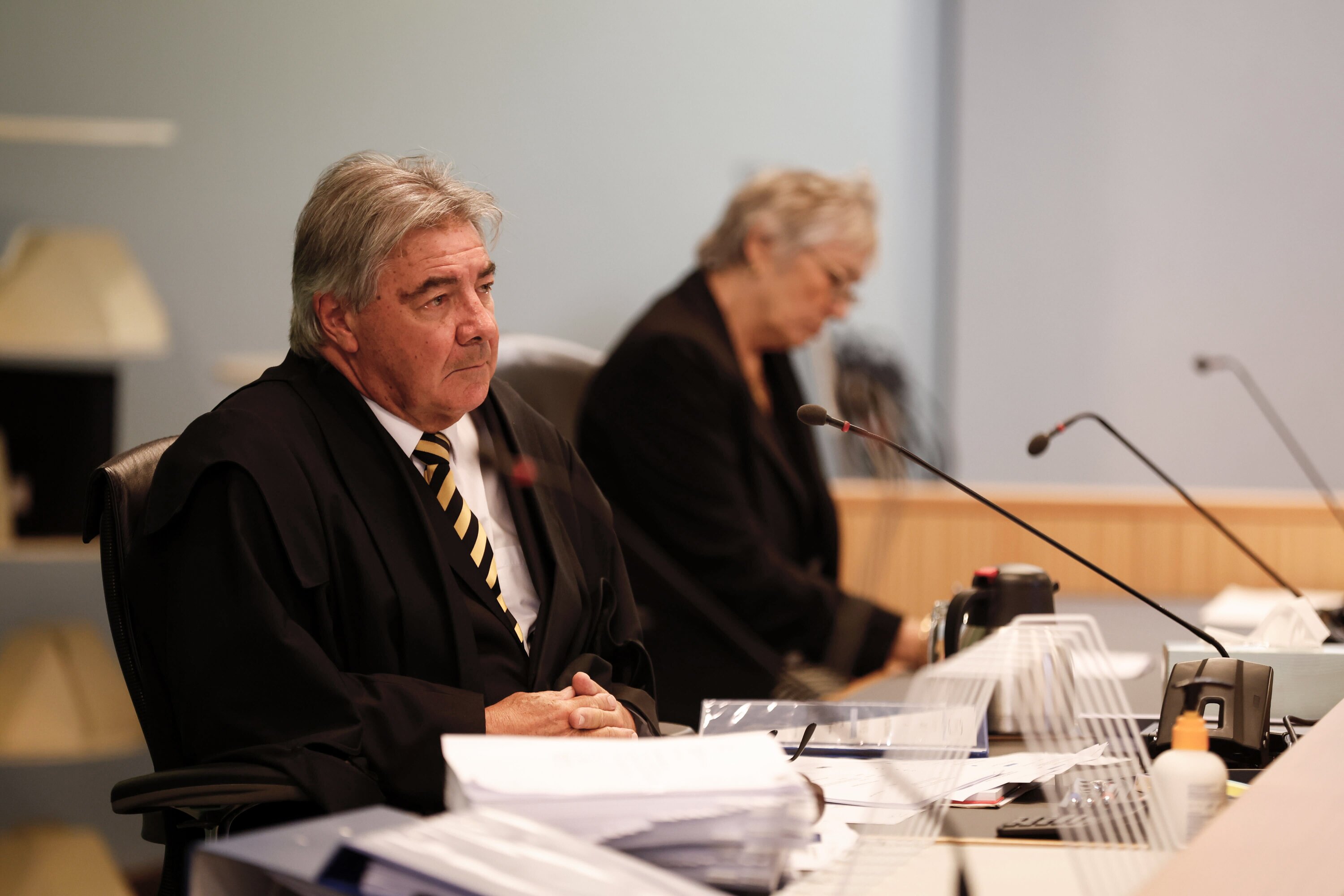
The Herald has, for similar reasons, voluntarily refrained from publishing non-essential details regarding the possible mode of death during previous witnesses’ evidence.
“The cause of death in many cases is an opinion,” Cordner said as he began the lecture, noting pathologists with the same set of facts can reach different conclusions.
Looking for patterns of injuries is important, but also looking for absence of injuries, he said.
There are a lot of common misconceptions about hangings, he said, explaining that the “judicial hangings” - executions in which a person’s neck is broken - are not what pathologists see. The signs of a “domestic hanging” are more subtle, he said.
“We have to get that [executions] out of our minds as we think about this death,” he said.
For about 70% of homicide cases involving strangulation, there were clear injuries showing a sign of struggle, he said. For the other 30%, there are often specific reasons for which the victim was easy to overpower.
“That, for me, has been a general concern in this case,” he said.
Jurors have learned from the previous pathologists there were no injuries, such as scratch marks on Hanna’s neck, that might indicate a struggle to remove hands or a ligature. There were also no internal injuries detected that were considered to be more common in strangulation than hanging.
Cordner cited an Australian study that found only about a third of people who commit suicide leave a note and about a third have attempted to kill themselves in the past. Police did not find a note in the Polkinghorne home.
One witness, Hanna’s sister, has given evidence that she revealed a self-harm attempt in the 1990s, sometime after the death of their father. That evidence was challenged by prosecutors, who noted no other witnesses - including close friends and family - had heard of such an attempt.
The pathologist is expected to continue his evidence this afternoon.
Craig Kapitan is an Auckland-based journalist covering courts and justice. He joined the Herald in 2021 and has reported on courts since 2002 in three newsrooms in the US and New Zealand.
The Herald will be covering the case in a daily podcast, Accused: The Polkinghorne Trial. You can follow the podcast at iHeartRadio, Apple Podcasts, Spotify, through The Front Page feed, or wherever you get your podcasts.