SpaceX’s US$1.77 trillion IPO: The red flags, the green flags, the bad sci-fi novel bits - Tech Insider
We’re counting down to liftoff. SpaceX will stage the largest initial public offering (IPO) in history, by a huge margin, when it lists on the Nasdaq on June 12 (June 13, NZT).
The firm confirmed this week that it will put 555,555,555 shares (4.24% of its total) on the market at US$135 apiece in a bid to raise US$74.4 billion at a US$1.77 trillion ($3.0t) valuation. That’s more than double its US$800m for a December 2025 private equity raise and four times its July 2025 valuation of US$400b.
It would make Elon Musk’s firm the eighth most-valuable listed firm on the planet, eclipsed only by Nvidia (US$5.4t), Apple (US$4.6t), Google parent Alphabet (US4.4t), Microsoft (US$3.3t), Amazon (US$2.8t), chip makers TSMC and Broadcom (which have both recently shot up to US$2.3t in the latest phase of the AI boom) and Saudi Aramco (US$1.7t).
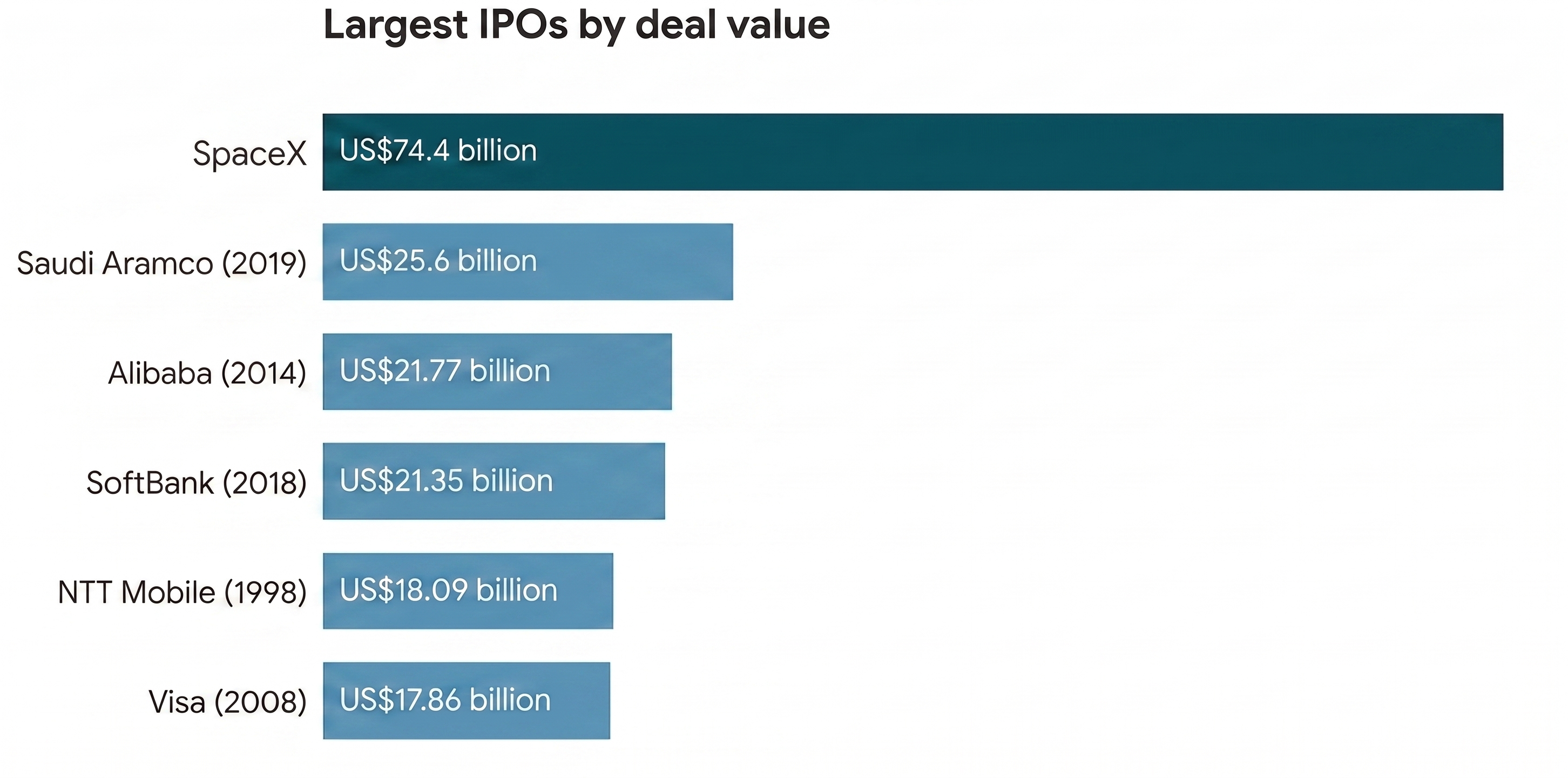
And the $74.4b raised from the IPO will make it the largest by deal value, way ahead of the US$25.6b raised by Saudi Aramco when it listed in 2019.
SpaceX has US$14b in cash and US$30b in debt (much of it attached to the entity formerly known as Twitter). While there has been a heavy focus on Musk’s hardware and software engineering skills ahead of the IPO, his financial engineering prowess in rolling the X debt into the deal could also be admired, from some angles. X and Musk’s AI firm, which makes Grok, were merged in a no-cost deal, then absorbed into SpaceX in another no-cost transaction.
Musk owns 40% of SpaceX today, but thanks to a system of two classes of stock, controls 85% of voting rights.
We can’t do a price-to-earnings ratio because SpaceX is not making money.
Last year, the company lost US$4.9b on revenue of US$18.7b (including sales from xAI.
That means SpaceX – presuming it hits its US$1.77t valuation target – will have a share price-to-revenue multiple of 95.
Nothing else comes close, among large companies. Some analysts have fretted that Nvidia is in a bubble. Its price-to-revenue multiple is 21.
Tesla has a price-to-revenue multiple of 15, Apple and Meta are both 9, and Amazon 4.
The aggregate price-to-sales ratio of the S&P 500 is 3.38.
In a June 2 research note, Morningstar analysts Nicolas Owens and Suryansh Sharma see most of SpaceX’s rocket launch and broadband businesses enjoying robust growth, strong profit margins and market dominance and growing economies of scale for years to come.
But they still “only” value the firm at US$680b, or a 37x revenue multiple (read their full reckons here).
Goldman Sachs, albeit from its perch as lead underwriter of the IPO (meaning it has to make up any shortfall on the US$74.4b IPO target, but will benefit from any upside), predicts that Starlink revenue will increase 100-fold by 2030.
Fantail Ventures founder Jonty Kelt says Starlink has about 10,000 satellites in orbit today and about 10 million subscribers worldwide. It’s adding some 3000 satellites a year as it builds up to its target of 40,000.
“I understand that gives really strong bandwidth and the ability to take on 100 million subscribers. That’s a lot of upside.
“That business [Starlink] accounts for about 60% of US$17b revenue today, so around $11b and could potentially grow to US$70b or US$80b within seven or eight years.”
SpaceX’s Starship rocket, still in a testing phase, has five to 10 times the payload capacity of the company’s mainstay today, the Falcon 9, Kelt adds.
He also notes an immediate driver of growth: Colossus, the gigawatt-scale data centre spun up within months in Tennessee to train XAi’s Grok.
Musk recently reached a deal that will see Claude maker Anthropic pay US$1.25b a month for exclusive access to Colossus through to May 2029.
The Nasdaq made a series of rule changes as it sparred with its rival, the NYSE, for SpaceX’s listing.
There’s always an element of manufactured scarcity with any IPO. In the US, usually 10 to 20% of shares are floated. With SpaceX, public investors will have to fight over just 4.24%.
And of that 4.24% or so bloc, a third has been reserved for retail investors. Some commentators say less sophisticated retail investors will help pump up the price, while Musk says he’s democratising the ownership opportunity.
Then there’s the fact that SpaceX will enter the Nasdaq-100 index (a basket of the exchange’s 100 largest non-financial stocks) after just 15 days. Historically, a new listing has had a “seasoning” period of three months to a year before entering the index.
Habour Asset Management portfolio manager Lewis Fowler says this means exchange-traded funds (ETFs) that track the Nasdaq-100 will have no choice but to buy SpaceX shares, even if they double in price during their first week.
“The consequence of that forced buying is amplified by the thin float,” Fowler said in a research note.
Between retail investors fighting for a tiny number of shares, and institutional buyers having no choice but to buy a chunk of the float – Fowler estimates 48% – many see SpaceX shares rising, possibly quite sharply, during their first days and weeks of trading.
But then comes the kicker: Morningstar’s Owens and Sharma note that, while the customary lock-up period is 180 days to a year, pre-IPO SpaceX investors will be able to sell out as soon as July.
“Existing shareholders other than founder Musk, who has agreed not to sell any of his approximately 40% economic stake for at least one year after the IPO, are lined up to benefit.
“In the months following the IPO, when successive tranches of stock held by private investors and employees are slated for sale into the public market, selling pressure may weigh on the shares.”
While it seems to be largely forgotten by analysts in the build-up to SpaceX’s mega listing, Musk had a spectacular falling out with US President Donald Trump in June last year, which played out on social media in real time.
Musk was enraged at the US Government’s huge increase in spending and debt, with Trump’s Big Beautiful Bill. As the pair traded personal insults, and Tesla’s share price dived, Trump posted, “The easiest way to save money in our Budget, Billions and Billions of Dollars, is to terminate Elon’s Governmental Subsidies and Contracts.”
He didn’t follow through on that threat, but in the next few months, a series of huge US Government contracts went to Rocket Lab, which now has a $US2.2b launch and space system pipeline.
Musk’s volatility matters because he will wield absolute power over SpaceX post-listing, thanks to his lock on 85% of voting shares. The SpaceX prospectus says, “Mr Musk will be able to control the outcome of matters requiring shareholder approval.”
Harbour’s Fowler says, “Musk retains complete operational control, with shareholder voting rights and fiduciary duties effectively eliminated.
“Large pension funds have described it as ‘the most management-favourable governance structure ever brought to the US public markets at this scale’. We would be hard-pressed to argue otherwise.”
(After my interview with Kelt – see the video at the top of this story – I asked if he planned to buy SpaceX shares. He demurred that Fantail focuses on early-stage companies.)
“There’s the ‘Elon factor’,” he says. “People are willing to pay more for that guy.”
Musk almost single-handedly brought EVs to the mainstream with Tesla and has a huge cult following for his pioneering roles in AI, robotics, brain implants and other fields.
The entrepreneur has also swallowed his pride and had a rapprochement with Trump over the last few months. The pair were snapped sharing lunch.
Yet each has an alpha personality. Can the detente hold? Will Musk inevitably feud with the next President and next Nasa administrator?
And even if it does, Morningstar notes the “key person risk” of a company being reliant on one man’s vision.
Starlink has developed a lock on satellite-delivered internet over the past few years and emerged as a cash machine in the process. It recently raised its prices worldwide, including for its 53,000 customers in New Zealand, from whom it generated more than $100m in revenue last year. With smaller players (including “wisps” in rural NZ) going out of business, many punters had no choice but to pay up.
You wouldn’t think it from most commentary, but Starlink’s days of near-monopoly are numbered.
Amazon Leo now has hundreds of satellites in orbit and is building up to numbers similar to Musk’s. It says it will start its first commercial service by the end of this year, which will include 300,000 rural Australians under a deal with the National Broadband Network. Amazon Leo’s first New Zealand ground station is under construction, following Overseas Investment Office approval. There have been putative Starlink rivals before, like the tiny Lync, but Amazon has budgeted US$10b for its service.
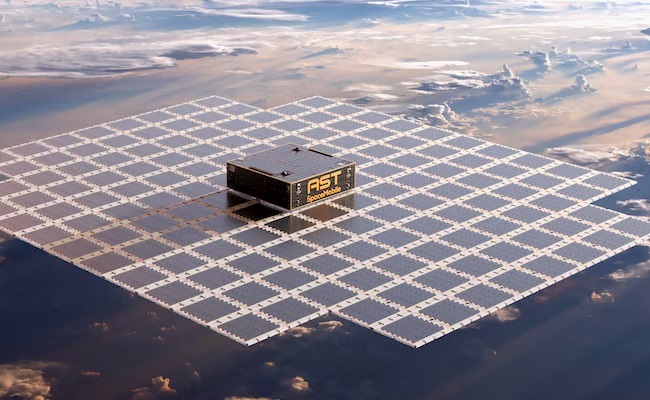
Then there’s AST SpaceMobile, which has a different model – a handful of satellites with tennis court-sized arrays – which also has its first birds in low-Earth orbit and is expected to begin its first service by year’s end. Local launch partner 2degrees has a ground station under construction near Marton, in Manawatū. Again, there are deep pockets. AST SpaceMobile’s investors include AT&T, Vodafone PLC, Samsung and Google. It’s sitting on US$3.5b in cash and has a US$41b market cap.
Meanwhile, Starlink faces major ongoing costs. While it has thousands of satellites in orbit, their fuel lasts for only three to five years before they fall out of the sky and need to be replaced.
That means that, while SpaceX launched more rockets than every rocket-launching entity combined last year, about three-quarters of launches involved new or replacement Starlink satellites.
SpaceX had 170 successful launches last year, of which 165 were of its mainstay Falcon 9 rocket and five test flights for its huge Starship prototype.
Only one private competitor came anywhere near close: Rocket Lab, with 21 launches.
But Rocket Lab is about to undergo a giant leap with the first launch of its much larger Neutron rocket by year’s end, which, if all goes to plan, will cost customers around US$50m to US$55m per launch, undercutting SpaceX’s comparable Falcon 9.
It won’t put Musk on the ropes, but it could take the edge off the sort of hypergrowth needed to maintain a multi-trillion valuation.
The Jeff Bezos-owned Blue Origin managed just one launch of its New Glenn rocket last year (in December, sending two Rocket Lab-designed and built satellites on their way to Mars).
Bezos – the planet’s second richest human after Musk, with a fortune around US$285b – has not detailed his financial ambitions for his aerospace firm, but says it will ultimately help hundreds of millions of people and heavy industry move to space.
“SpaceX is the undisputed global market leader in launch economics and satellite-based connectivity, but the market could become more competitive if the technological capabilities of players such as Blue Origin, Rocket Lab or Chinese startups improve meaningfully,” Morningstar’s Owens and Sharma say.
Starlink’s IPO filing says the firm “can enable the cost-effective and rapid deployment of massive AI compute satellite constellations – with potentially millions of satellites – for orbital data centres.”
It adds, “We expect to begin deploying our orbital AI compute satellites as early as 2028.”
But even those who see data centres in space as being potentially viable long-term see huge engineering challenges, including radiation hardening, giant solar panels and heat sinks, which would all add hugely to the weight and thus launch costs of satellites.
Deployment by 2028 seems ambitious, given the technical challenges, and in the context that Musk has a long history of missing goals and launch targets (according to a New York Times analysis of 602 goals he has laid out over the years).
He initially promised a Tesla robotaxi service in 2016, for example. That was later revised to 2019. In the event, a limited trial did not begin until last year.
The Tesla Semi commercial truck was first promised to hit the roads in 2019, after an initial unveiling by Musk in 2017. A couple of token units were sold in 2023. It’s yet to be produced at volume.
SpaceX’s prospectus says Musk was granted 200m performance-based shares in January this year, worth US$27b at the IPO price, that he can claim “upon the company’s establishment of a permanent human colony on Mars with at least one million inhabitants”.
It adds that SpaceX will “establish a lunar economy, transport humans and cargo to the moon and Mars, and develop human augmentation systems, involve significant technical complexity, unproven technologies or technologies that do not exist”.
It adds, “Such initiatives may not achieve commercial viability.”
There are 63 mentions of Mars. The prospectus also looks further afield.
“We believe the next paradigm shift for humanity is the creation of a resilient, perpetually expanding space-faring civilisation that drives continuous innovation across new frontiers, ultimately propelling us to Kardashev Type II status.”
That denotes technology so advanced that a star’s full energy can be captured by wrapping it in a shell called a Dyson Sphere.
SpaceX’s SEC filing also speaks to ambitions, including manufacturing on Mars. It says, “We plan to pursue asteroid mining operations to extract metals and other critical resources from near-Earth and main-belt asteroids.”
While some investors will find the prospectus inspiring, it’s fair to say many of its goals are not going to be achieved over the next few quarters.
Chris Keall is an Auckland-based member of the Herald’s business team. He joined the Herald in 2018 and is the technology editor and a senior business writer.