The loneliness of being Black in New Zealand
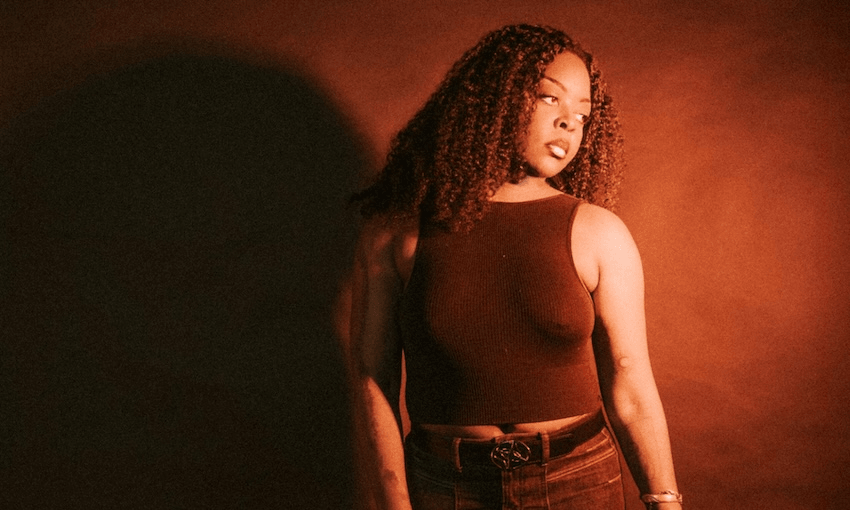
New Zealand’s racism has a specific texture, writes Diana Simumpande. It hides behind platitudes like ‘we don’t see colour’ and ‘that’s not who we are’.
I‘m standing on a sticky floor in the middle of a mosh pit at a JID concert. There’s something about a crowd that chose to be here, for this specific artist, that feels safe. Like maybe, just for tonight, I’m with people who might get it.
The music stops. The stage lights dim. JID leans into the microphone, and the crowd holds its breath. He starts talking about where he’s from. About growing up Black in Atlanta and how that affected his family, his community, and what it cost them. The room is still. As the words sink in, my eyes dart to a white guy, a few rows over. He turns around, groans and rolls his eyes.
“For f***’s sake.”
My boyfriend and I look at each other. We find a familiar exhaustion in each other’s eyes. Our humanity, it turns out, just wasn’t entertaining enough.

Going to see a Black artist in New Zealand is more than just seeing an artist I like. It’s a chance to connect with a part of myself. A shared consciousness. A shared vibration. I remember being at a Tyler, The Creator concert, watching his eyes scan the crowd for a Black face. Finding one. The split-second acknowledgement that means we are here and I see you. I don’t get to have that in many places in this country, so that small moment means something.
So when JID stopped to talk about where he came from, I wasn’t really listening as a fan. I was listening as someone who needed to hear it. And when that white boy rolled his eyes, he wanted the show. The energy. The raw performance of Blackness. But the minute JID became a real person with an uncomfortable history, the consumer got impatient. Just shut up and entertain me. Sell the fantasy. Just not any of the humanity.
He wanted to consume the parts of Blackness that felt good, without actually engaging with it on a meaningful level. Which, if I’m being honest, is not all that different from what I navigate in my everyday life.
It felt like two concerts were happening at once: one for people who actually came for what his music means and where it comes from. And one for those just seeking the spectacle of Blackness. I think about how I fit in that space. Am I there to watch an artist I like? Or am I simply there as background decoration, validating someone’s access to Black culture?
A friend said something to me recently. “I’ve noticed that in certain rooms, not a lot of people really know what to make of you.” I felt seen in a way I hadn’t expected. Because that is probably the most accurate summary of my entire life in this country.
For the first four years of my life, I didn’t know I was Black. That’s because I was born in Zambia, where most people are Black, which means no one really is. It wasn’t until I moved to the UK and eventually to New Zealand that the world started giving me a version of myself I didn’t quite recognise. I realised that being Black came with invisible strings attached. It was a problem. A performance, everything but me.
When you’re Black in New Zealand, you’re both desired and dismissed. My Blackness is always up for consumption, but my humanity is invisible. This creates a kind of loneliness: people see a projection rather than a person. Each time I enter a room, I wonder what version of me they’ve already decided on, and how much energy it will take to attempt to be myself.
In New Zealand, you’re a minority within a minority, inside a country that is still, in many ways, learning that you exist at all.
“Oh, New Zealand has black people now?”
Part of that is structural. Blackness in New Zealand is treated as one-size-fits-all. But Black people here come from everywhere: Zambia, Ghana, Jamaica, the UK. We’re not bound together by a shared history like Black Americans or Black Britons. What connects us here is mainly how other people see us. And the strongest reference point most people have is an ultra-commodified version of African American culture, packaged up and sold to the world. So that becomes the version you’re supposed to perform. Supposed to recognise yourself in. The version that allows you to move freely. Because it’s the only one they know.
New Zealand’s racism has a specific texture. It doesn’t announce itself with a megaphone. It hides behind platitudes like “we don’t see colour” and “that’s not who we are.” A liberalism so defensive of its own self-image that it treats the naming of actual harm as a bigger sin than the harm itself. Your wound is bleeding, but first, you must spend hours proving the existence of the knife.

So when something does happen, you’re alone in that, too. Sometimes it’s jokes about chicken or absent fathers. Maybe someone treats you as their free pass to say the n-word. Other times, you’re the novelty Black friend who gets passed around like a party trick. On the bus, a stranger’s hands find their way into your afro without asking.
Sometimes it’s just a Tuesday. I think about being at a friend’s house as a teenager. Their dad asks me to hold up my palms under the bright kitchen lights. He says, “See, they’re white! That’s because when God spraypainted you Black, you were on all fours.”
He is smiling. I remember the heat rushing to my face. I look around to see if anyone is reacting, still not quite believing what I heard. But mostly, I remember the humiliation. Everyone is laughing. No one thinks anything is wrong but me.
Then comes the instantaneous arithmetic your brain performs in milliseconds. Do I say something? Do I ruin the dinner party? Do I defend my basic humanity alone in a kitchen where I am a guest, and still have to sit at their table and ask them to pass the salt?
And if you do speak up, you get the race card. You’re overreacting. Racism isn’t really a thing here. Be Grateful. Or worse, they cry, and suddenly you’re comforting the person who hurt you while your pain sits unaddressed on the floor.
Or do you simply tuck it away in the corner of your mind, hold up your palms and smile? Get through it, go home, and wake up the next day like it never happened, because you know the math never works out in your favour.
For a long time, I performed. To make things easier, to feel less rejection, to be less threatening. But I am learning that performing for those who limit me to their shallow idea of Blackness costs me my joy.
People call Black women strong. I’d push back on that. I’d say resilient. Strong implies you don’t feel it. Resilience means you feel it all and get back up anyway.
And I do get back up.
I get back up with the courage to finally say: I am not a monolith. I am not a performance. I’m not your pass to say the n-word.
I am a person. A multilayered, complicated, contradictory, joyful and deeply exhausted person. Treat me like one. Engage with my Blackness if you want to, but really engage with it. Not just the parts that look cool. Take all of it. The performance and the person behind it. I’m not asking for much.